

Annual Electronic Waste Footprint Per Person Is 11.2 Kg
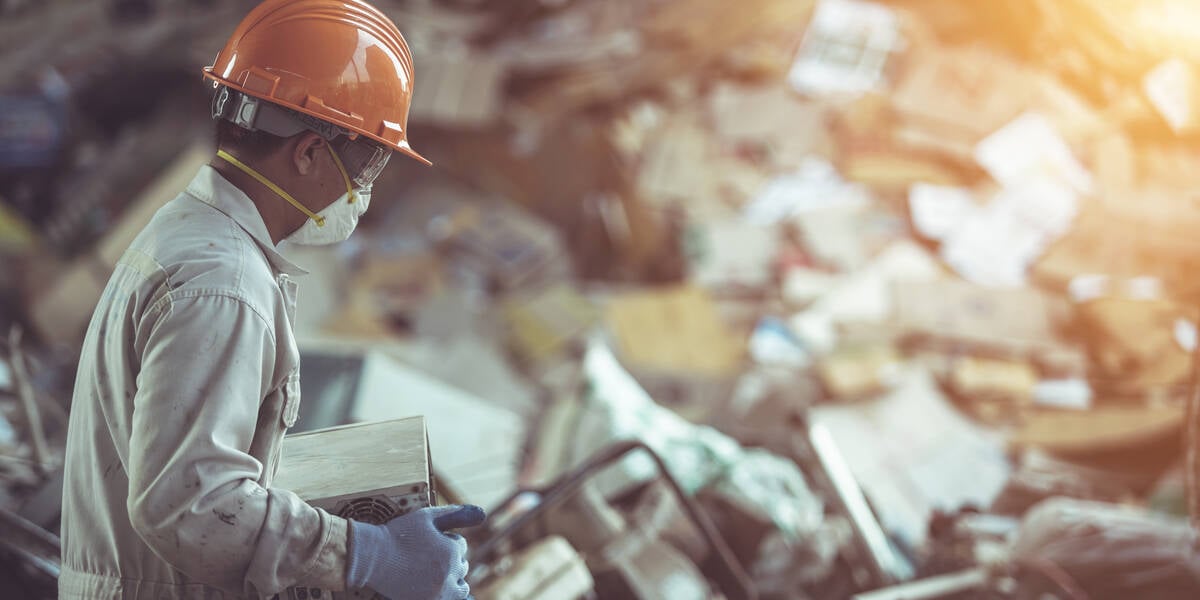
Tech buyers should purchase refurbished devices to push vendors to make hardware more repairable and help the shift to a more circular economy, according to a senior analyst at IDC.
Presenting a TED talk, vice president of devices for EMEA Francisco Jeronimo said that in 2022 there were 62 million tons of electronic waste generated while the average e-waste per person amounted to 11.2 kg annually.
While governments and manufacturers should press for more ethical sourcing and better recycling practices in consumer tech, buyers are not entirely powerless.
"When we look into all this waste, we know there's a problem, but we don't look into what we are doing to fix it," he said. "We blame governments, we blame corporations, we blame the brands. Because at the end of the day, how can I make my smartphone more sustainable? I can't. It needs to be the brand [and] governments [that] are bringing legislation to force the brands, but we have a superpower."
The buyer's superpower comes in the form of extending the life of devices we own, and choosing to buy secondhand refurbished devices when we need new ones, he said.
"Circularity is the answer. We need to decide whether we're going to keep buying new devices or take action to extend the life of the devices we use and make better choices when we buy new products."
If users in the European Union were able to extend by one year the lifespan of washing machines, notebooks, vacuum cleaners and smartphones, roughly four million tons of CO2 emissions would be saved, a European Environmental Bureau study claimed in 2019.
Jeronimo said the popularity of secondhand clothing has taken off on platforms like Vinted and eBay, but more could be done in technology.
"When we need a new smartphone or tablet or PC, we rush to the store to buy it new, and that needs to change, and there are 62 million tons of reasons why it matters."
Firstly, users should be able to get malfunctioning equipment repaired. "Sometimes it's not easy because brands don't make it easy. But that is changing. The second way is to consider refurbished products, which is a product that has been tested, cleaned, repaired, maybe it got a new battery or screen, and it comes with a warranty."
Extending the lifespan of each product by an average of a year by repairing it or buying refurbished devices would be the equivalent of taking 2 million cars off the road every year.
- The 'End of 10' is nigh, but don't bury your PC just yet
- PIRG's 'Electronic Waste Graveyard' lists 100+ gadgets dumped after support vanished
- Framework guns for cheap laptops with upgradeable alternative
- Laptop makers stalled on repairability improvements
However, earlier this year, research showed that laptop makers have largely stalled on improving repairability. The Public Interest Research Group (PIRG), a US-based nonprofit advocating repairability, found that while the latest generation of smartphones became more repairable in 2024, laptops saw little to no advances, with most brands remaining difficult to mend.
"There was not a significant improvement across the eight most popular laptop brands in the US: HP, Apple, Dell, Acer, Lenovo, Microsoft, Samsung, and ASUS," PIRG said in a report. "While Apple and Dell laptops both saw some improvement in ease of disassembly, the other brands saw minimal to no change from 2024 to 2025."
Meanwhile, the growth in refurbished device sales continues to outstrip new devices. Figures released last year showed that shipments of refurbished smartphones increased globally by an estimated 9.5 percent in 2023 to 309.4 million devices, contrasting with the 3.2 percent decline in new handsets shipped in the same period.
In March 2024, research showed the tech industry was creating electronic waste almost five times faster than it was recycling it (using documented methods). A United Nations report found that e-waste recycling has benefits estimated to include $23 billion of monetized value from avoided greenhouse gas emissions and $28 billion of recovered materials like gold, copper, and iron. It also comes at a cost – $10 billion associated with e-waste treatment and $78 billion of externalized costs to people and the environment.
Of the 62 million tons of e-waste generated globally in 2022, an estimated 13.8 million tons were documented, collected, and properly recycled, the report found. ®
From Chip War To Cloud War: The Next Frontier In Global Tech Competition
The global chip war, characterized by intense competition among nations and corporations for supremacy in semiconductor ... Read more
The High Stakes Of Tech Regulation: Security Risks And Market Dynamics
The influence of tech giants in the global economy continues to grow, raising crucial questions about how to balance sec... Read more
The Tyranny Of Instagram Interiors: Why It's Time To Break Free From Algorithm-Driven Aesthetics
Instagram has become a dominant force in shaping interior design trends, offering a seemingly endless stream of inspirat... Read more
The Data Crunch In AI: Strategies For Sustainability
Exploring solutions to the imminent exhaustion of internet data for AI training.As the artificial intelligence (AI) indu... Read more
Google Abandons Four-Year Effort To Remove Cookies From Chrome Browser
After four years of dedicated effort, Google has decided to abandon its plan to remove third-party cookies from its Chro... Read more
LinkedIn Embraces AI And Gamification To Drive User Engagement And Revenue
In an effort to tackle slowing revenue growth and enhance user engagement, LinkedIn is turning to artificial intelligenc... Read more