

AMD: Our Epyc CPUs Helped Mercedes Win F1 Constructors' Championship
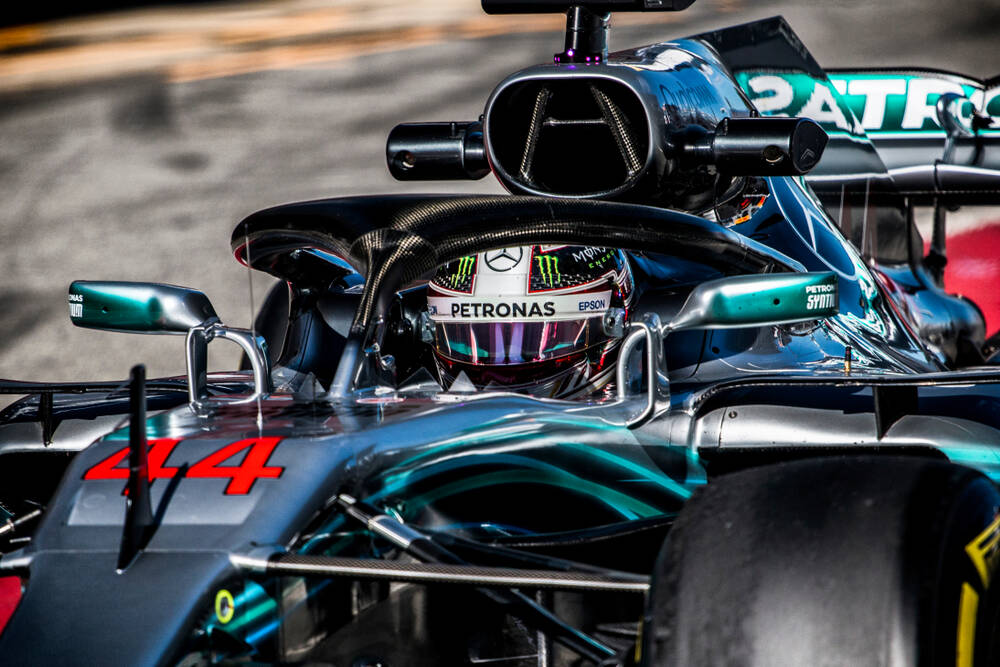
AMD claims its Epyc CPUs played a role in the Mercedes-AMG Petronas Formula One team winning last year's Constructors' Championship race.
The F1 team rely on second-generation Epyc processors in its servers to power the computational fluid dynamics (CFD) software that is critical to modeling and testing the aerodynamics of F1 cars, which in turn can give them an important edge in driving faster.
In a case study [PDF] recently published by AMD, the Mercedes team said Epyc-based servers allowed it to speed up CFD workloads by 20 percent compared to previous servers. Which CPUs were in those previous servers? Unfortunately, it's never stated, and we hope that future case studies shed more light on configuration comparisons.
Regardless, the case study provides an interesting explanation as to why the price-performance characteristics of server CPUs, where AMD has largely held an advantage over Intel, can make a difference in a regulated, engineering-driven sport like F1 racing.
Since CFD is so critical to F1, the Fédération Internationale de l'Automobile (FIA), F1's governing body, aims to level the playing field among contestants by governing how much money each team can spend on servers. Compute capacity, however, is determined on a sliding scale, with the bottom team getting 25 percent more allocation than the top team.
This means that the Mercedes team, which finished top in F1's 2021 season, has a greater need to get as much computing power per dollar for CFD. The real limitation is in how many model geometries the team can run in the program within a given period, so there is a big incentive to ensure that it can perform calculations as fast as possible.
- Intel promotes graphics chief Raja Koduri weeks after Arc discrete GPU reveal
- Ryzen Pro CPUs are better for work than Intel's, claims AMD
- Intel: Our fabs can mass produce silicon qubit devices
- Samsung dethrones Intel as chip sector grows 26% in 2021
Simon Williams, head of aero development software for the Mercedes team, said his team decided to use second-generation Epyc CPUs because they turn around CFD calculations faster, which cuts down on the time it takes to determine ideal conditions for aerodynamics.
"The AMD Epyc servers have enabled us to run a lot more work in parallel," he said. "Aerodynamicists, if they get a result back during the day, they can do another design and do a second run overnight. When they return in the morning, they will have completed two iterations."
Williams said the amount of performance provided by each Epyc CPU also allowed the Mercedes team to cut down on the amount of space it needed in the datacenter, which is another area under constraint.
AMD has talked a big game about the price-performance benefits of its Epyc processors, which has allowed it to recapture server CPU market share from Intel over the last few years. We're very curious to see if AMD Epyc can continue outperforming Intel's Xeon processors, or if the rival's upcoming Sapphire Rapids CPUs will change that equation at all, given recent praise for Intel's Alder Lake PC chips. ®
From Chip War To Cloud War: The Next Frontier In Global Tech Competition
The global chip war, characterized by intense competition among nations and corporations for supremacy in semiconductor ... Read more
The High Stakes Of Tech Regulation: Security Risks And Market Dynamics
The influence of tech giants in the global economy continues to grow, raising crucial questions about how to balance sec... Read more
The Tyranny Of Instagram Interiors: Why It's Time To Break Free From Algorithm-Driven Aesthetics
Instagram has become a dominant force in shaping interior design trends, offering a seemingly endless stream of inspirat... Read more
The Data Crunch In AI: Strategies For Sustainability
Exploring solutions to the imminent exhaustion of internet data for AI training.As the artificial intelligence (AI) indu... Read more
Google Abandons Four-Year Effort To Remove Cookies From Chrome Browser
After four years of dedicated effort, Google has decided to abandon its plan to remove third-party cookies from its Chro... Read more
LinkedIn Embraces AI And Gamification To Drive User Engagement And Revenue
In an effort to tackle slowing revenue growth and enhance user engagement, LinkedIn is turning to artificial intelligenc... Read more