

Amazon's Project Kuiper Satellites Now Boarding The Rocket To Relevance
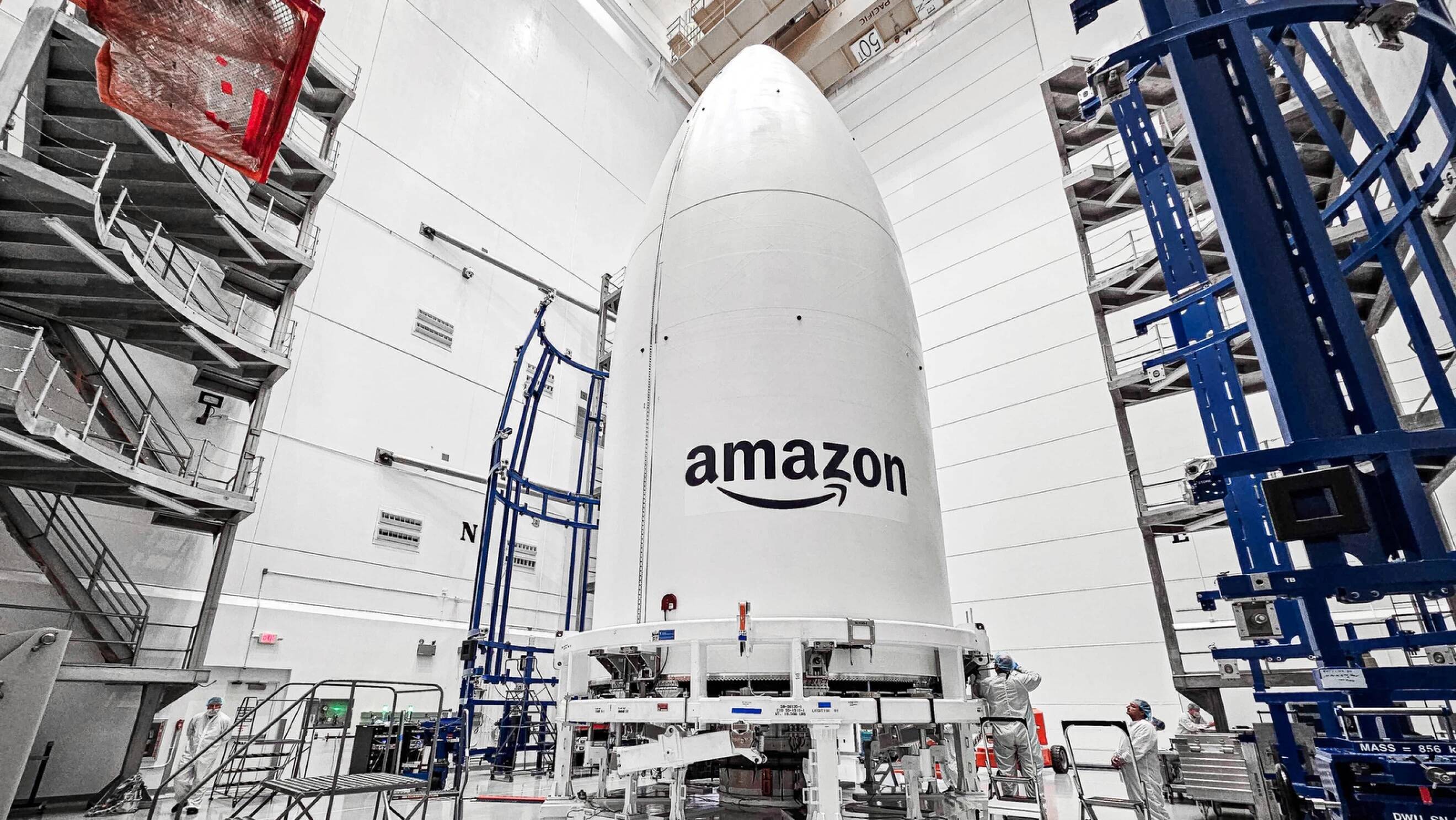
The first batch of Amazon's Project Kuiper satellites is due to be lofted into orbit next week.
The launch is scheduled to take place from Cape Canaveral Space Force Station on a United Launch Alliance (ULA) Atlas V rocket. It is expected to go ahead no earlier than 1200 ET on Wednesday, April 9.
The mission, named KA-01, will deploy 27 satellites at an altitude of 280 miles. Amazon says the payload will be the heaviest ever flown by an Atlas V, using the most powerful variant of the launcher, with five solid rocket boosters in addition to the main booster.
Delays have plagued the Kuiper project. It managed to get a pair of satellites into orbit on October 6, 2023, on the Kuiper Protoflight mission and, basking in the success of the trial, estimated that the full-scale deployment of the broadband constellation would begin in the first half of 2024.
That goal was missed, as was Amazon's revised deadline to send the satellites upwards before the end of 2024.
Amazon says it has significantly enhanced the satellites since those two prototypes launched in 2023.
"We have improved the performance of every system and sub-system on board, including phased array antennas, processors, solar arrays, propulsion systems, and optical inter-satellite links."
- Amazon's Kuiper secures license to take on Starlink in the UK
- Taiwan in talks to tap Amazon's Project Kuiper space broadband
- Amazon: Our cloud growth just sped up. Did you know we are also quite a big retailer?
- Amazon's Project Kuiper slips to end of 2024 for first full-scale launch
Additionally, the satellites are now coated in a dielectric film to scatter reflected sunlight and make them less visible to ground-based astronomers.
Amazon's entire broadband constellation when deployed will include more than 3,200 spacecraft, and more than 80 launches are secured. The first two launches are set for the Atlas V. Another Bezos space project, Blue Origin, has only just managed the maiden flight of its New Glenn rocket, and other new launchers planned for the constellation – the Ariane 6 and Vulcan Centaur – have also suffered substantial delays.
A contract for three SpaceX Falcon 9 launches was signed by Amazon in 2023 to bolster its launch schedule.
The problem is that Project Kuiper has a deadline. Its license calls for half the constellation to be deployed by July 2026, though a request for an extension from the Federal Communications Commission seems likely.
Amazon said: "Following KA-01, we will continue to increase our production, processing, and deployment rates as we prepare to begin delivering service to customers.
"We have already begun shipping and processing satellites for our next mission: KA-02 will also use a ULA Atlas V rocket and launch from Cape Canaveral Space Force Station." ®
From Chip War To Cloud War: The Next Frontier In Global Tech Competition
The global chip war, characterized by intense competition among nations and corporations for supremacy in semiconductor ... Read more
The High Stakes Of Tech Regulation: Security Risks And Market Dynamics
The influence of tech giants in the global economy continues to grow, raising crucial questions about how to balance sec... Read more
The Tyranny Of Instagram Interiors: Why It's Time To Break Free From Algorithm-Driven Aesthetics
Instagram has become a dominant force in shaping interior design trends, offering a seemingly endless stream of inspirat... Read more
The Data Crunch In AI: Strategies For Sustainability
Exploring solutions to the imminent exhaustion of internet data for AI training.As the artificial intelligence (AI) indu... Read more
Google Abandons Four-Year Effort To Remove Cookies From Chrome Browser
After four years of dedicated effort, Google has decided to abandon its plan to remove third-party cookies from its Chro... Read more
LinkedIn Embraces AI And Gamification To Drive User Engagement And Revenue
In an effort to tackle slowing revenue growth and enhance user engagement, LinkedIn is turning to artificial intelligenc... Read more