

AI: Why Chefs Are Turning To Artificial Intelligence
By Michael Dempsey
Technology of Business reporter
Image source, Firmenich
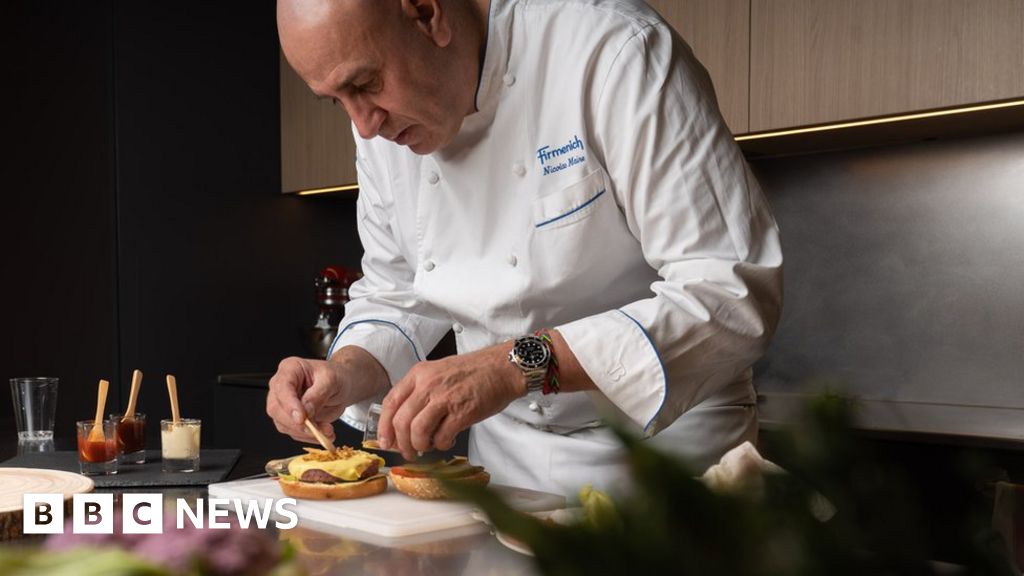
Nicolas Maire has accumulated 18 Michelin stars during his career
Nicolas Maire is the model of a professional French chef with years of experience and 18 Michelin stars under his belt, a man who dominates his kitchen dispensing nuggets of culinary wisdom as he prepares food for his guests.
Today, this kitchen is buried inside a sprawling corporate HQ on the outskirts of Geneva. Mr Maire works for Firmenich, a business with a perfume industry pedigree stretching back to 1895.
Firmenich's nose for a new market saw it diversify into food ingredients as the public appetite for alternatives to meat led to a scramble to put plant-based food on supermarket shelves.
The company says there is a global market for plant-based meat substitutes of $25bn (£19bn) and believes this will grow to $200bn by 2030.
To help perfect the flavours of these innovative foods, Mr Maire has a new sous-chef in the form of Sam, an artificial intelligence (AI) robot.
Image source, Firmenich
New plant-based foods have raised demand for flavouring
Along with a team of flavourists, Sam helps blend a huge array of flavours for clients.
In humans the sense of taste stems from multiple receptors that are primed to alert our brains to the nature of any possible food we encounter.
Sam lacks this sense of taste, but it has been trained on a database of ingredients gathered over 60 years at the company.
Using a technique called machine learning, it has raced through examples of flavour combinations and has learnt its own definitions, maturing over 18 months into today's AI robot.
Eric Saracchi runs the digital side of Firmenich: "Flavours are more complex than perfumes," he says, and Sam had to understand what a strawberry is, or how grilled beef hits the tongue, before finding matches between tastes and plant foodstuffs.
The robot is primed with so many ingredients it is known internally as "a piano with 5,000 keys".
That piano is played by the company's team of human flavourists.
The top tasters are the master flavourists, and out of some 30 in the world six work at Firmenich.
Creators of flavours are so rare, "you can't replace them, you can only enhance them," says Mr Saracchi.
Image source, Firmenich
Patrick Salord is principal flavourist at Firmenich
Flavourists are at the heart of Firmenich, and Patrick Salord is its principal flavourist.
"Being a flavourist is a combination of art and science. I took a masters degree in chemistry before I began this career. We train to pick the best ingredients to achieve the flavour we want. We evaluate and describe them and compare them."
He uses certain aromas and tastes to mask "off-notes" such as acidic tastes while giving a formula the right texture. He talks of the tonality of food, how removing one tiny ingredient can change the overall taste.
Sam takes the knowledge of flavourists and generates new formulas in minutes, a fraction of the time Mr Salord and his team take using their own skills. "It suggests a formula that is in line with our senses."
Image source, Getty Images
One big advantage of an AI robot is that it has no cognitive bias. This lack of human prejudices helps Firmenich to get past any unconscious leanings of the flavourists.
The objectivity of Sam, devoid of influences that can sway even the most professional of flavourists, allows it to work at speed. "It adds value by combining the knowledge of all the other flavourists here," says Mr Salord.
The machine rapidly gives an indication of how a flavour can be created and how much of an ingredient should be included. And Sam can hold the line between Mr Salord's team of flavourists and public tastes, refereeing decisions when the flavourists' view differs from that of a consumer panel.
But the finished product needs more - and that's what Mr Salord's team bring to the tasting party, which belongs to the start of the day.
"We try to taste in the morning before we have coffee. By the afternoon your sense of taste becomes tired and affected by lunch. So we leave the afternoon for work on the computer."
Back in Mr Maire's kitchen the cross-fertilisation between flavourist and robot is coming out of the frying pan. He is accustomed to hosting business clients, searching for a specific taste they can drop into foodstuffs on supermarket shelves.
The flavourists remain his close colleagues, even though AI is "a powerful, beautiful tool." And he rates the taste of UK consumers highly. "It's an advanced market with many vegan people." Firmenich is betting big on the rest of the world changing their food habits in line with the British.
He concedes that this marriage of science and culinary arts has its critics. "When you say chemicals it's not sexy for gastronomy."
His triumphant retort is to brandish thick slices of a pale juicy meat that tastes like a good cut of chicken but springs from Sam's recipe for vegetable protein, resembling a paste. "The essence of what we do is innovation, for me molecules are another flavour."
Mr Maire maintains he is ready to whip up Christmas turkey and more from plant-based ingredients. "We are only at the beginning of what can be done. We have the competency to make Christmas pudding flavours too."
His beef burger is less appealing, in the mouth sausage seems to be a dominant taste rather than beef. Sam and the flavourists have more work to do.
From Chip War To Cloud War: The Next Frontier In Global Tech Competition
The global chip war, characterized by intense competition among nations and corporations for supremacy in semiconductor ... Read more
The High Stakes Of Tech Regulation: Security Risks And Market Dynamics
The influence of tech giants in the global economy continues to grow, raising crucial questions about how to balance sec... Read more
The Tyranny Of Instagram Interiors: Why It's Time To Break Free From Algorithm-Driven Aesthetics
Instagram has become a dominant force in shaping interior design trends, offering a seemingly endless stream of inspirat... Read more
The Data Crunch In AI: Strategies For Sustainability
Exploring solutions to the imminent exhaustion of internet data for AI training.As the artificial intelligence (AI) indu... Read more
Google Abandons Four-Year Effort To Remove Cookies From Chrome Browser
After four years of dedicated effort, Google has decided to abandon its plan to remove third-party cookies from its Chro... Read more
LinkedIn Embraces AI And Gamification To Drive User Engagement And Revenue
In an effort to tackle slowing revenue growth and enhance user engagement, LinkedIn is turning to artificial intelligenc... Read more