

4G To Dominate Cellular IoT Until 2028, When 5G Takes Over

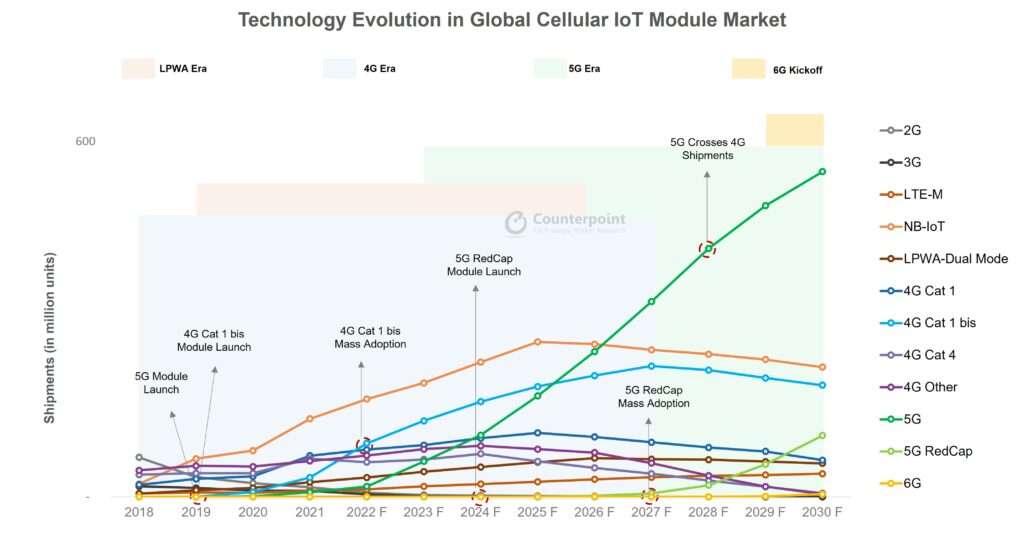
4G will continue to be the dominant cellular connectivity technology used by IoT devices until 2028, according to a report from Counterpoint Research.
"With the ongoing sunset of 2G and 3G networks across the world, most of the demand has been shifting to LPWA, 4G Cat 1 and 4G Cat 1 bis technologies until now," said senior research analyst Soumen Mandal in a teaser of research released on Monday.
Mandal acknowledged that NB-IoT will still remain popular in parts of Asia, and Europe, while 4G Cat 1-based modules will continue to grow for a few more years.
2028 was marked as the year shipments of 5G cellular modules will exceed 4G devices, with the analyst willing to designate 2027 as the start of the "5G era."
Counterpoint Research said the transition from 4G to 5G will be faster than previous transitions – 2G to 3G or Low Power Wide Area (LPWA) to 4G.
In 2030, shipments of all cellular modules will exceed 1.2 billion units – and join a fleet of 2.5 billion 5G units already shipped.
- What will the factory of the future look like? Let's start with Intel, Red Hat, and 5G
- At 9 for every 100 workers, robots are rife in Singapore – so we decided to visit them
- Edge computing set for growth – that is, when we can agree what it is
- There's a new Chipzilla in town: Samsung topples Intel to become largest chip maker
The researcher also predicted that when 5G does finally take over, mass adoption of IoT applications involving everything from connected cars to healthcare to wearables will be the driver.
6G allegedly won't appear until 2029, and will initially be deployed for high-end enterprise applications and broadband services. But just because 5G will dominate doesn't mean 4G, LPWA, and others will go away, according to Counterpoint's Neil Shah.
Counterpoint Research
IOT connectivity predictions. Click to enlarge
"5G will be preferred for Industrial 4.0 (like robotics, automation and digital twins), router/CPE (like FWA and private networks) and automotive (like connected and autonomous mobility) applications, LPWA will be preferred for utilities (smart meter) and 4G Cat 1 bis and 5G RedCap for POS applications," said the research veep.
Companies are already preparing for this future of interactive machines as they automate or add robots into old factories.
Some regions, like Asia, which have high-volume manufacturing, are already loaded up with robots and automated equipment.
The International Federation of Robotics reported Asia's average robot density had an 18 per cent CAGR from 2015 until 2020.
Meanwhile, Germany's Siemens and Bosch are currently retrofitting their own factories with private 5G networks and testing autonomous vehicles that communicate with each other on the 5G network inside the factory and unconnected from public networks. ®
From Chip War To Cloud War: The Next Frontier In Global Tech Competition
The global chip war, characterized by intense competition among nations and corporations for supremacy in semiconductor ... Read more
The High Stakes Of Tech Regulation: Security Risks And Market Dynamics
The influence of tech giants in the global economy continues to grow, raising crucial questions about how to balance sec... Read more
The Tyranny Of Instagram Interiors: Why It's Time To Break Free From Algorithm-Driven Aesthetics
Instagram has become a dominant force in shaping interior design trends, offering a seemingly endless stream of inspirat... Read more
The Data Crunch In AI: Strategies For Sustainability
Exploring solutions to the imminent exhaustion of internet data for AI training.As the artificial intelligence (AI) indu... Read more
Google Abandons Four-Year Effort To Remove Cookies From Chrome Browser
After four years of dedicated effort, Google has decided to abandon its plan to remove third-party cookies from its Chro... Read more
LinkedIn Embraces AI And Gamification To Drive User Engagement And Revenue
In an effort to tackle slowing revenue growth and enhance user engagement, LinkedIn is turning to artificial intelligenc... Read more