


One of the most significant changes to super – the introduction of the transfer balance cap (TBC) – came into effect on 1 July 2017. It’s worth understanding how it is applied and how to take advantage of new opportunities when it’s increased.
As the name suggests, the TBC limits how much super can be transferred into a retirement phase pension account or used to buy another income stream for retirement using super money.
When you become eligible to access all your super you have the choice of withdrawing a lump sum, an income stream, or a combination of both. If you open a retirement income stream, the income earned on the capital supporting that income stream is tax free.
The introduction of the TBC was designed to reinforce the role of super to provide retirement income, not as a store of intergenerational wealth or means of avoiding tax, by placing a reasonable cap on the amount that can be invested in the tax-free retirement phase.
How the transfer balance cap works
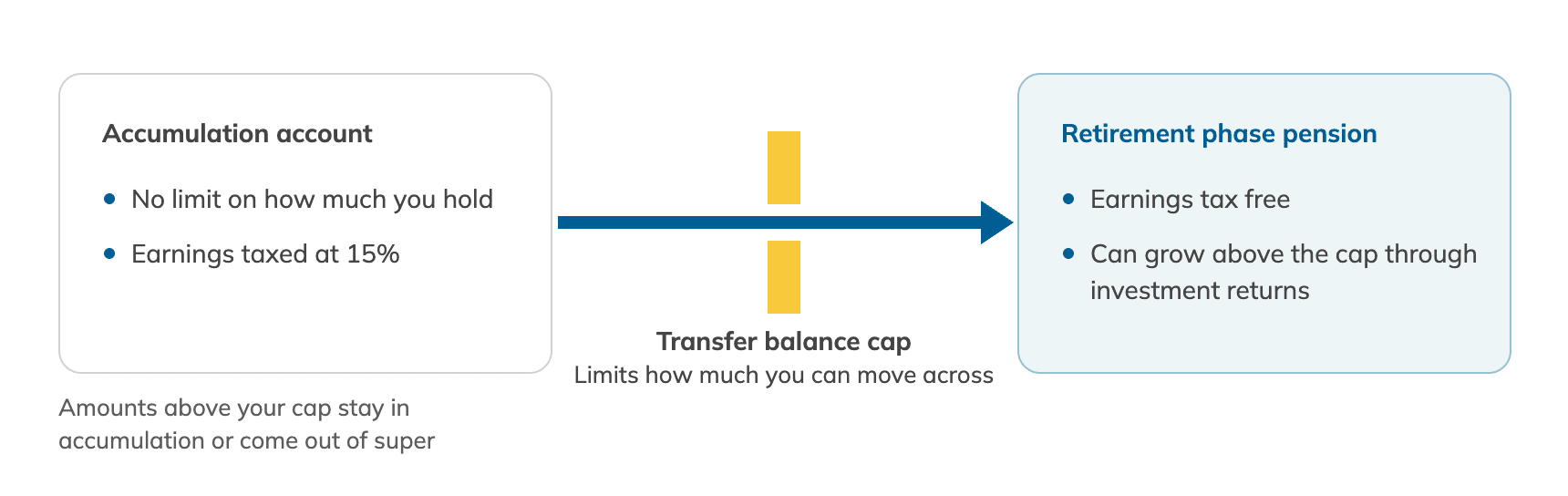
From 1 July 2026 the general transfer balance cap is $2.1 million. Your personal cap may be lower if you started a retirement phase pension before that date.
Source: ATO
The transfer balance cap (TBC) and how it changes
On 1 July 2017, a cap on the amount that can be used to commence a pension in retirement phase was introduced. The cap was initially set at $1.6 million.
The cap is indexed periodically in $100,000 increments, in line with inflation. Most recently, the cap was indexed to $2.1 million from 1 July 2026, as shown in the table.
| Date of indexation or introduction | General transfer balance cap |
|---|---|
| 1 July 2017 | $1.6 million |
| 1 July 2021 | $1.7 million |
| 1 July 2023 | $1.9 million |
| 1 July 2025 | $2 million |
| 1 July 2026 | $2.1 million |
How do the transfer balance cap rules work?
The transfer balance cap limits the amount you can transfer into a retirement income stream, but any change in the value of the income stream after it has started is not taken into account.
For example, if you transferred $1.7 million to an income stream in July 2022 you used the whole available cap at that time. If the balance of your account later rose above the cap due to investment returns, the limit would not be breached. Only transferring more money into a retirement income stream can cause you to exceed the cap.
If you go over the cap, you are liable to pay tax on the excess transfer balance earnings (excess transfer balance tax). You also need to transfer any excess to a super accumulation account or withdraw it as a lump sum. This is called a commutation.
Does this mean I can’t have more than my TBC amount in super?
No. You can have more than your cap in super, but you can only use the amount up to your cap to start a retirement income stream.
If you have more in super than your transfer balance cap after retirement you can leave the remainder in your accumulation account. The fund pays 15% tax on earnings in the accumulation phase (compared with 0% in retirement phase).
You can also remove the amount above the cap from the super system if you choose but, if the amount is then invested in your name, any income will be taxed at your personal tax rate.
What is a transfer balance account?
If you receive your super as an income stream, you will have a transfer balance account (TBA) with the ATO. That account will start on either the date you first received a retirement income stream after 1 July 2017, or on that date if you were already receiving a retirement phase income stream on 30 June 2017.
A transfer balance account is a record of all the events that count towards your transfer balance cap and is kept by the ATO. If you have more than one super pension or annuity, the amounts you used to commence each one (or the ‘special value’ of the income stream if it is a capped defined benefit) will all be recorded and added together in your transfer balance account report (TBAR) with the ATO. This account remains active until your death, and you can access your TBAR at the ATO via your myGov account.
If you already had a retirement income stream before 1 July 2017, your super fund was required to report the value as at 30 June 2017. If you commenced an income stream after 1 July 2017, your fund will have reported the commencement value of that super income stream. You can always talk to your super fund if you disagree with the amount reported on your TBAR.
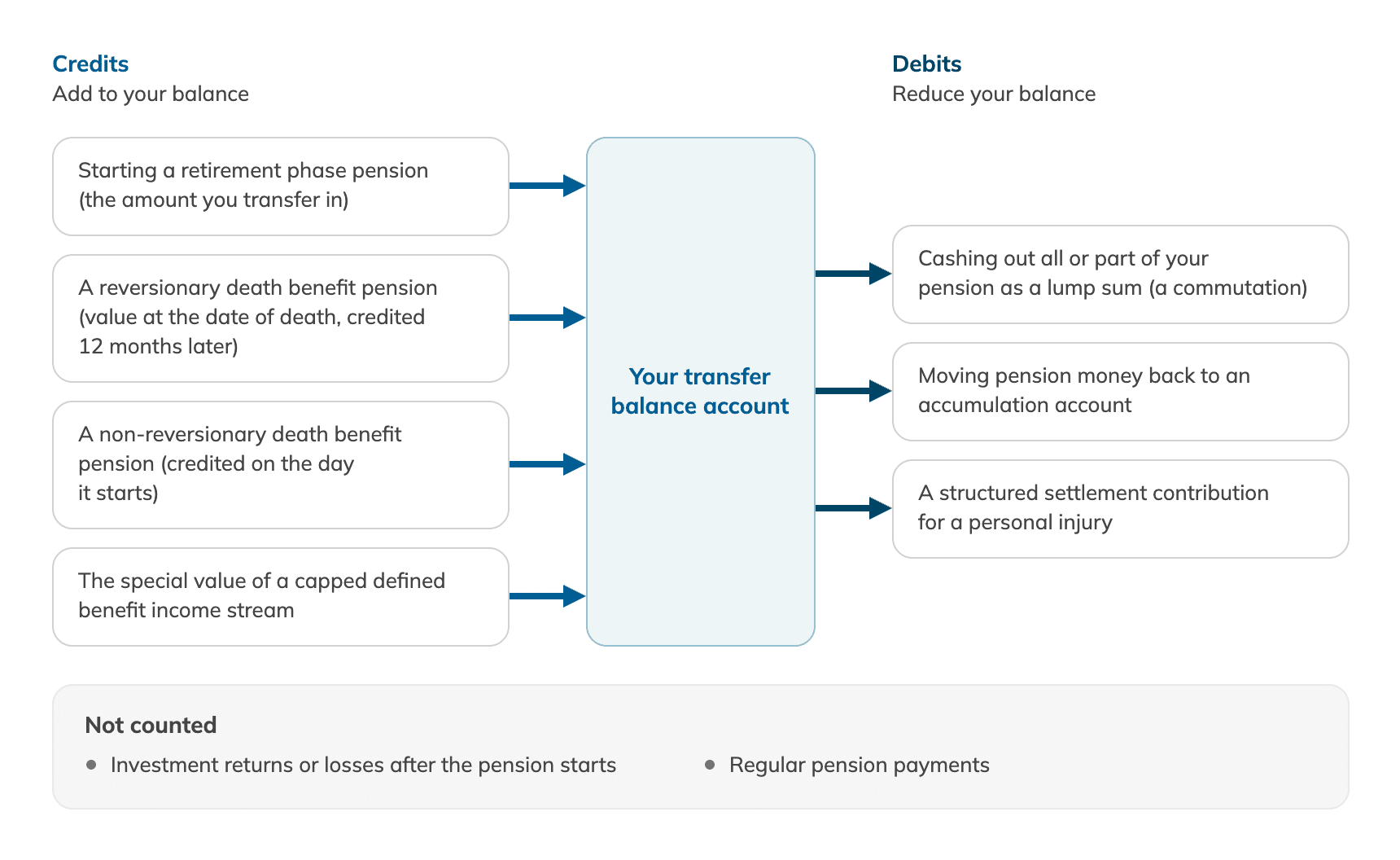
If you take a lump sum from your income stream, or transfer some or all of it back into the accumulation phase, a debit is recorded in your transfer balance account. This creates ‘space’ in your account to be used when you later start another income stream.
The transfer balance cap is exceeded when the balance in your TBAR is higher than your personal cap.
A transfer balance account report will include both credits and debits as shown in this example:
| Date | Transaction | Debit | Credit | Transfer balance |
|---|---|---|---|---|
| 1 Jan 2018 | Superannuation income stream purchase | $0 | $1,600,000 | $1,600,000 |
| 1 Jun 2018 | Partial commutation of the income stream to a lump sum | $200,000 | $0 | $1,400,000 |
What changes your transfer balance
Source: ATO
What counts towards the transfer balance cap?
Any super transferred into retirement phase from an accumulation account to support an income stream counts as a credit towards the cap, as does the special value of any defined benefit pension you become entitled to.
Death benefit income streams also count as credits towards your cap. A death benefit income stream is an income stream started with the proceeds of a deceased person’s super, most commonly a spouse. Read more about consequences of receiving a death benefit income stream in the last section of this article.
Providing they meet certain criteria, as defined by law in the box below, structured settlement contributions do not count towards the cap. A credit and a debit for the structured settlement amount will appear in your TBAR on the same day. A structured settlement is a payment for a personal injury you have suffered that is contributed to a complying super fund.
“The contribution must arise from:
(a) The settlement of a personal injury claim that is based on the commission of a wrong, or a right created by statute, effected by a written settlement agreement between the parties
(b) Settlement of a personal injury claim arising under an Australian workers compensation law, or
(c) The order of a court made in respect of a claim that is based on the commission of a wrong, or a right created by statute (not including a court order approving or endorsing a settlement agreement as mentioned above).”
What happens if I breach the TBC?
If you breach the cap you will receive an excess transfer balance determination from the ATO. You are required to pay tax on the excess transfer balance earnings for every day your transfer balance account is over the limit. Those earnings are calculated by a daily pre-determined formula, which is part of the law, and is worked out as follows:
90-day bank accepted bill yield + 7 percentage points ÷ number of days in the calendar year
The tax rate is 15% for your initial excess transfer balance amount, increasing to 30% for your next excess transfer balance amount, if you exceed the cap again.
The earnings compound daily and are credited to your transfer balance account and included in the next day’s earnings calculations. That only stops when the ATO issues an excess transfer balance determination (to crystallise the amount) or you commute the excess transfer balance and its earnings by cashing it as a lump sum or transferring it back into an accumulation account; whichever is earliest.
If you don’t commute the amount by the required date on the determination, the ATO will send a commutation authority to your super fund to release it, even if the amount is small.
What happens when the cap is indexed?
When indexation occurs, anyone who has not already commenced a retirement income stream has access to the new higher limit.
Individuals who have previously started an income stream have a personal transfer balance cap that is adjusted for indexation based on the proportion of the cap they have already used in the past.
If your transfer balance account has ever been equal to or higher than your cap, you will not receive any indexation.
Indexation is calculated by dividing the highest ever balance of your transfer balance account by your transfer balance cap on the earliest day you had that balance. That number is then expressed as a percentage, rounded down to the nearest whole number, and subtracted from 100. The resulting percentage of the indexation increment is then added to your prior cap.
Confused? Luckily, you will not need to calculate this for yourself. The ATO keeps your personal cap up to date with indexation in their online service you can access via myGov. If you’re keen to understand it, here’s how it works.
Case study: How to work out your new transfer balance cap
Marlene started a retirement income stream with a value of $1.2 million for the first time on 1 November 2021. At the time the transfer balance cap was $1.7 million.
When the cap was indexed on 1 July 2023, her new cap was calculated as follows:
- $1.2 million / $1.7 million = 0.706 or 70.6% (this is rounded down to 70%)
- 100% – 70% = 30%
- 30% of $200,000 = $60,000
- Marlene’s cap after 1 July 2023 indexation was $1.7 million + $60,000 = $1.76 million
In May 2025, Marlene transferred an additional $300,000 into a second retirement income stream. This created a credit of $300,000 to her transfer balance account, bringing its total to $1.5 million. This is the new highest balance in her TBA and her personal cap on the day was $1.76 million due to the prior indexation.
When the cap was indexed on 1 July 2025, her new cap was calculated as follows:
- $1.5 million / $1.76 million = 0.852 or 85.2% (this is rounded down to 85%)
- 100% – 85% = 15%
- 15% of $100,000 = $15,000
- Marlene’s cap after 1 July 2025 indexation is $1.76 million + $15,000 = $1.775 million
When the cap was again indexed on 1 July 2026, Marlene’s unused cap percentage was still 15%, based on the same highest ever TBA balance and personal cap as the prior year. Her new cap was calculated as follows:
- 15% of $100,000 = $15,000
- Marlene’s cap after 1 July 2026 indexation is $1.775 million + $15,000 = $1.79 million
Marlene’s share of each increase in the general cap

Marlene’s share is the unused percentage of her personal cap, rounded down, based on her highest ever transfer balance.
Source: SuperGuide calculations
It’s important to remember that if there are transfer balance events that reduce the amount supporting your pension – for example the pension was partially commuted – your indexation will depend on the highest ever balance of your TBA.
Death and the transfer balance cap
When you inherit a death benefit income stream its value is added to your transfer balance account. The timing of the addition depends on whether it is reversionary or non-reversionary.
When a person who held an income stream and had nominated a reversionary beneficiary dies, the ownership of the income stream automatically passes to the reversionary beneficiary and a reversionary death benefit income stream starts.
In this case, the value on the day of death is calculated and a credit of that amount is made to the transfer balance account of the recipient 12 months after the death. This delay provides time for the beneficiary to make adjustments to avoid exceeding the cap if they need to.
A non-reversionary death benefit income stream is an income stream commenced with super death benefits when there was no reversionary nomination. The account may have been in accumulation phase or in a retirement income stream without a reversionary nomination.
In this case, a credit to the recipient’s transfer balance account of the value of the death benefit income stream occurs on the day it starts.
If you inherit a super death benefit as a lump sum, there are no consequences for your transfer balance cap.
Case study: Reversionary pension
Mary and Geoff, married for 40 years, began retirement income streams with $1.2 million each in August 2023, nominating each other as reversionary beneficiaries.
Geoff passed away in June 2026 and Mary became entitled to the reversionary pension. The balance of Geoff’s account at the time was $1,000,000. This value will be credited to Mary’s transfer balance account in June 2027.
Mary’s transfer balance cap was increased to $1,974,000 on 1 July 2026 because of proportional indexation.
If Mary does nothing, the total balance in her transfer balance account after the credit from Geoff’s reversionary pension will be $2,200,000, which will exceed her cap of $1.974 million and make her liable for excess transfer balance tax.
To avoid this, Mary can transfer the excess amount of $226,000 from her original pension back into an accumulation account, or cash it as a lump sum. This will cause a corresponding debit to her transfer balance account, removing the risk of exceeding the cap.
Mary’s transfer balance once Geoff’s pension is credited
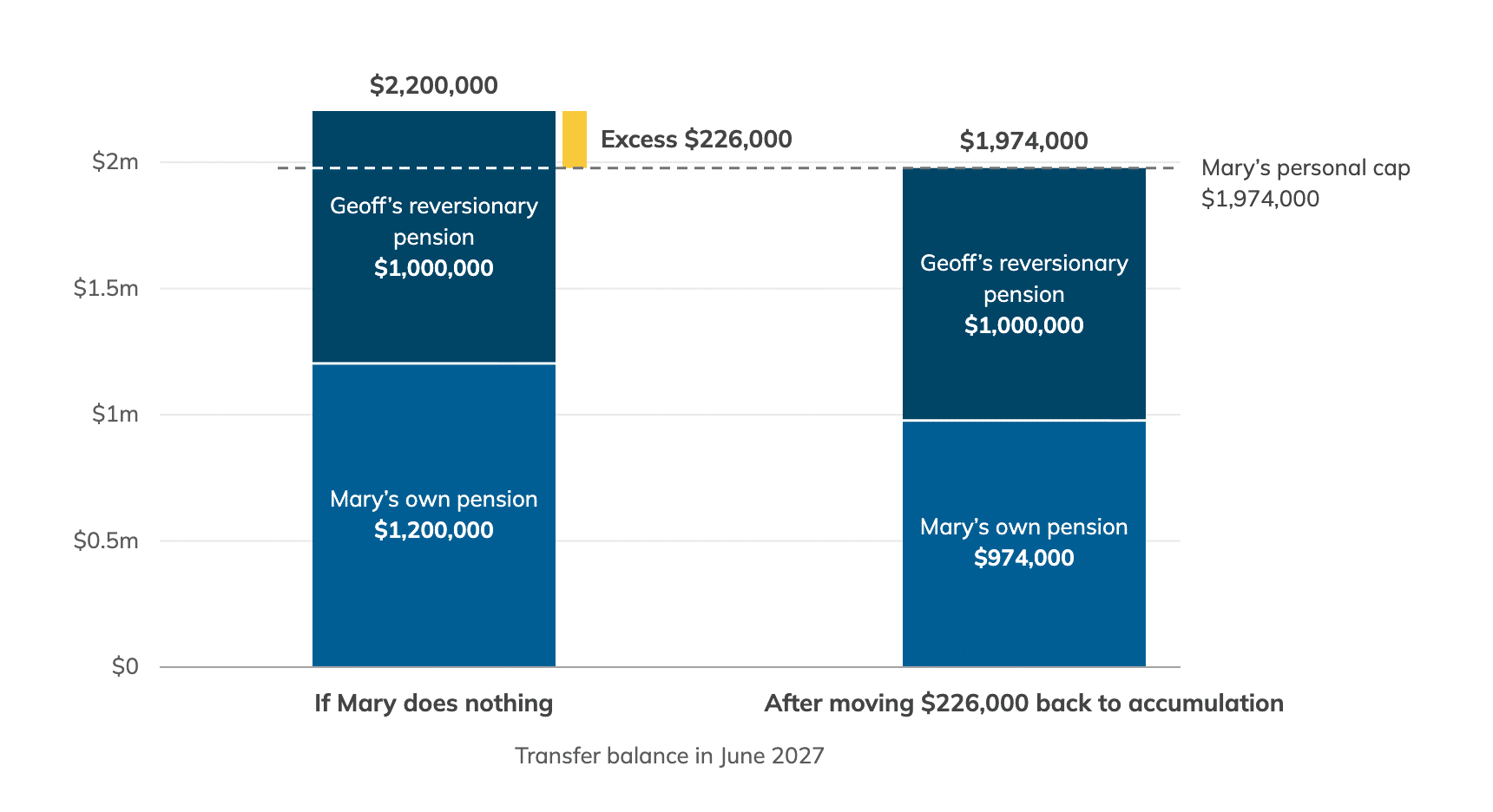
Geoff’s reversionary pension is credited to Mary’s transfer balance account in June 2027, 12 months after his death, at its value on the day he died.
Source: SuperGuide calculations
When a child receives a death benefit income stream their transfer balance cap is not the general cap. Instead, they have a ‘modified personal transfer balance cap’.
The modification of the transfer balance cap depends on the deceased parent’s super interests – that is, whether they were in accumulation or retirement mode – and the child dependent’s share of the super interests. These modification calculations are called cap increments.
A child recipient of a death benefit income stream must cash it when they reach age 25 unless they are disabled. At the time benefits are cashed, the modified transfer balance cap arrangements end. The rules for child recipients are complex and described in detail on the ATO website. Scroll down to ‘child recipients of a death benefit income stream’.
Common questions about the transfer balance cap
Here are answers to some of the most common questions SuperGuide members ask about the transfer balance cap.
Q: How is the general transfer balance cap indexed, and when will we know if it is increasing on 1 July?
A: The general transfer balance cap is indexed in line with the Consumer Price Index (CPI) in increments of $100,000.
If the increase in CPI is enough to cause indexation, it takes effect on 1 July.
Indexation depends on the CPI for the December quarter, which the Australian Bureau of Statistics (ABS) publishes in late January. The ATO confirms the new cap soon after.
Q: If my pension balance grows above the transfer balance cap because of investment earnings or a revaluation of its assets, will I breach the cap or have to pay extra tax?
A: No. Growth in your pension balance does not count towards the transfer balance cap. If the balance of your pension account rises above the cap due to investment returns (including capital gains), the cap is not breached. Only transferring more money into a retirement phase pension can cause you to exceed the cap.
If your pension accounts are getting close to the cap purely because of an increase in your fund’s earnings, you don’t need to do anything.
You can track how much of your cap you have used, and how much space is available to start new pensions, by logging in to myGov.
Your transfer balance account shows what is currently counted towards your cap. Your personal transfer balance cap is also available to view. If the balance in your transfer balance account is below your personal cap, you have space equal to the difference between the two figures to add more to the retirement phase.
Q: If I start a pension with less than my transfer balance cap, can I move more money from accumulation into pension phase later? Can I keep an accumulation account in a different fund?
A: Yes. If you have not used your whole transfer balance cap, you can transfer further amounts to retirement phase at a later date. You do this by starting a new pension.
Your transfer balance account tracks how much of your cap you have used, and myGov will also display your personal transfer balance cap.
For example, if the balance of your transfer balance account is $1 million and your personal transfer balance cap is $1,690,000, you could use up to $690,000 to start a new pension without breaching your cap.
When you have a pension (or multiple pensions) you can also keep an accumulation account in the same fund that holds your pension(s), or in a different fund. It is possible to hold multiple accumulation accounts if you wish, but be mindful that an SMSF can hold only one accumulation account per member.
When you want to start a new pension, you may either:
- start a new pension from your accumulation account and keep your current pension, or
- close the current pension, add its balance to the accumulation account, and use the combined account balance to start a new pension
Q: I started my pension when the transfer balance cap was $1.6 million. When the general cap is indexed, does my personal cap go up too?
Sign up free to read this answer
Access this answer with a free SuperGuide account. You’ll also get access to 100+ free guides.
Q: I’m drawing regular payments from my account-based pension. Do those payments reduce the amount counted towards my transfer balance cap, or does it stay at the amount I started the pension with?
Sign up free to read this answer
Access this answer with a free SuperGuide account. You’ll also get access to 100+ free guides.
Q: I’ve used my transfer balance cap to start a pension. Is there a limit on how much I can keep in an accumulation account, and how long can I leave it there?
Sign up free to read this answer
Access this answer with a free SuperGuide account. You’ll also get access to 100+ free guides.
Q: When I start my first pension, should I use the full transfer balance cap, or a little less so my personal cap can benefit from future indexation?
This answer is for SuperGuide members
Members can read every answer on our guides, plus access member-only webinars, calculators and tools.
Q: If I move some or all of my pension back to accumulation, or take a lump sum from it, can I later use that space to start a new pension? Is the money counted twice?
This answer is for SuperGuide members
Members can read every answer on our guides, plus access member-only webinars, calculators and tools.
Q: What restrictions apply once I reach my transfer balance cap? Can I still make contributions to super, or receive employer contributions?
This answer is for SuperGuide members
Members can read every answer on our guides, plus access member-only webinars, calculators and tools.
Q: I’m 61 and still working. If I start a transition to retirement (TTR) pension, do I need to report it for the transfer balance cap? And what happens if my TTR balance is more than my available cap when I turn 65?
This answer is for SuperGuide members
Members can read every answer on our guides, plus access member-only webinars, calculators and tools.
Q: I receive a lifetime defined benefit pension from a public sector scheme. How is it counted towards my transfer balance cap, and what happens if its value is above the cap?
This answer is for SuperGuide members
Members can read every answer on our guides, plus access member-only webinars, calculators and tools.
Q: If my spouse dies and I receive their super as a pension, does it count towards my transfer balance cap? What if it would take me over the cap?
This answer is for SuperGuide members
Members can read every answer on our guides, plus access member-only webinars, calculators and tools.
Q: I have used all of my personal transfer balance cap. I’m now looking at making a downsizer contribution. From what I’ve read, any downsizer sums must stay in accumulation where someone has reached their personal TBC. Is there any option where I could commute part of my pension back to accumulation, take a lump sum withdrawal from accumulation and then start a new pension up to my TBC once more?
This answer is for SuperGuide members
Members can read every answer on our guides, plus access member-only webinars, calculators and tools.
Q: I’ve been told that if my personal transfer balance cap is lower than the general transfer balance cap, and I haven’t used the bring-forward rule, I can contribute the full annual non-concessional cap rather than just the difference between the two caps. Is that right?
This answer is for SuperGuide members
Members can read every answer on our guides, plus access member-only webinars, calculators and tools.
Q: I’m confused by one aspect of the non-concessional contribution rules. If my total super balance is just under the limit for a three-year bring-forward and I contribute the maximum, my new balance will be above the general transfer balance cap. Is this allowed, or can I only contribute up to the cap?
This answer is for SuperGuide members
Members can read every answer on our guides, plus access member-only webinars, calculators and tools.
Join SuperGuide and supercharge your retirement
Unlock expert guides and tools that help you boost your retirement savings, plan and prepare for retirement.