


The super system offers tax benefits to help you save for retirement. In return, there are strict rules about when you can make withdrawals and how much tax you, or the people who inherit your super, will pay.
The proportioning rule is one of these tax rules. It means you can’t choose to withdraw only tax-free or taxable amounts. Each withdrawal must reflect the proportions in your account.
Knowing the rule can help you create a more effective recontribution strategy, lowering tax for beneficiaries after you pass away. It will also explain how your own withdrawals are treated, including if you become eligible for the early release of your super (before age 60).
Tax components
Before we cover the proportioning rule, you need to know how your super account is broken up into tax-free and taxable components.

1. Tax-free component
This component includes your non-concessional (after-tax) contributions.
If you were a member of a super fund before July 2007, you may also have other tax-free amounts in your super account.
Within your tax-free component, there are two different elements:
- Contributions segment: Made up of non-concessional (after-tax) contributions made into your super account after 30 June 2007.
- Crystallised segment: Made up of amounts that would have been tax free if they had been paid to you before 1 July 2007. Examples are after-tax contributions made before 30 June 2007, capital gains tax (CGT) exempt components and pre-July 1983 components.
2. Taxable component
The taxable component is the remainder of your account balance (i.e. any amount that is not a tax-free component). This comes from concessional (before-tax) contributions and investment earnings, so the value changes regularly.
Within your taxable component, there are two elements:
- Taxable component – taxed element: Made up of concessional contributions and investment income your super fund has paid tax on.
- Taxable component – untaxed element: Made up of concessional contributions and investment income your super fund has not paid tax on. Some super funds for government employees are untaxed, and these funds are the main source of untaxed elements. An untaxed element will also be generated if a death benefit, including life insurance, is paid from a fund that claimed tax deductions for insurance premiums. Most funds do claim deductions for premiums, but if you have a self-managed super fund (SMSF), you can choose whether to do so.
You can usually find out the tax components of your account by getting a quote on your fund’s website. If you can’t find it, call your fund and they will work it out for you.

Retirement planning isn’t the same for everyone.
Take our 2-minute quiz to find out which stage you’re at and what you could focus on next.
The proportioning rule
The proportioning rule prevents you and your beneficiaries from choosing which tax component to withdraw.
Withdrawals and transfers to another super account include the same ratio of tax-free and taxable components as your balance. For example, if your account balance is 70% taxable and 30% tax free, your withdrawals will also be 70% taxable and 30% tax free.
One exception to the proportioning rule is when you request to transfer some of your concessional contributions to your spouse’s super account using contribution splitting. In this case, the transfer comes only from your taxable component because it is drawn from your concessional contributions.
When you start a pension, its proportions are fixed based on the tax components in the original account. For example, if the account used to start the pension was entirely tax-free component, the pension will remain 100% tax-free component until it is closed.
Tax on withdrawals
If you’re eligible to withdraw your super, the tax rate you will pay on your savings depends on your age and the tax components included in your payment.
If you withdraw some of your super before you reach age 60, you will generally pay tax on the taxable components of your super savings unless you qualify for a terminal illness benefit.
On the other hand, if you wait until you reach age 60, your withdrawal will be tax free unless it contains an untaxed element. Untaxed elements come from untaxed super funds, which are uncommon.
When your super is paid after your death, the person who receives it will need to pay tax on the taxable components if they are not your dependant under tax law.
No tax is payable on the tax-free component.
Because the proportioning rule requires tax components to be paid in proportion, you can’t avoid tax by choosing to withdraw only the tax-free component. Your payment will include both tax-free and taxable amounts, in the same ratio as your account balance.
How the proportioning rule affects super strategies
The proportioning rule is important for two common strategies:
- The recontribution strategy to reduce tax for future beneficiaries
- A rollover strategy to lock in a higher tax-free proportion after suffering a permanent disability.
The recontribution strategy is used to convert taxable components into a tax-free component by withdrawing money from super and using the funds to make non-concessional (after-tax) contributions. Using a separate account for contributions avoids tax components mixing in one account, which would require future withdrawals to be paid proportionally from each component. This is important in two types of recontribution strategy:
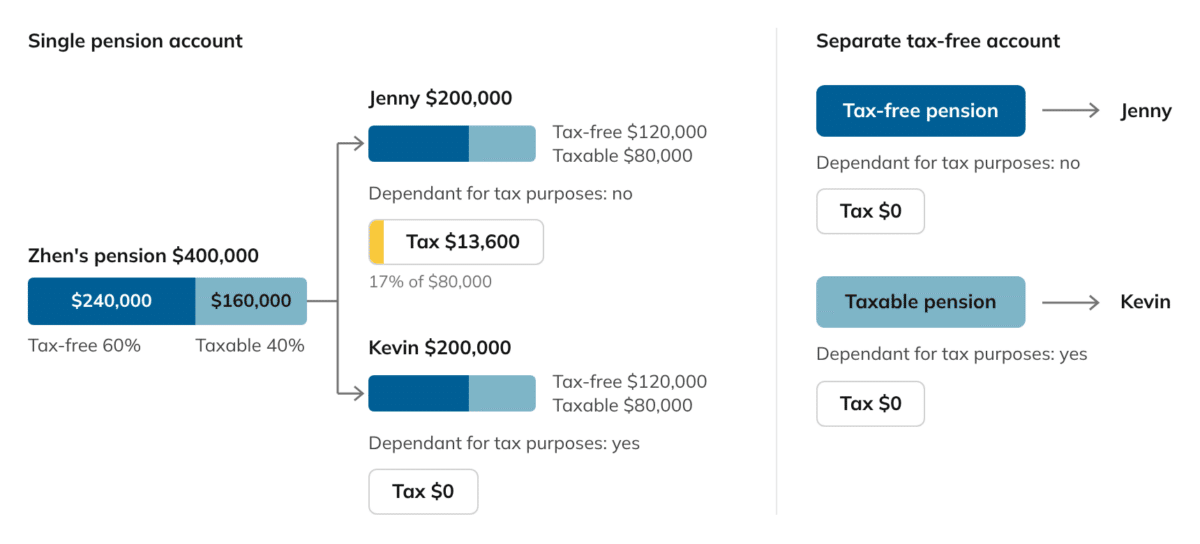
- The dual pension strategy: The new account created from the contributions is used to start a tax-free pension that can be left to a non-dependant beneficiary, ensuring their benefit is tax free. Your remaining super, including taxable components, can be used for a second pension. Alternatively, withdrawals from the tax-free pension can be kept to the minimum while all additional spending needs are taken from the taxable pension.
- A multi-stage recontribution strategy: A multi-stage strategy involves more than one withdrawal and recontribution, often over a period of many years. It can be used when your account balance is too high to be entirely converted to tax-free proportion with one withdrawal and recontribution because of the non-concessional contribution cap.
Adding contributions to a separate account in a multi-stage strategy means future withdrawals can be taken from the account that still contains a high taxable proportion. The withdrawal and following contribution will convert more taxable proportion to tax-free than would be possible using one account. The effect occurs because if the entire balance was in one account, the second and subsequent withdrawals would include more tax-free component thanks to the proportioning rule.
The rollover strategy for permanent disability benefits takes advantage of an increase to the tax-free component that happens when you take a permanent incapacity or total and permanent disability payment from super. The tax-free uplift applies to lump sum payments, including a rollover (transfer) to a new super fund.
Rolling over a disability benefit means the ‘tax-free uplift’ is calculated and included in the rollover. The strategy can be helpful if you will not cash your entire balance immediately. It means future withdrawals from your new fund contain the increased tax-free amount. Without a rollover, you may need to provide more medical certificates to your fund to qualify for the uplift when you request another withdrawal.
Zhen’s scenario with a single pension versus two pensions
The following questions were raised by members in our Q&A webinars.
Q: When a superannuation fund enters the pension phase, all investment earnings become tax free on both the taxable and tax-free components. Are these tax-free earnings allocated to the tax-free and taxable components in the same proportion as the existing balance, or are all tax-free earnings added solely to the tax-free component?
Q: As my self-managed super fund (SMSF) balance is about double the TBC how does proportioning of the income work in the portions that are separated into Pension phase and Accumulation phase? I am over 60. If I made a lump sum withdrawal from the accumulation portion does re-proportioning take place ?
Get more guides like this with a free account
Get independent guidance and practical tools to help you make
better super and retirement decisions.