

Yen Hits Fresh 40-Year Low. Can Japan Still Defend Its Currency?

The Japanese Yen tumbled to another four-decade low today, with USD/JPY breaking above the 163 mark as investors continued to unwind Yen positions against the backdrop of widening global yield differentials and surging energy prices. The move has once again thrust Japan’s currency policy into the spotlight, raising familiar questions over whether authorities will step into the market to slow the decline.
For now, markets appear unconvinced that intervention is imminent. Although Japan has a history of acting when currency moves become disorderly, officials have generally avoided fighting strong market trends during periods of deep liquidity, where intervention tends to be both more costly and less effective. Instead, traders are focused on a more fundamental question: whether Tokyo still has any policy tools capable of reversing the Yen’s structural weakness rather than merely slowing its pace.
That question is becoming relevant ahead of the Bank of Japan’s July 31 policy meeting. While intervention threats may still generate bouts of volatility, the bigger issue for markets is whether monetary policy, fiscal policy and global interest-rate dynamics have left Japan with few attractive options.
Intervention Threats Are Losing Their Bite?
Japanese officials wasted little time responding to the Yen’s latest slide. After USD/JPY climbed through 163 overnight, Finance Minister Satsuki Katayama reiterated the government’s familiar warning, saying authorities’ stance “has not changed at all” and that they would “take decisive action appropriately at any time” if needed. Chief Cabinet Secretary Minoru Kihara delivered a similar message, stressing that the government stood ready to “respond as appropriate at any time.” Yet the market reaction was tellingly muted. Traders largely ignored the remarks, underscoring how verbal intervention has become increasingly ineffective after repeated use over the past several years.
The silence from top currency diplomat Atsushi Mimura was perhaps equally noteworthy. As the official widely regarded by markets as having the greatest influence over the timing of any intervention, his decision not to make any public comments left investors with little reason to believe immediate action was being prepared. While authorities have repeatedly demonstrated a willingness to intervene when currency moves become excessively volatile, they have also shown a preference for acting when market conditions are thinner, allowing intervention to have a greater impact with less firepower.
That consideration may be particularly important this week. With global markets fully staffed and liquidity deep through the middle of the week, any attempt to push back against a yield-driven Dollar rally would likely prove expensive and short-lived. Instead of challenging the trend directly, Tokyo may prefer to preserve the element of surprise while relying on verbal warnings to discourage speculative positioning. So far, however, those warnings have fallen on deaf ears, with investors increasingly convinced that intervention can at best slow the Yen’s decline rather than reverse it.
BoJ Hike Speculation May Buy Time, Not Solve the Problem
The Yen did find brief relief after Bloomberg reported that Bank of Japan officials were open to raising interest rates at a faster pace than economists currently expect, as the currency’s persistent weakness increases upside risks to inflation. The report suggested policymakers are becoming more concerned that a weaker Yen is amplifying imported inflation, even though markets still overwhelmingly expect the BoJ to leave policy unchanged at its July 31 meeting before considering another rate hike later this year.
Whether officially sanctioned or not, such reports could form part of a broader strategy to steady the currency ahead of next week’s meeting. If outright intervention has become less effective, shaping market expectations through carefully calibrated rhetoric or policy leaks may offer a less costly way to support the Yen. By encouraging investors to price in a more hawkish BoJ path, officials could narrow rate expectations modestly and trigger bouts of Yen short-covering without spending foreign exchange reserves.
That possibility makes the coming days particularly important. Markets will be watching closely for any further hints from BoJ officials or government sources that policymakers are becoming less comfortable with current exchange rate levels. A steady drumbeat of hawkish signals would suggest authorities are attempting to prepare markets for a more assertive policy stance. Even so, expectations alone can only provide temporary support. Unless the BoJ ultimately delivers a meaningfully more aggressive tightening cycle than markets currently anticipate, any Yen rebound driven by rhetoric is likely to prove short-lived.
Japan’s Policy Dilemma Runs Deeper Than the Exchange Rate
Even if the Bank of Japan ultimately decides to tighten policy more aggressively, it is far from clear that doing so would produce a sustained recovery in the Yen. The fundamental problem is that Japan’s currency weakness is rooted in structural yield differentials rather than simply expectations for one additional rate hike. With Brent crude climbing above $94 a barrel, markets are concerned that renewed energy inflation could keep the Federal Reserve and other major central banks on a tighter policy path for longer. If overseas interest rates continue rising alongside Japanese rates, the gap underpinning Yen weakness may barely narrow.
At the same time, the BoJ cannot focus solely on the exchange rate. Japan’s government bond market is already showing signs of strain, with the 10-year JGB yield reaching 2.90% earlier this month—its highest level since the late 1990s—before easing modestly to around 2.73%. Rising yields reflect not only inflation concerns linked to higher oil prices but also growing unease over Prime Minister Sanae Takaichi’s fiscal expansion plans. Investors are D demanding higher compensation to hold Japanese government debt as expectations for further monetary tightening collide with concerns over expanding government borrowing.
That leaves policymakers confronting a difficult balancing act. A faster pace of rate hikes could lend the Yen some support, but it would also risk accelerating the rise in JGB yields, tightening financial conditions and increasing the government’s debt-servicing burden. In other words, the BoJ is not dealing with a single policy objective. It faces a two-front challenge: stabilizing a weakening currency while avoiding unnecessary stress in a bond market already grappling with multi-decade high yields. Under those circumstances, even a more hawkish BoJ is unlikely to deliver the kind of sustained Yen appreciation markets are hoping for.
Technical Outlook: Bulls Eye 163.47 Before 166.70
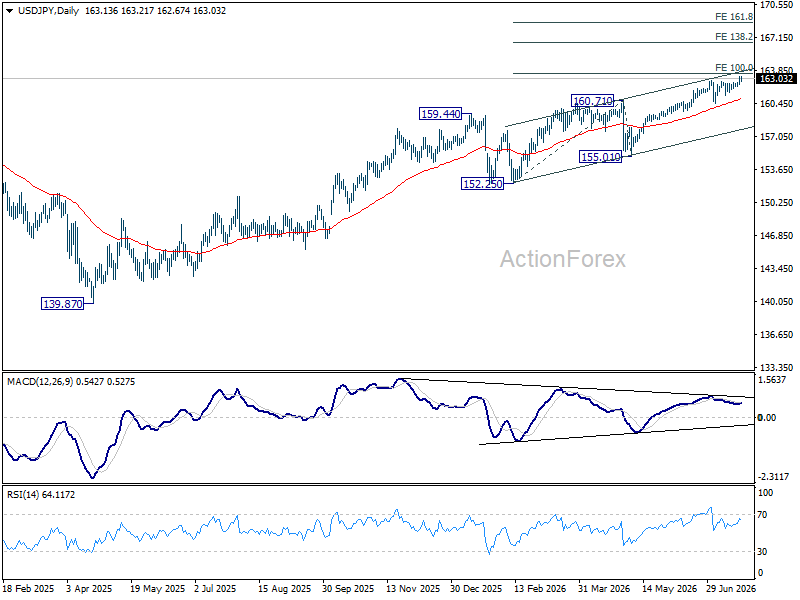
Technically, immediate target for USD/JPY is now on 100% projection of 152.25 to 160.71 from 155.01 at 163.47. Firm break there, and sustained trading above rising channel ceiling, could prompt upside acceleration to 138.2% projection at 166.70.
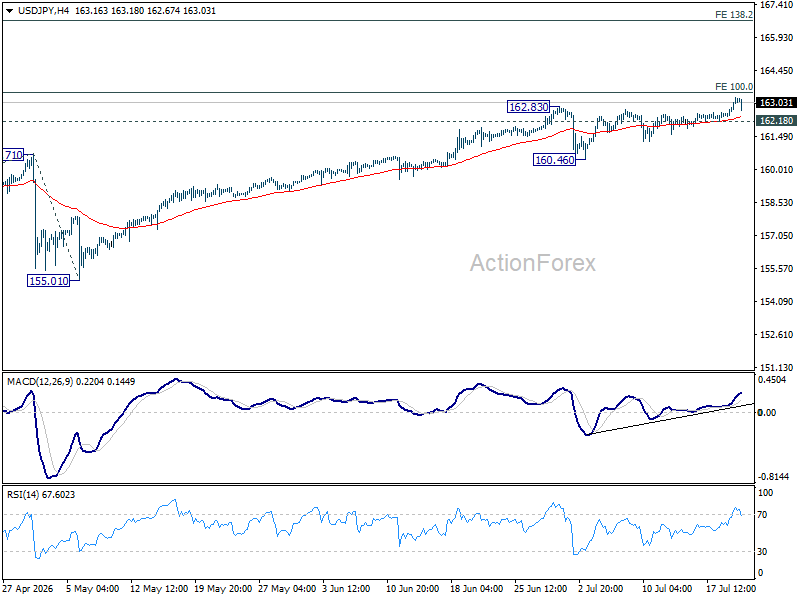
On the downside, break of 162.018 minor support will bring more consolidations first. But near term outlook will now stay bullish as long as 160.46 support holds, even in case of deep retreat.
Gyrostat September Retirement Portfolio Resilience Assessment
September Retirement Portfolio Resilience Assessment Markets have fallen. The price of risk has risen. ... Read more
Does The West Have A Problem With Government Bonds
If you have been following the financial pages over the past few weeks, one theme has begun to stand out from the usual ... Read more
August Retirement Portfolio Resilience Assessment
Markets Are Higher. The Price of Risk Is Lower. Retirement invest... Read more
When The Wave Turns
Why Retirement Investing Is Moving Towards Resilience Jeremy Grantham’s latest market warnings have revived an old tru... Read more
Gyrostat Capital Management: July Retirement Portfolio Resilience Assessment
The Market Is Currently Presenting an Opportunity to Strengthen Retirement Portfolio Resilienc... Read more
The Invisible Risk That Decides Your Retirement
Why how investors behave matters more than what markets do and what disciplined port... Read more