

UK Signs Deal To Share Police Biometric Database With US Border Guards
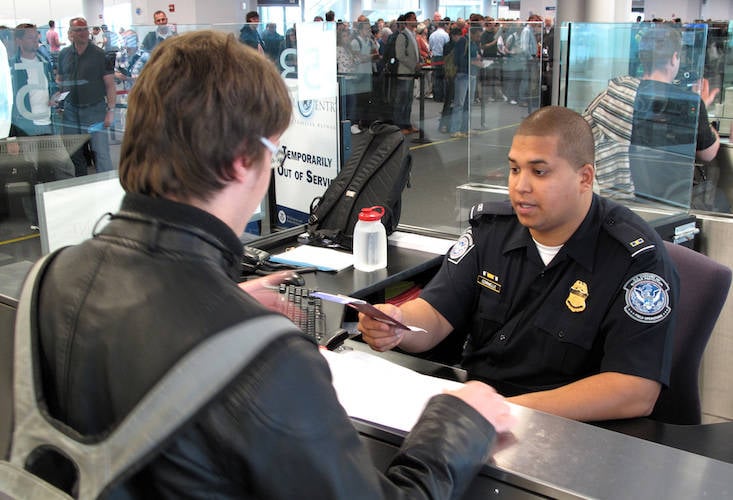
The UK has signed up to a US plan for sharing police-held biometric data about citizens with US border officials.
According to a member of the European Parliament's Committee on Civil Liberties, Justice and Home Affairs (LIBE), the body met "informally" with representatives of the US Department of Homeland Security this week to discuss the plans.
They come under the auspices of the Enhanced Border Security Partnership (EBSP), which is designed to increase the US Department Of Homeland Security's ability to detect threats through biometric information sharing. Israel signed up to the arrangement in March.
LIBE committee member and Pirate Party MEP Patrick Breyer said that during the meeting last week, the committee discovered that the UK – and three EU member states, though their identities were not revealed – had already signed up to reintroduce US visa requirements which grant access to police biometric databases.
In the UK, the Home Office declined the opportunity to deny it was signing up for the scheme. A spokesperson said: "The UK has a long-standing and close partnership with the USA which includes sharing data for specific purposes. We are in regular discussion with them on new proposals or initiatives to improve public safety and enable legitimate travel."
Under UK law the police can retain an individual's DNA profile and fingerprint record for up to three years from the date the samples were taken, even if the individual was arrested but not charged, provided the Biometrics Commissioner agrees. Police can also apply for a two-year extension. The same applies to those charged, but not convicted.
According to reports, the US Enhanced Border Security Partnership (EBSP) initiative will be voluntary initially but is set to become mandatory under the US Visa Waiver Program (VWP), which allows visa-free entry into the United States for up to 90 days, by 2027.
MEP Breyer said that when asked exactly what data the US wanted to tap into, the answer was as much as possible. When asked what would happen at US borders if a traveler was known to the police in participating states, it was said that this would be decided by the US immigration officer on a case-by-case basis.
The DHS program is part of a project to update the visa waiver scheme under which EU members and other European countries enjoy visa-free travel to the US under certain conditions.
Breyer noted: "I expect the EU Commission and also the German government to reject the demand of the US authorities and not allow themselves to be blackmailed.
- America edges closer to a federal data privacy law, not that anyone can agree on it
- Did ID.me hoodwink Americans with IRS facial-recognition tech?
- Clearview AI promises not to sell face-recognition database to most US businesses
- EU countries want to pool photos in massive facial recog database
"If necessary, the visa waiver program must be terminated by Europe as well. Millions of innocent Europeans are listed in police databases and could be exposed to completely disproportionate reactions in the USA.
"The US lacks adequate data and fundamental rights protection. Providing personal data to the US exposes our citizens… to the risk of arbitrary detention and false suspicion, with possible dire consequences, in the course of the US 'war on terror'. We must protect our citizens from these practices," Breyer said.
The Register has asked DHS for comment. ®
Gyrostat Capital Management: Why Risk Management Is Not About Predicting Risk
Why Risk Management is Not About Predicting Risk Financial markets reward confidence, but they punish certai... Read more
Gyrostat January Outlook: Calm At Multiyear Extremes
This monthly Gyrostat Risk-Managed Market Outlook does not attempt to forecast market direction. Its p... Read more
Gyrostat December Outlook: The Market Does The Work
Harnessing Natural Volatility for Consistent Returns Markets have always moved more th... Read more
Gyrostat Capital Management: Why Advisers Must Scenario-Plan Both The Bubble And The Bust
The Blind Spot: Why Advisers Must Scenario-Plan Both The Bubble and The Bust In financial m... Read more
Gyrostat Capital Management: The Hidden Architecture Of Consequences
When Structures Themselves Become A Risk In portfolio construction, risk is rarely where we look for it.... Read more
Gyrostat November Outlook: The Rising Cost Of Doing Nothing
Through the second half of 2025, markets have delivered a curious mix of surface tranquillity and instabi... Read more