

The Three Ways Fed Chair Warsh Could Move Gold At Jackson Hole — And Why Only One Threatens The Rally

TL;DR: Gold’s Jackson Hole test on Friday isn’t really about rate signals — it’s about whether Fed Chair Kevin Warsh draws a clear line between monetary policy and Treasury’s efforts to influence long-end bond markets, with only one of three likely outcomes genuinely threatening the rally.
Gold’s Jackson Hole Test Is Bigger Than Rates
Gold is heading into Fed Chair Kevin Warsh’s Jackson Hole speech on Friday, Aug. 28, with investors focused on far more than whether he nudges expectations for another rate hike. September tightening odds are already relatively low, leaving limited room for a conventional rates signal alone to redefine the rally. Bigger question is institutional: how firmly Warsh separates monetary policy from Treasury’s increasingly active efforts to influence conditions at long end of bond market.
That matters because Gold’s latest advance looked like a fiscal-credibility trade first and a rate-cycle trade second. Rally accelerated around Treasury’s Aug. 19–20 decision to double minimum long-duration buybacks from $2bn to at least $4bn per operation. But skepticism quickly centered on what buybacks cannot do: they can improve liquidity and redistribute duration pressure, but they do not reduce underlying borrowing requirement or repair fiscal arithmetic. Real yields and Dollar can reinforce that trade, but concern over longer-run fiscal credibility has become an important driver in its own right. A fuller discussion of that mechanism is available in Dollar Index Faces Structural Breakdown Toward 90, EUR/USD Eyes 1.20 Breakout.
Why Warsh Matters More Than September Hike Odds
Jackson Hole therefore becomes a test of how Warsh defines boundary between Fed and Treasury. Greater reliance on short-term bill issuance leaves government interest costs more sensitive to changes in Fed policy. That does not mean fiscal costs will determine Warsh’s reaction function. Rather, it makes his answer more consequential: markets need to know whether Treasury financing pressure is something Fed should explicitly ignore when setting policy, or whether closer Treasury-Fed coordination becomes part of framework.
Warsh’s own history prevents an easy assumption that a Trump-appointed Fed Chair will automatically lean toward accommodation. He has long criticized an oversized Fed balance sheet and large-scale asset purchases, and his recent remarks at ECB’s Sintra forum emphasized price stability and defense of 2% inflation target. That tension is precisely why Friday matters. Warsh could validate concern about fiscal dominance, reject it directly, or leave markets with much the same ambiguity they have today.
Three Ways Friday Could Go
1. Treasury-Fed Accommodation (most bullish for Gold)
Most bullish outcome for Gold would be a speech that leans into Warsh’s “New Treasury-Fed Accord” in a way investors interpret as Fed becoming more sensitive to government financing or bond-market pressures.
That would reinforce concern that line between monetary policy and fiscal financing is becoming less distinct. Gold would not need a dovish rate signal for that interpretation to matter. A perceived willingness by Fed to accommodate fiscal stress would directly strengthen the fiscal-credibility, or “debasement,” thesis behind part of current rally.
2. Monetary Independence and Market Discipline (most bearish for Gold)
Most bearish outcome would be Warsh drawing a clear line in opposite direction. He could reassert his anti-QE instincts, emphasize that Treasury financing considerations should not determine monetary policy, and frame balance-sheet restraint as a way of forcing government debt back onto private markets rather than allowing Fed to absorb fiscal pressure.
Crucially, Warsh would not need to promise a September hike to hurt Gold. A forceful defense of monetary independence could weaken one of rally’s central assumptions: that persistent fiscal pressure will eventually constrain Fed or encourage renewed balance-sheet accommodation.
3. Strategic Ambiguity (the simplest outcome)
Third possibility is also simplest: Warsh discusses Treasury-Fed coordination in broad terms but avoids defining what it means operationally. He could emphasize price stability, institutional cooperation and financial-market functioning without resolving where monetary policy ends and Treasury debt management begins.
That would leave Gold’s underlying thesis largely untouched. Fiscal deficits, rising debt-service costs and Treasury’s maturity-management challenge would still exist after speech. In that sense, ambiguity is not neutral for an established trend: it allows incumbent fiscal-credibility trade to continue without fresh contradiction.
Why Only One Scenario Really Threatens the Thesis
That creates an important asymmetry. Gold does not need Warsh to endorse fiscal-credibility trade for it to survive. Treasury-Fed accommodation would reinforce it, while an ambiguous speech would leave its foundations in place. Only a clear market-discipline message directly challenges expectation that Fed may eventually be drawn into accommodating fiscal pressure.
Even that would not erase broader fiscal problem. A strong independence speech could weaken monetary-accommodation leg of Gold thesis, but it would not reduce deficits, lower debt stock or change Treasury’s financing requirement. That makes a bearish Warsh outcome potentially powerful for price without necessarily destroying longer-term argument.
Short-term price reaction is another matter. Gold is already technically stretched, which means thesis asymmetry and price asymmetry are not the same thing. Even a fundamentally bullish speech could trigger profit-taking if investors use Jackson Hole to lock in gains. Conversely, a bearish interpretation could produce a sharp correction that proves larger than underlying change in fiscal thesis.
ActionForex’s Technical View on Gold
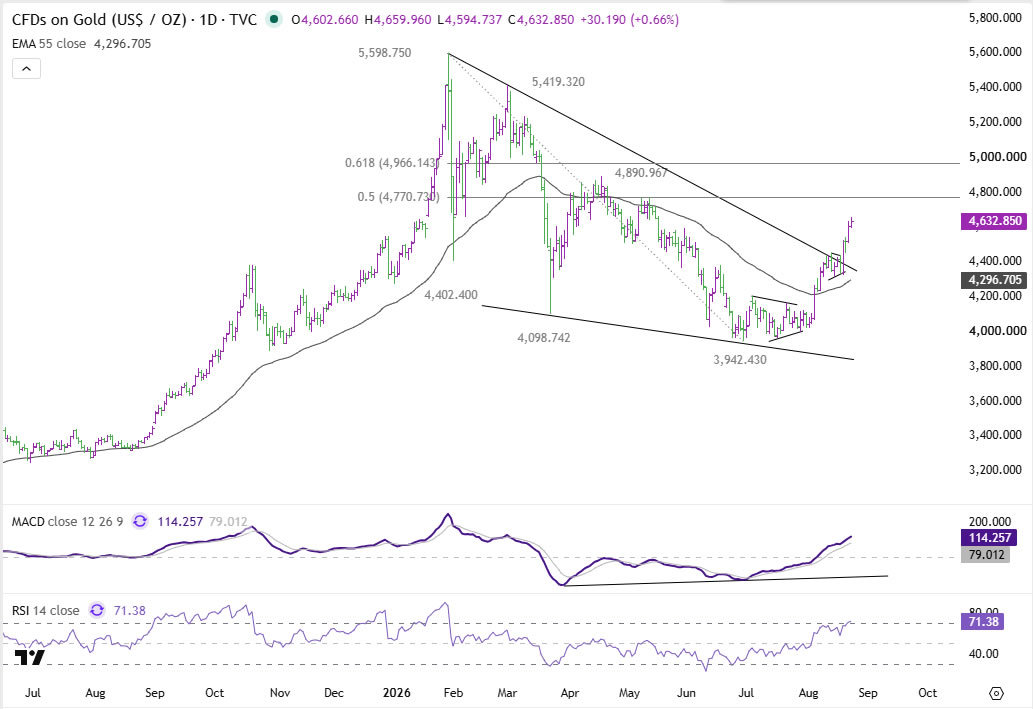
Technical development remains consistent with correction from 5,598.75 having completed at 3,942.43. Further rise is favored, but overbought conditions on daily RSI could cap first attempt through 4,770.73–4,966.14, representing 50% and 61.8% retracements of decline from 5,598.75 to 3,942.43.
Near-term outlook stays bullish while 55-day EMA, now at 4,296.69, holds on any retreat. Firm break of 4,966.14 would strengthen case for retest of 5,598.75 high.
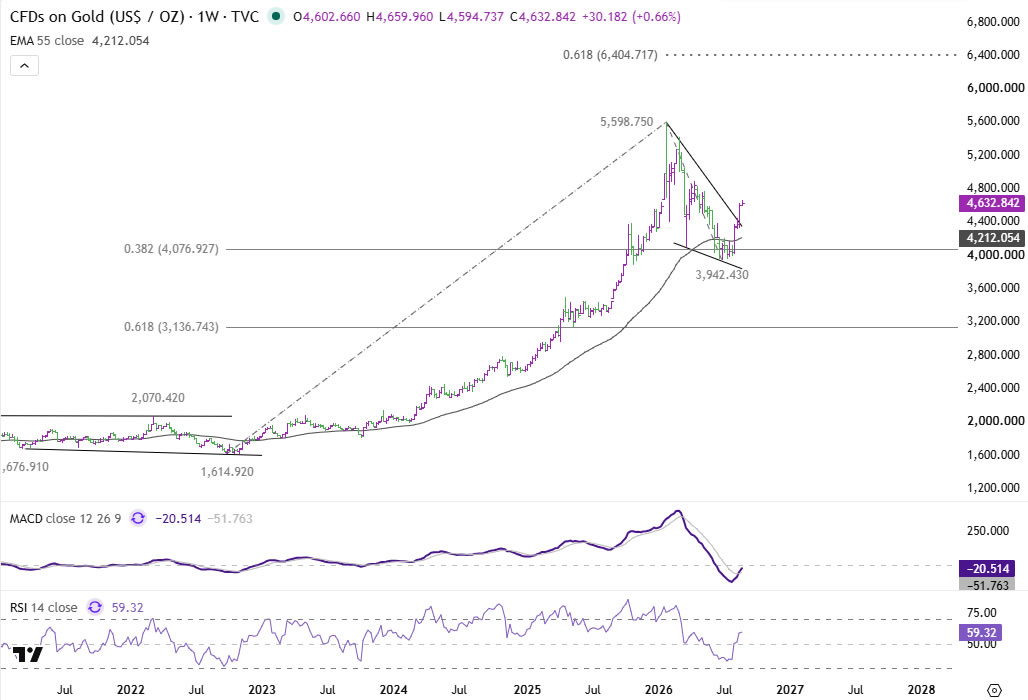
In bigger picture, long-term uptrend also remains intact after Gold defended 4,076.92, the 38.2% retracement of 1,614.92 to 5,598.75, and quickly recovered above 55-week EMA. It is still too early to conclude that long-term uptrend is ready to resume. But if that is eventually confirmed, tentative medium-term objective would be 6,404.71, the 61.8% projection of 1,614.92 to 5,598.75 from 3,942.43.
Friday’s real tell is therefore not simply whether Warsh sounds hawkish or dovish. Gold traders should listen for whether Fed Chair explicitly defends monetary independence from Treasury financing pressures. Two of three broad outcomes leave current fiscal-credibility thesis intact. Only one directly challenges it—and with Gold already overbought, even that distinction may matter more for durability of rally than for size of Friday’s first move.
Key Takeaways
- Gold’s rally is a fiscal-credibility trade first and a rate-cycle trade second, meaning September hike odds alone won’t determine Friday’s reaction.
- Two of three likely Jackson Hole outcomes — accommodation and strategic ambiguity — would leave the fiscal-credibility thesis behind Gold’s rally intact.
- Only a forceful defense of monetary independence from Treasury financing pressure would genuinely threaten the rally’s foundation, without erasing the underlying fiscal problem.
- Gold is already technically overbought, so even a fundamentally bullish speech could trigger profit-taking regardless of what Warsh actually says.
- Gold faces resistance at 4,770.73-4,966.14; a break would strengthen the case for a retest of the 5,598.75 high, with 6,404.71 as a tentative longer-term objective.
August Retirement Portfolio Resilience Assessment
Markets Are Higher. The Price of Risk Is Lower. Retirement invest... Read more
When The Wave Turns
Why Retirement Investing Is Moving Towards Resilience Jeremy Grantham’s latest market warnings have revived an old tru... Read more
Gyrostat Capital Management: July Retirement Portfolio Resilience Assessment
The Market Is Currently Presenting an Opportunity to Strengthen Retirement Portfolio Resilienc... Read more
The Invisible Risk That Decides Your Retirement
Why how investors behave matters more than what markets do and what disciplined port... Read more
Gyrostat Capital Management: The Missing Allocation In Retirement Portfolio Construction?
For decades, retirement portfolios have largely been constructed using combinations of growth assets a... Read more
When The Gate Comes Down
A Stress Test Rather Than a ScandalApollo Debt Solutions is not a blow-up story. It is something arguably more instructi... Read more