

Silvers Deficit May Be Narrowing, But 58.68–62.30 Will Decide The Next Move

TL;DR: Deutsche Bank sees Silver’s physical deficit narrowing toward a possible 2027 surplus as solar demand intensity falls and vault inventories rebuild, but with Silver trading around 60.80, the next move still hinges on the near-term technical fight between 58.68 support and 62.30 resistance—and on Wednesday’s FOMC minutes.
Why This Matters
Silver was trading around 60.80 in early Wednesday trade, well below the 71.16 late-August high and dramatically off levels above 120 seen earlier this year. The medium-term physical backdrop is also becoming less supportive, which raises a useful distinction for traders: a narrowing deficit is a slow-moving structural story that can cap how far a future rally extends, but it says little about which way Silver moves in the next session. That’s decided by the technical levels in play right now, and by how markets react to this week’s Fed signals.
Physical Tightness Is Easing, Deutsche Says
Deutsche Bank’s Daniel Ghali argues that the market deficit is narrowing as inventories rebuild and demand weakens in several important areas, raising the possibility that the physical market could move into surplus in 2027.
The Deutsche report was published on October 2, with Ghali discussing the findings in an interview with BNN Bloomberg. London commercial vault holdings had risen to more than 914 million ounces by the end of August, according to the Deutsche analysis. More than 300 million ounces were considered freely available, around 70% above October 2025 levels and the highest since November 2024. CME and Shanghai inventories have also increased. Ghali attributes the rebuilding to a combination of recycling, metal returning from private vaults and weaker demand.
Solar Demand Is Doing Much of the Work
The more important shift appears to be on the demand side. Deutsche estimates that global silver use in solar has fallen by more than 20%, including roughly one-third in China, while the amount of silver used per solar cell has declined around 17%.
That reduction in silver intensity has changed the economics of the sector. Silver’s share of solar-module costs had risen above 30% earlier this year but has since fallen back to around 14%. Indian imports are also running roughly 25% below year-ago levels, although August data indicated some recovery.
For Ghali, the result is that peak physical scarcity is now “clearly in the rear-view mirror.” Deutsche sees the current deficit shrinking and believes a physical surplus is possible next year. More available metal should also reduce the probability of the extreme squeezes that contributed to silver’s earlier volatility.
That conclusion still needs qualification. Neither the Deutsche material nor the media coverage provides a quantified 2027 surplus estimate, while China’s persistent price premium remains difficult to reconcile with an uncomplicated normalization story. The possibility that investment funds release additional metal in a prolonged Fed hiking cycle is also conditional rather than assured.
A Narrower Deficit Limits Upside, But It Is Not a Collapse Call
The medium-term implication is less about outright bearishness than about a smaller scarcity premium. Deutsche expects silver to average around $70 by Q2 2027, still materially above current spot levels. The bank is therefore not arguing that the metal must fall substantially from here. Rather, the physical market appears better supplied than during the most acute phase of last year’s squeeze, potentially limiting the scope for another scarcity-driven surge.
That distinction matters. The physical balance is a slow-moving driver. It can influence how far a move ultimately extends, but it does not decide whether silver rises or falls in the next session.
ActionForex’s Technical View on Silver
62.30 Keeps Risks Tilted to the Downside
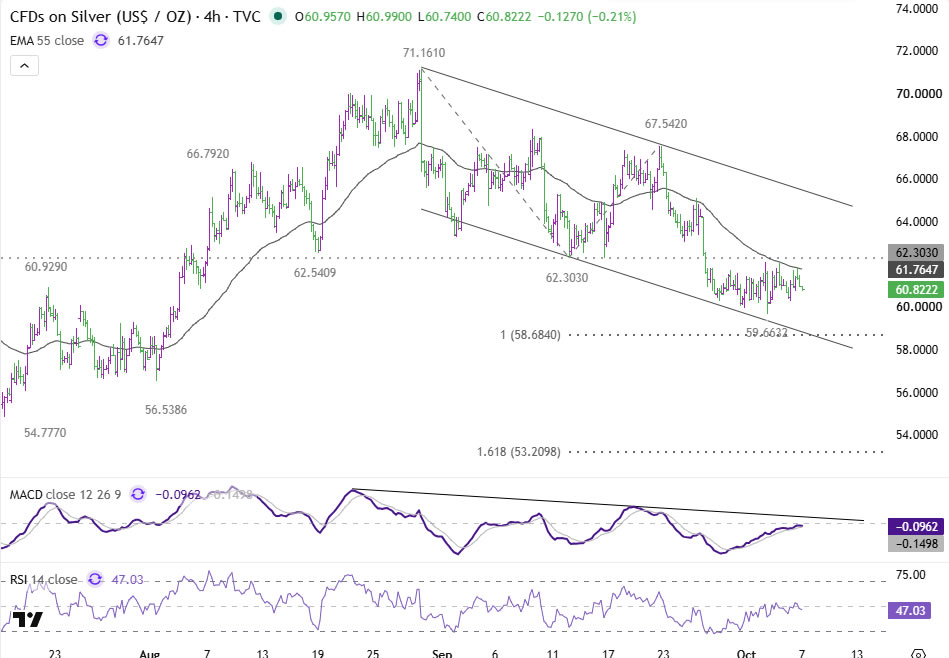
The technical bias remains on the downside as long as 62.30 resistance holds. Silver’s decline from 71.16 still fits a three-wave corrective structure, with the first leg falling to 62.30, a rebound to 67.54, and the latest leg extending to 59.66 last week. That keeps the broader sequence of lower highs intact and leaves the burden on buyers to reclaim former support.
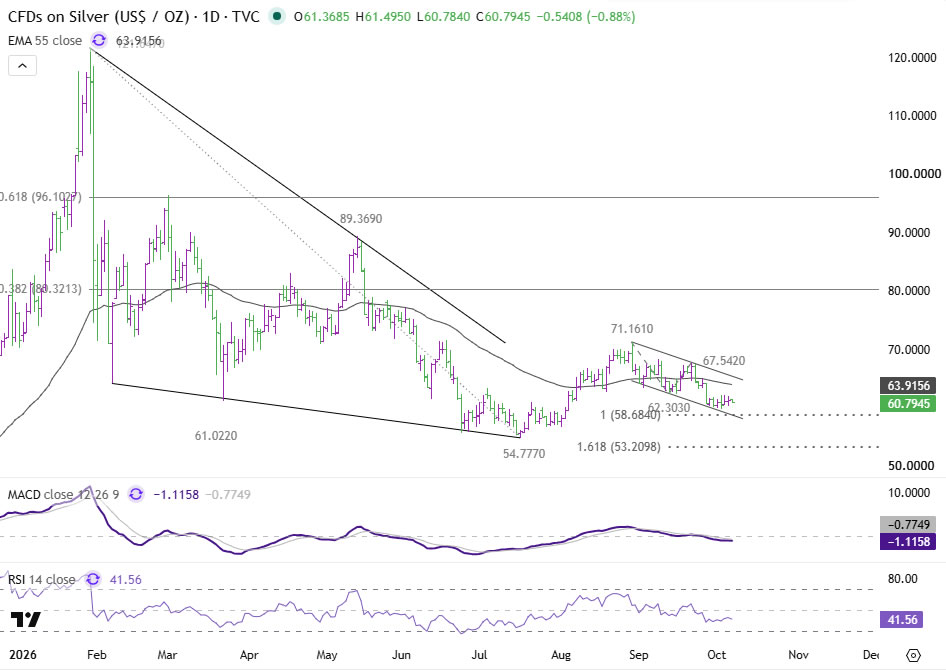
The first hurdle is the falling 4H 55 EMA around 61.76, but the more important level is 62.30, which has turned from support into resistance. As long as silver remains below there, another test of 59.66 remains the favored scenario. A decisive break above 62.30 would be the first meaningful sign that the decline from 71.16 may have completed, while a daily close above the 55 EMA near 63.92 would provide stronger medium-term confirmation.
58.68 Is the Key Downside Test
A break below 59.66 would expose 58.68, the 100% projection of the 71.16 to 62.30 decline measured from 67.54. That is the next important test of whether the current correction is merely extending or turning into a deeper bearish move.
A firm break of 58.68 would strengthen the downside case and shift focus to 53.21, the 161.8% projection target, which sits below the 54.78 July low. Until 62.30 is reclaimed, the technical structure therefore continues to favor downside risk over a sustained recovery.
FOMC Minutes Matter More for the Next Session
The next move is therefore more likely to be decided by US rates and Fed expectations than by the slower-moving physical balance.
The FOMC minutes are due at 2:00pm ET on Wednesday, while Fed commentary and US yields remain important as markets continue to price a December hike. With yields still near multi-decade highs, another rise in rates would keep pressure on silver, while a softer rates reaction could give the metal room to challenge 62.30.
The medium-term physical story is becoming less supportive. But in the near term, the technical decision remains much simpler: 62.30 on the upside and 58.68 on the downside.
Key Takeaways
- Deutsche Bank sees Silver’s physical deficit narrowing toward a possible 2027 surplus, driven mainly by a roughly 20% drop in solar demand and rebuilding vault inventories above 914 million ounces.
- Deutsche still expects Silver to average around $70 by Q2 2027—this is a smaller-scarcity-premium call, not a bearish collapse thesis.
- The near-term technical bias stays bearish while 62.30 resistance holds, with 59.66 the favored next test.
- A break below 58.68 would open the door to 53.21, below the July low at 54.78; a break above 62.30 (confirmed by a close above the 63.92 EMA) would be the first sign the decline from 71.16 has completed.
- Wednesday’s FOMC minutes and US yield reaction are likely to matter more for Silver’s next move than the slower-moving physical deficit story.
Gyrostat September Retirement Portfolio Resilience Assessment
September Retirement Portfolio Resilience Assessment Markets have fallen. The price of risk has risen. ... Read more
Does The West Have A Problem With Government Bonds
If you have been following the financial pages over the past few weeks, one theme has begun to stand out from the usual ... Read more
August Retirement Portfolio Resilience Assessment
Markets Are Higher. The Price of Risk Is Lower. Retirement invest... Read more
When The Wave Turns
Why Retirement Investing Is Moving Towards Resilience Jeremy Grantham’s latest market warnings have revived an old tru... Read more
Gyrostat Capital Management: July Retirement Portfolio Resilience Assessment
The Market Is Currently Presenting an Opportunity to Strengthen Retirement Portfolio Resilienc... Read more
The Invisible Risk That Decides Your Retirement
Why how investors behave matters more than what markets do and what disciplined port... Read more