

RBA And BoE Hikes Largely Priced — Can GBP/AUD Escape Its Six-Month Range?

TL;DR: The RBA (4.60% to 4.85%, 81.2% priced) and the BoE (3.75% to 4.00%, 94.4% priced) are both expected to hike this week, so GBP/AUD will hinge on new forecasts and guidance beyond November rather than the hikes themselves. The cross remains inside its 1.8533–1.9360 six-month range.
Why Do Two Priced-In Hikes Matter for GBP/AUD?
Two interest-rate increases in the same week would ordinarily provide plenty of material for currency traders. But for GBP/AUD, the more interesting question is what happens after the RBA and BoE deliver the hikes investors already expect. Both central banks are confronting renewed inflation pressures, yet markets have priced sharply different tightening paths for the year ahead. Whether policymakers support those expectations could matter far more than the immediate decisions, particularly for a currency cross that has spent nearly six months struggling to establish a new direction.
The RBA is expected to raise its cash rate from 4.60% to 4.85% on Tuesday, with markets assigning an 81.2% probability to the move. Thursday’s BoE meeting is even more heavily anticipated, with a 94.4% probability attached to an increase from 3.75% to 4.00%. Both decisions will come with updated economic forecasts, giving investors an opportunity to judge whether the central banks consider current market expectations appropriate.
The common problem is inflation. Australian headline CPI accelerated from 4.0% to 4.3% in September, while underlying inflation reached 3.6%. Britain’s headline inflation rose from 3.1% to 3.5%, exceeding earlier BoE expectations. Meanwhile, Brent crude around $111 has raised the prospect of further increases in transport, production and distribution costs, complicating efforts to bring inflation back toward target.
- Australia: headline CPI rose from 4.0% to 4.3% in September; underlying inflation reached 3.6%.
- Britain: headline inflation rose from 3.1% to 3.5%, above earlier BoE expectations.
- Brent crude, around $111, adds transport, production and distribution cost pressure.
Yet despite these similarities, the policy outlooks look very different. Markets expect relatively little additional RBA tightening after November, but anticipate a sustained series of BoE increases through much of 2027.
That contrast creates the central tension for GBP/AUD. If one central bank challenges its expected path while the other reinforces it, the cross could move sharply even though both deliver the same 25bps increase this week.
Follow the RBA and BoE outcomes on the ActionForex Telegram channel.
RBA: Inflation Has Strengthened the Case for a Hike, but the Forecasts Matter More
The RBA enters Tuesday’s meeting facing evidence that inflation is proving more persistent than previously expected.
September headline CPI reached 4.3% yoy, while trimmed mean inflation increased to 3.6%. The underlying measure also rose 1.0% during the September quarter, rather than showing the moderation the RBA had hoped to see. Services inflation accelerated from 3.7% to 4.1%, indicating that inflation pressures extend beyond the immediate effects of more expensive fuel and energy.
Governor Michele Bullock acknowledged the problem during her October 28 appearance before the Senate. Inflation is likely to be higher than the RBA’s August forecasts, she indicated, while the labour market may still be somewhat tighter than previously assessed despite the rise in unemployment. Weak productivity growth adds to the challenge by limiting the economy’s capacity to expand without additional price pressure.
These developments explain why Australia’s four major banks expect another increase. A hold would be a genuine surprise, particularly after the recent inflation data. But once the expected hike is delivered, attention should shift quickly to whether policymakers believe more tightening will be needed.
The September policy statement explicitly left further increases available if necessary. Retaining that language would keep the tightening option firmly in place. Softening it, or suggesting that policy has become sufficiently restrictive, could signal that the Board is moving closer to a prolonged pause.
However, the most revealing part of Tuesday’s announcement may be the RBA’s new inflation forecasts, not the wording of the policy statement.
The August Statement on Monetary Policy expected trimmed mean inflation to fall to 3.3% by the end of 2026, 3.0% by mid-2027 and 2.6% by the end of next year. Those projections assumed Brent crude averaging around $81 in the December quarter and a cash-rate path near 4.4–4.5%.
- Trimmed mean inflation forecast: 3.3% by end-2026, 3.0% by mid-2027, 2.6% by end-2027.
- Assumed Brent crude: around $81 in the December quarter.
- Assumed cash-rate path: near 4.4–4.5%.
Neither assumption reflects current conditions particularly well. Brent is now around $111, while the market-implied cash rate approaches 4.9% during 2027.
Higher oil prices should place upward pressure on inflation, particularly as additional transport and production costs work through the economy. But the higher interest-rate path used to condition the forecasts should work in the opposite direction by restraining spending, investment and eventually price increases.
The question is which influence dominates.
If the RBA now projects underlying inflation staying materially above its previous end-2027 forecast of 2.6%, despite assuming higher interest rates, it would suggest that the inflation problem is more persistent than previously assessed. Markets could respond by pricing a greater likelihood of additional tightening or a longer period before rates can be reduced.
But there is another side to the calculation. Unemployment reached 4.7% in September, already above the RBA’s previous forecast of 4.5% for December. Growth has also lost momentum, raising the possibility that the economy is developing more spare capacity than the central bank previously anticipated.
A weaker labour-market outlook combined with a credible decline in projected inflation could allow the RBA to signal that much of the necessary tightening has already been delivered.
Market pricing currently points to a cash-rate peak around 4.94% in March 2027, followed by a modest decline toward 4.84% by September. There is little room in that path for either an extended sequence of hikes or meaningful easing.
The Australian Dollar’s reaction may therefore depend on whether the new forecasts disturb that relatively narrow expectation, rather than on an increase that markets have already largely absorbed.
BoE: A Hike Is Almost Certain, but Four More May Be Harder to Justify
If the RBA’s challenge is deciding how much tightening remains necessary, the BoE faces the additional problem of a market that may already be expecting too much.
Thursday’s anticipated increase to 4.00% is hardly controversial in current pricing. The real disagreement concerns what comes afterward.
Markets imply Bank Rate reaching 4.11% in December, 4.28% in February, 4.44% in March and roughly 4.80% by September 2027. That amounts to the equivalent of approximately 3.3 additional quarter-point increases after this week’s expected hike.
- December: 4.11%
- February: 4.28%
- March: 4.44%
- September 2027: roughly 4.80%, about 3.3 quarter-point hikes beyond this week’s move.
Many economists are considerably less convinced that Britain will need such a prolonged tightening cycle. A Reuters poll conducted in October found only about half expecting another increase during the first quarter of 2027. Several major forecasting institutions anticipate that Bank Rate will reach 4.25% after November and February hikes, followed by an extended pause.
For the first few months, those expectations are not dramatically different. The market’s implied February rate of 4.28% is close to the 4.25% level expected by the more cautious forecasters.
The real disagreement emerges beyond February, where market pricing adds approximately another 55bps of tightening by September 2027.
There are reasons to question whether the MPC will endorse that path.
In September, BoE policymakers discussed the possibility that the upward slope of market interest rates reflected higher risk premia rather than genuine expectations of additional Bank Rate increases. Several members considered the level of restraint already implied by financial markets broadly sufficient, although others cautioned against treating risk premia as a substitute for actual policy tightening.
Chief Economist Huw Pill subsequently pushed back against expectations of a series of increases. Governor Andrew Bailey also indicated that evidence of second-round inflation effects was relatively subdued so far, while emphasizing that it was too early to conclude that the danger had passed.
These comments suggest the BoE may be reluctant to validate the full tightening trajectory already reflected in the market curve.
But investors cannot dismiss the inflation risks either. UK headline CPI accelerated to 3.5% in September, well above earlier BoE projections. Services inflation reached 3.7%, while higher energy prices threaten to keep headline inflation elevated into next year. Even if some indirect effects have developed more slowly than feared, the renewed energy shock gives policymakers reasons to preserve a restrictive stance.
That makes Thursday’s Monetary Policy Report unusually important.
The BoE’s July projections were based on Bank Rate around 4.2% through much of 2027–2029. The current market curve implies a substantially higher path, approaching 4.8% by September 2027.
If the new forecasts show inflation falling significantly below the 2% target over the following two to three years under those higher market rates, investors could interpret that as evidence that the curve is overly restrictive. Such an outcome would make it harder to justify the entire sequence of additional hikes currently priced.
By contrast, inflation projections close to target would suggest that the more aggressive market path is at least consistent with the BoE’s central outlook.
The vote split and Governor Bailey’s press conference will help clarify how much confidence policymakers place in that assessment.
For Sterling, the potentially disappointing outcome is not necessarily a failure to hike, but a hike accompanied by guidance that stops well short of endorsing the increases markets expect afterward.
How Much of the Narrowing RBA–BoE Policy Gap Is Already Priced Into GBP/AUD?
The contrast between the two central banks becomes particularly clear when their expected interest-rate paths are compared.
Australia currently has an approximately 85bps policy-rate advantage over Britain. By February 2027, market pricing suggests that advantage narrows to around 64bps. By March, it falls toward 50bps, and by September 2027 it virtually disappears.
- Now: Australia’s policy-rate advantage is about 85bps.
- February 2027: narrows to around 64bps.
- March 2027: falls toward 50bps.
- September 2027: virtually disappears.
That would represent a substantial change in the relative interest-rate environment. But the important qualification is that investors already expect much of it to happen.
GBP/AUD will therefore be driven less by the anticipated narrowing itself than by whether new information makes that narrowing appear too aggressive or too modest.
The most obvious downside scenario would involve an RBA that retains a clear willingness to tighten further, followed by a BoE that questions the need for the three or four additional increases embedded in its market curve. Australian rate expectations could rise relative to British expectations, putting renewed pressure on GBP/AUD.
A different combination could produce the opposite reaction. If the RBA’s projections show weaker growth and suggest that monetary policy is already sufficiently restrictive, while the BoE validates its more aggressive tightening path, Sterling could strengthen against the Australian Dollar.
There is arguably more room for disappointment on the BoE side because the market curve extends much further beyond the tightening anticipated by many economists. However, that does not guarantee a dovish outcome. Britain’s inflation overshoot and higher energy costs could just as easily encourage policymakers to maintain a hawkish stance.
The larger point is that two expected hikes can still move GBP/AUD substantially if the guidance changes relative interest-rate expectations. Whether those changes are large enough to establish a lasting trend is another question.
ActionForex’s Technical View: GBP/AUD, a Six-Month Range Inside a Larger Bearish Structure
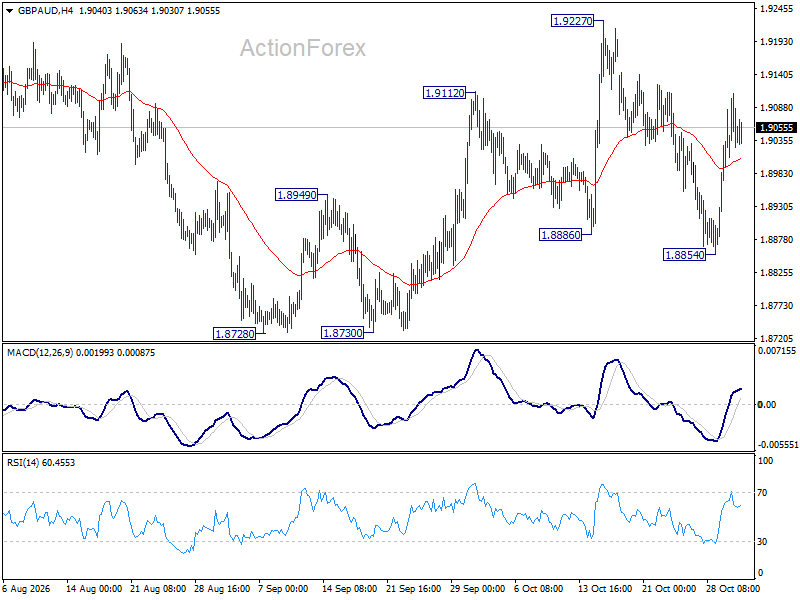
GBP/AUD has been trading within a broad 1.8533–1.9360 range since forming a medium-term bottom in May. Despite several recovery attempts, the cross has struggled to develop sustained upside momentum, while selling pressure has also been insufficient to drive a renewed break below the May low.
With GBP/AUD around 1.9055, the market is positioned near the middle of that consolidation as the two central-bank meetings approach.
The 4-hour chart identifies 1.9227 as the immediate resistance to watch. A break above it could extend the recovery toward 1.9360, particularly if the BoE delivers a more hawkish message than anticipated or the RBA signals that its tightening cycle is nearing completion.
On the downside, a break below 1.8854 could bring 1.8728 into focus. That would be consistent with a hawkish RBA combined with a BoE that challenges the market’s aggressive tightening expectations.
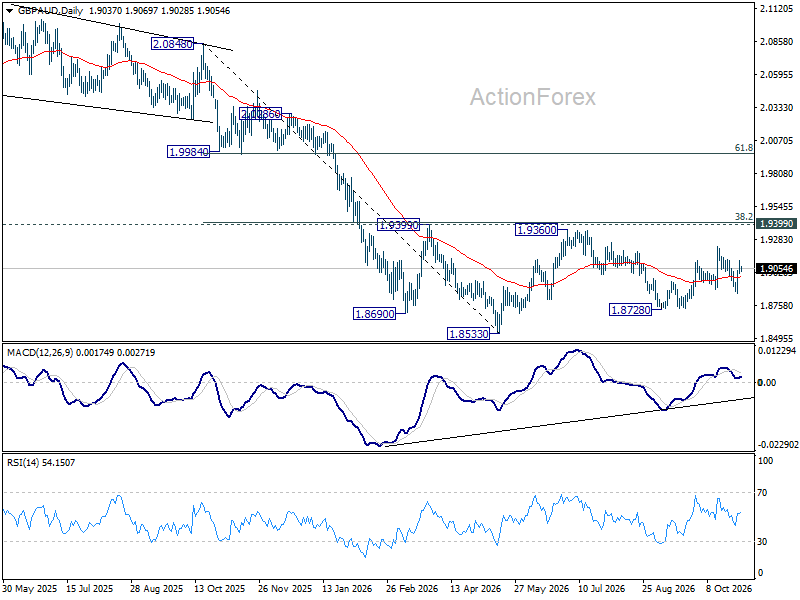
However, breaking either 1.9227 or 1.8854 would not, by itself, establish a decisive breakout from the medium-term trading range. Both levels sit within the broader consolidation that has contained GBP/AUD since May.
The longer-term chart continues to favour a bearish interpretation. GBP/AUD is trading below its falling 55-week EMA, while substantial resistance lies around 1.9399–1.9417. This area includes the 38.2% retracement of the decline from 2.0848 to 1.8533 at 1.9417, creating an important barrier to any sustained recovery.
As long as that resistance zone holds, the broader decline from the 2025 high at 2.1643 remains the dominant technical structure.
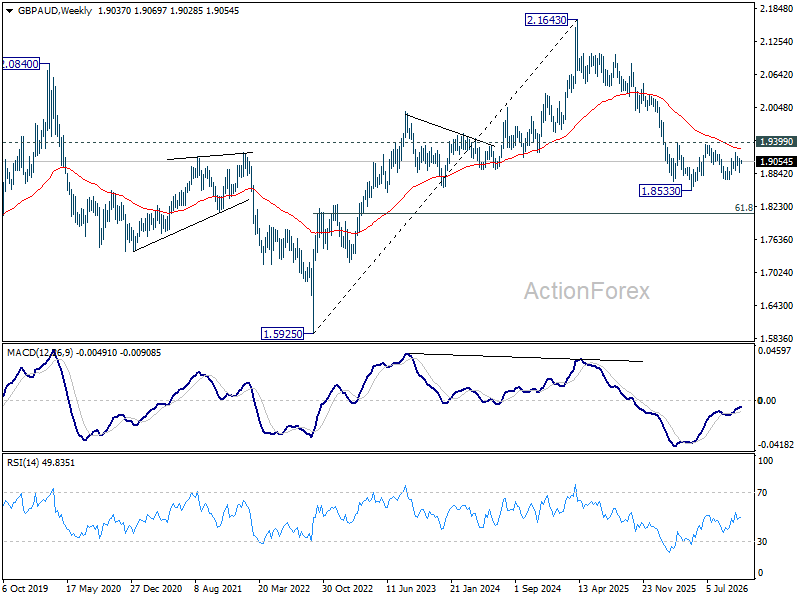
A break below 1.8728 would be the first indication that the medium-term consolidation is giving way to renewed downside pressure, bringing 1.8533 back into view. A decisive break below that May low would provide stronger evidence that the larger downtrend is resuming.
Momentum, however, is not uniformly bearish. Weekly MACD has recovered from deeply negative levels, and weekly RSI is close to 50. The daily and 4-hour indicators also suggest that the immediate downside momentum has eased. These readings are consistent with an extended consolidation rather than a market already committed to another major decline.
The distinction matters because the longer-term bearish structure does not necessarily imply an imminent breakdown.
This week’s RBA and BoE decisions could be sufficient to move GBP/AUD toward either edge of its six-month range, but a sustained breakout would probably require a more consequential change in the expected policy paths beyond November.
The RBA’s inflation forecasts will show whether Australian tightening expectations are too restrained. The BoE’s projections will help determine whether British markets have priced too much.
Until one of those assessments changes meaningfully, GBP/AUD may continue trading between established support and resistance, even as the central-bank decisions generate substantial short-term volatility.
Key Takeaways
- The RBA is priced at 81.2% to hike from 4.60% to 4.85% on Tuesday, and the BoE at 94.4% to hike from 3.75% to 4.00% on Thursday, so the decisions themselves are largely absorbed.
- The RBA’s new inflation forecasts, which previously saw trimmed mean at 2.6% by end-2027, may matter more than its policy statement.
- Markets price Bank Rate near 4.80% by September 2027, roughly 55bps above where more cautious forecasters see it peaking after February.
- Australia’s roughly 85bps policy-rate advantage is expected to narrow to around 64bps by February 2027 and virtually disappear by September 2027.
- GBP/AUD, near 1.9055, needs a break of 1.9227 or 1.8854 to test its 1.8533–1.9360 range edges, while resistance at 1.9399–1.9417 keeps the larger structure bearish.
Stay ahead of the RBA and BoE’s next policy signals and their impact on GBP/AUD—join the ActionForex Telegram channel for regular market updates and analysis.
Behavioural & Retirement Portfolio Resilience
Behavioural Survivability and Retirement Portfolio Resilience Why the lived experience of market recovery matters as mu... Read more
Australia's Rate Rise Bites: Highest In 15 Years
The Reserve Bank of Australia has lifted interest rates to their highest level since 2011, and its governor admits the w... Read more
October Retirement Portfolio Resilience Assessment
Markets stabl Read more
Gyrostat September Retirement Portfolio Resilience Assessment
September Retirement Portfolio Resilience Assessment Markets have fallen. The price of risk has risen. ... Read more
Does The West Have A Problem With Government Bonds
If you have been following the financial pages over the past few weeks, one theme has begun to stand out from the usual ... Read more
August Retirement Portfolio Resilience Assessment
Markets Are Higher. The Price of Risk Is Lower. Retirement invest... Read more