

'Quantum Computer Algorithms Are Linear Algebra, Probabilities. This Is Not Something That We Do A Good Job Of Teaching Our Kids'
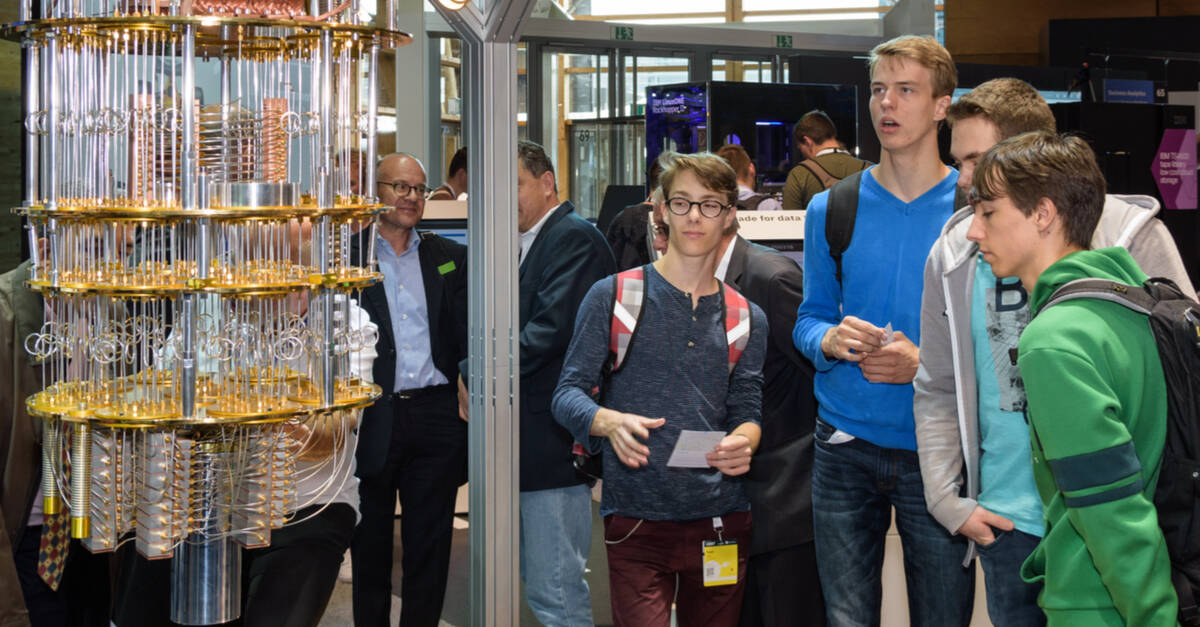
Let's say, for the sake of argument, that quantum computers will exist in some useful fashion in the not too distant future.
And if that is the case, fundamental changes will be needed in education, supply chains, and national policies for us to use the machines to solve complex problems, panelists said a forum hosted by R Street Institute this week.
"We need ... to prepare people to think about computation in a fundamentally different way," said Chris Fall, senior advisor at the Center for Strategic and International Studies, during the discussion.
On conventional computers, information is encoded in strings of 0s and 1s, while in quantum computers, information is encoded in quantum bits that have a value of 0, 1, or a superposition of both states. This allows quantum computers to store much more information than a classic machine and process it in less time, in theory. There are limitations, such as the fact that they are unstable and prone to error despite efforts to address that, and may hit a wall if unprotected from background radiation. Encryption-breaking quantum computers are forever 15 years away.
Sorry, yes, we're assuming they will eventually work.
Google, D-Wave, IBM, Intel, Microsoft, Honeywell, and so on, are building qubits in different ways. Their goal is to build fault-tolerant machines that can run super-fast calculations by tempering qubit behavior and correcting errors introduced from the environment.
"The routine manipulation of the properties of single atoms in people's devices, devices, cars – that is going to change everything. We don't have a full understanding of how that's going to happen." Fall said.
Starting now, education needs to be better for people to take advantage of the quantum processing breakthroughs as the hardware journey matures, the panelists said. Problem solving and algorithms will look very different in areas like finance and science, for example.
"The language of quantum algorithms are linear algebra and probabilities. This is not something that we do a good job of teaching our kids from a very early stage. That is kind of where we need to get started now," Fall said.
Quantum computing is a different problem-solving system and calculates differently from conventional computers, was the gist of the discussion.
- Calculating the big picture: Future HPC efforts will soon see off its von Neumann past
- Big Blue's quantum rainmaker jumps to room-temp diamond quantum accelerator company
- 'Large-scale computing' needs a government team driving it, says UK.gov
- NSA: We 'don't know when or even if' a quantum computer will ever be able to break today's public-key encryption
Governments will need to drive change if quantum computing is a matter of national interest and public need, said Scott Friedman, a senior policy advisor of the House Homeland Security Committee.
Global legislation to protect semiconductor supply chains, like the CHIPS for America Act and Europe's Chips Act, needs to factor in quantum computing infrastructure, panelists said.
Most cryogenic refrigerators for quantum computers are made in Europe, and the United States needs to work with allies to secure those supply chains, said Allison Schwartz, global government relations and public affairs leader at quantum computer maker D-Wave Systems.
The government also needs to facilitate collaboration and bridge a gap between educators, developers, and scientists involved in algorithms and developing hardware, the panelists said.
The US introduced legislation called QUEST (Quantum User Expansion for Science and Technology) for increased access of quantum hardware and resources for research and further education. A National Quantum Initiative Act (NQI) was signed into law in 2018 to supercharge quantum computing development and research, but activity around these have stalled.
"The advisory committee for the NQI hasn't met in a while ... on the executive branch side. An easy next step to bring more focus in this area would be to convene that again and get broader input from the community," said Kate Weber, policy lead for quantum, robotics, and fundamental research at Google, which hopes to a build a fault-tolerant computer by 2030.
The moderator, R Street Institute senior fellow Miles Taylor, raised the idea of quantum computers creating sentient beings, much like the machines in the Terminator movies.
"I don't know if we're going to have a sentient computer," CSIS's Fall said, adding, "we're learning to manipulate single atoms at ... industrial scale. That's not a laboratory project. It'll change the world." ®
Why Low Volatility Is Not The Same As Low Risk
Why Low Volatility is Not The Same As Low Risk Some of the worst-performing portfolios in... Read more
Gyrostat May Market Outlook: When The Cost Of Protection Falls - Signals For Portfolio Positioning
This monthly Gyrostat Risk-Managed Market Outlook does not attempt to forecast market direction. It... Read more
The Risk Most Portfolios Do Not Explicitly Manage
Most portfolios are constructed on a simple and widely accepted assumption: that equity risk will be r... Read more
Gyrostat April Outlook: The Changing Cost Of Protection
Signals For Portfolio Construction This monthly Gyrostat Risk-Managed Market Outlook does not attemp... Read more
What Advisers Misunderstand About Protection
Protection is rarely rejected outright. More often, it is misunderstood. Most advisers recognise th... Read more
Gyrostat Market Outlook: Looking Beyond The 30-day Volatility Headlines
This outlook examines how financial markets are pricing risk rather than attempting to forecast market... Read more