

Oil Nears $120 Point Of No Return As Trump Deadline Looms And Hormuz “Toll Booth” Battle Decides Outcome

Oil is nearing a $120 breaking point as US President Donald Trump’s Iran deadline looms, with markets increasingly focused on whether the US–Iran battle for Hormuz control will tip into full escalation. The urgency is rising as the “Power Plant Day” deadline approaches, with no clear resolution in sight. Markets are no longer reacting to headlines but positioning for an outcome, as the Hormuz “toll booth” battle increasingly defines the conflict. With WTI already above $116 and Brent pushing toward $115, crude is approaching the 120 escalation threshold, a level that would signal a shift from pricing risk to pricing a “generational energy crisis”.
Despite ongoing diplomatic noises, including a 45-day ceasefire proposal from intermediaries, there is little sign of meaningful progress. Both the US and Iran have rejected compromise terms, reinforcing a deadlock that is increasingly driven by strategic objectives rather than short-term de-escalation. At the core of this conflict is no longer just military action, but the ownership of Hormuz. Control of the Strait has become the defining issue.
Iran’s 10-point proposal highlights this clearly. Its demand for a “safe passage protocol,” combined with a roughly $2 million fee per tanker, effectively seeks to establish a global energy “toll booth.” This is about more than security—it is an attempt to secure long-term leverage and a sanctions-proof revenue stream.
The US position is equally firm. Washington is demanding unconditional reopening of the Strait, while Trump’s suggestion of US-imposed tolls signals a competing claim to control. Both sides are now contesting not just access, but ownership and monetization.
This dynamic has created a clear “zero-sum game”. Iran cannot reopen without losing leverage, while the US cannot accept Iranian control without conceding strategic ground. The result is a standoff with little room for compromise.
For markets, oil is the ultimate trigger. A decisive break above 120 would signal that disruption—not containment—is being priced. The distinction now hinges on “short war vs long siege”. If strikes lead to rapid capitulation, oil could reverse sharply lower. But if retaliation targets regional energy infrastructure, the conflict risks evolving into a prolonged disruption. That is where “generational energy risk” emerges. A sustained disruption to Hormuz flows would not just lift prices—it would reshape inflation, supply chains, and policy expectations globally.
Market pricing is already hinting at this possibility. The unusual WTI premium over Brent, reflects the rise of a safe barrel trade, where US crude is viewed as the most secure supply in a fragile global system.
In the currency markets, Dollar is currently the strongest one for the day so far, followed by Loonie, and then Euro. Kiwi is worst, followed by Swiss Franc, and then Aussie. Yen and Sterling are positioning in the middle.
In Asia, at the time of writing, Nikkei is down -0.03%. Hong Kong is on holiday. China Shanghai SSE is up 0.03%. Singapore Strait Times is down -0.34%. Japan 10-year JGB Yield is down -0.021 at 2.411. Overnight, DOW rose 0.36%. S&P 500 rose 0.44%. NASDAQ rose 0.54%. 10-year yield rose 0.022 to 4.335.
Inflation “Going Toward Red,” Fed Officials Warn as Stagflation Risks Rise
Fed ‘s Goolsbee and Hammack are turning more concerned as inflation shifts from “orange” toward “red,” driven by oil shocks and persistent tariff pressures. With price risks rising and the labor market still stable, the outlook points to growing stagflation risks and a longer path before any rate cuts. Read More.
EUR/USD Daily Outlook
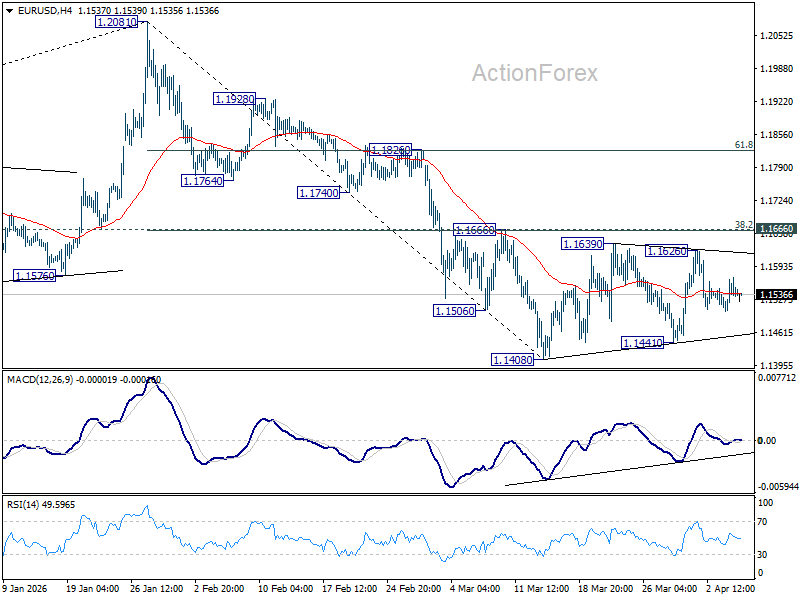
Daily Pivots: (S1) 1.1508; (P) 1.1540; (R1) 1.1575; More….
EUR/USD dips mildly today, but stays well inside established range above 1.1408. Intraday bias remains neutral and more consolidations could be seen. With 1.1666 cluster resistance (38.2% retracement of 1.2081 to 1.1408 at 1.1665) intact, further decline is expected. On the downside, firm break of 1.1408 will resume the fall from 1.2081 to 38.2% retracement of 1.0176 to 1.2081 at 1.1353. However, decisive break of 1.1666 will argue that the fall from 1.2081 has completed, and turn bias back to the upside for 61.8% retracement of 1.2081 to 1.1408 at 1.1824.
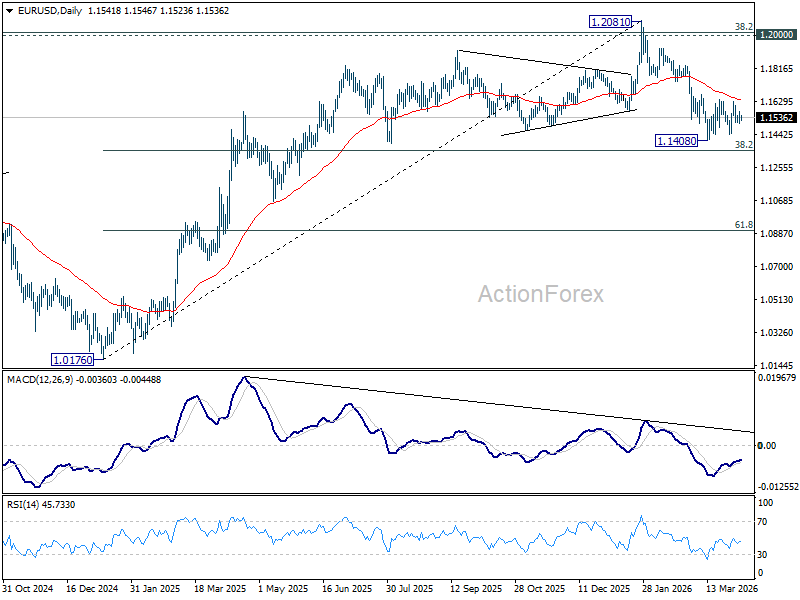
In the bigger picture, prior break of 55 W EMA (now at 1.5011) should confirm rejection by 1.2 key cluster resistance level. The whole up trend from 0.9534 (2022 low) might have completed as a three wave corrective rise too. Deeper fall is expected to long term channel support (now at 1.0535). Meanwhile, risk will stay on the downside as long as 1.2081 holds, even in case of strong rebound.
Gyrostat September Retirement Portfolio Resilience Assessment
September Retirement Portfolio Resilience Assessment Markets have fallen. The price of risk has risen. ... Read more
Does The West Have A Problem With Government Bonds
If you have been following the financial pages over the past few weeks, one theme has begun to stand out from the usual ... Read more
August Retirement Portfolio Resilience Assessment
Markets Are Higher. The Price of Risk Is Lower. Retirement invest... Read more
When The Wave Turns
Why Retirement Investing Is Moving Towards Resilience Jeremy Grantham’s latest market warnings have revived an old tru... Read more
Gyrostat Capital Management: July Retirement Portfolio Resilience Assessment
The Market Is Currently Presenting an Opportunity to Strengthen Retirement Portfolio Resilienc... Read more
The Invisible Risk That Decides Your Retirement
Why how investors behave matters more than what markets do and what disciplined port... Read more