

Markets Cautious As Hormuz Escort Plan Runs Into Resistance

Markets stayed cautious today as hopes for a multinational naval coalition to escort tankers through the Strait of Hormuz ran into early resistance from key governments. While the proposal briefly raised expectations that the disruption to Middle East energy flows might be contained, several countries have so far stopped short of committing naval assets, leaving traders waiting for clearer signals before taking large positions.
Oil prices remain elevated as a result. With the lack of progress on securing shipping routes, energy markets continue to price in the risk that crude flows through the Strait could face sustained disruption. At the same time, prices have not exploded higher because investors still believe some form of protection for tanker traffic could eventually emerge.
That balance between risk and hope has produced a relatively calm tone across broader markets. Currency trading has been subdued, with most major pairs holding within Friday’s ranges. Investors appear reluctant to commit ahead of both geopolitical developments and a packed week of central bank meetings.
The proposed escort mission first gained traction after US President Donald Trump publicly urged several nations to contribute naval forces to protect commercial shipping. Countries mentioned included Japan, South Korea, Britain, France and China. The idea was that a coordinated patrol effort could shift the situation from fears of a complete supply cutoff toward a scenario of “managed disruption.”
However, the diplomatic response has been cautious at best. Australia directly rejected participation, with Transport Minister Catherine King stating that Canberra would not be sending a naval vessel and that the country had not been asked to contribute in that capacity.
European responses have been similarly restrained. British Prime Minister Keir Starmer has adopted a “wait and see” approach while coordinating discussions with Canadian Prime Minister Mark Carney, and Germany’s foreign minister Johann Wadephul openly expressed skepticism about the proposal, saying Berlin does not intend to become an active participant in the conflict.
France has taken a more conditional stance, noting that it has previously examined the possibility of an international mission to escort vessels through the strait but stressing that such an operation would only be considered when circumstances permit and once the intensity of fighting subsides.
In Asia, Japanese Prime Minister Sanae Takaichi also indicated that Tokyo has made no decision on dispatching escort vessels. She told the Upper House that Japan is still studying what actions might be possible within the country’s legal framework and what could be done independently.
Equity markets in the region showed mixed reactions. Hong Kong’s Hang Seng Index managed to edge higher, supported by stronger-than-expected Chinese economic data showing improved industrial production, retail sales and investment. Still, gains remained limited amid continued uncertainty about the global outlook.
China’s property sector remains the elephant in the room. The ongoing real estate slump continues to weigh on investor confidence, and the country also faces a unique vulnerability to any Hormuz disruption as roughly half of its seaborne crude imports originate from the region. Even if Chinese vessels receive assurances of safe passage, higher global shipping costs could still squeeze manufacturing margins.
In currency markets, the Japanese Yen strengthened slightly following renewed intervention warnings from Tokyo. Finance Minister Satsuki Katayama told Parliament the government is maintaining “maximum vigilance” and stands ready to take “decisive steps” against excessive volatility. The 160 level in USD/JPY is now seen by some as the “red line” that could trigger official action.
Elsewhere, currencies remain largely range-bound as traders look ahead to one of the busiest weeks of monetary policy decisions this year. Meetings from the RBA, BoC, Fed, BoJ, BoE, SNB and ECB are scheduled, keeping investors cautious as they wait for both geopolitical and policy clarity.
In Asia, Nikkei fell -0.09%. Hong Kong HSI is up 1.44%. China Shanghai SSE is down -0.37%. Singapore Strait Times is up 0.26%. Japan 10-year JGB yield rose 0.029 to 2.274.
Gold breaks 5,000 as “Safe Haven Paradox” returns, 4,815 now key
Gold came under pressure earlier in the day, slipping below the 5,000 psychological level in what could be described as a “safe haven paradox,” where Dollar strength is overpowering traditional war-driven demand for bullion. Technically, the break of key support suggests downside risk toward 4,815.
China industrial production, retail sales, investment beat expectations in Jan–Feb
China’s economic activity showed a stronger-than-expected start to 2026, with industrial production, retail sales and fixed-asset investment all beating forecasts. However, the property sector remains a key drag on the broader recovery.
New Zealand BNZ services falls back Into contraction, weak demand hits
New Zealand’s services sector slipped back into contraction in February, with the BusinessNZ Performance of Services Index dropping to 48.0. Weak demand, high living costs and elevated interest rates continue to weigh on activity.
Seven central banks, one energy shock: Critical monetary policy week
The coming week marks one of the most consequential policy periods of 2026, with seven major central banks—including the Fed, RBA, BoJ, BoE and ECB—meeting within days of each other. The decisions come as surging oil prices from Middle East tensions reshape the global inflation outlook, forcing markets to reassess expectations for rate cuts and the broader direction of monetary policy.
EUR/JPY Daily Outlook
Daily Pivots: (S1) 181.85; (P) 182.75; (R1) 183.26; More…
Immediate focus is now on 182.00 support in EUR/JPY with today’s decline. Firm break there will resume the fall from 184.75 to retest 180.78 low. Decisive break there will indicate that fall from 186.86 is already correcting whole up rise from 154.77, and solidify the near term bearish outlook. On the upside, above 184.75 will resume the rebound from 180.78 to retest 186.86 high.
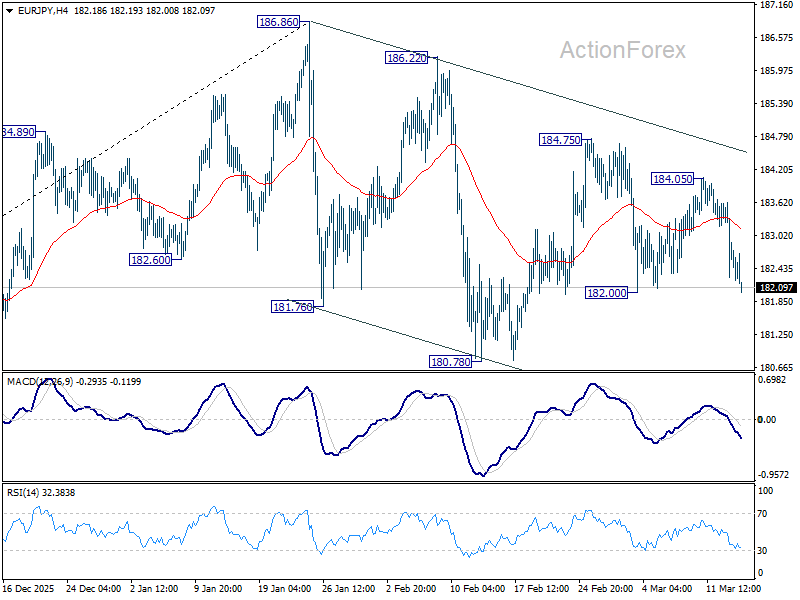
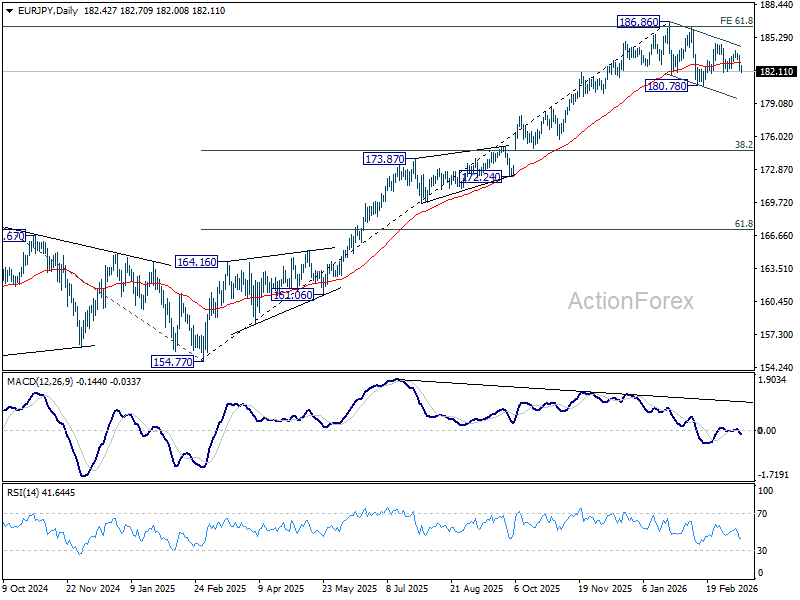
In the bigger picture, a medium term top could be in place at 186.86 and some more consolidations would be seen. Nevertheless, as long as 55 W EMA (now at 175.29) holds, the larger up trend from 114.42 (2020 low) remains intact. Firm break of 186.86 will pave the way to 78.6% projection of 124.37 (2022 low) to 175.41 (2025 high) from 154.77 at 194.88 next.
Gyrostat September Retirement Portfolio Resilience Assessment
September Retirement Portfolio Resilience Assessment Markets have fallen. The price of risk has risen. ... Read more
Does The West Have A Problem With Government Bonds
If you have been following the financial pages over the past few weeks, one theme has begun to stand out from the usual ... Read more
August Retirement Portfolio Resilience Assessment
Markets Are Higher. The Price of Risk Is Lower. Retirement invest... Read more
When The Wave Turns
Why Retirement Investing Is Moving Towards Resilience Jeremy Grantham’s latest market warnings have revived an old tru... Read more
Gyrostat Capital Management: July Retirement Portfolio Resilience Assessment
The Market Is Currently Presenting an Opportunity to Strengthen Retirement Portfolio Resilienc... Read more
The Invisible Risk That Decides Your Retirement
Why how investors behave matters more than what markets do and what disciplined port... Read more