

Loonie Sinks As WTI Oil Nears $60, OPEC+ Hike Looms

Canadian Dollar remains the weakest major currency this week, pressured by a combination of falling oil prices and dovish stance of the BoC. Canada’s key export driver slumped to a four-month low with WTI crude threatening to break below 60 handle. That decline comes just as the BoC’s own communications reinforced expectations of more easing ahead.
The oil market itself is under heavy pressure from expectations of a large OPEC+ output hike. Reports suggest the group could raise production by as much as 500,000 barrels per day in November—triple the October increase—in a bid to reclaim lost market share. Such a move would come at a time when analysts already warn the market may be tipping into sizeable surplus through Q4 and into 2026.
For the BoC, September summary of deliberations confirmed concerns that the economy is losing momentum. Policymakers noted further softening in the labor market and more convincing signs that core inflation pressures are easing. In addition, the removal of most retaliatory tariffs has reduced the risk of renewed cost-push inflation. Against that backdrop, the decision to cut rates to 2.50% was straightforward, and officials left the door open to additional easing.
Still, not all forecasts are bearish for the Canadian Dollar. A recent Reuters poll of 38 FX analysts showed a median projection for the Loonie to strengthen around 2.8% to 1.36 per U.S. Dollar by the end of 2025. That view rests on the assumption that the Fed will embark on a more aggressive easing path in 2026, while the BoC, having moved earlier, may conclude the cycle sooner.
Canada’s growth backdrop remains fragile but not disastrous. GDP contracted at an annualized pace of -1.6% in Q2, but subsequent monthly data suggest the economy may have avoided slipping into a technical recession.
So far this week, Loonie is at the bottom of the FX performance table, followed by Dollar and Swiss Franc. Yen continues to lead despite today’s mild retreat, with Kiwi and Aussie also among the outperformers. Euro and Sterling remain stuck in the middle of the pack.
In Europe, at the time of writing, FTSE is up 0.54%. DAX is down -0.17%. CAC is down -0.10%. UK 10-year yield is down -0.026 at 4.688. Germany 10-year yield is down -0.008 at 2.696. Earlier in Asia, Nikkei rose 1.85%. Hong Kong HSI fell -0.54%. China was on holiday. Singapore Strait Times rose 0.38%. Japan 10-year JGB yield fell -0.002 to 1.665.
Eurozone PPI down -0.3% mom, -0.6% yoy, energy drag while regional divergence widens
Eurozone producer prices fell by -0.3% mom and -0.6% yoy in August, weaker than expectations of flat monthly growth and a smaller -0.4% yoy decline. The drop underscores the continued disinflationary forces in the pipeline, particularly as energy prices remain soft.
Breaking down the Eurozone data, prices fell -1.3% mom for energy and -0.1% for both intermediate and durable consumer goods. In contrast, modest increases were seen in capital goods (+0.1%) and non-durable consumer goods (+0.1%).
Across the EU as a whole, PPI slipped -0.4% mom and -0.4% yoy. At the country level, the steepest monthly declines were recorded in Denmark (-1.3%), the Netherlands and Romania (both -1.0%), and Austria (-0.8%). Meanwhile, Estonia (+5.4%), Finland (+1.9%) and Slovakia (+1.3%) bucked the trend with notable gains.
Eurozone PMI signals 0.4% Q3 GDP growth, backs ECB hold
Eurozone services activity strengthened in September, with PMI Services finalized at 51.3, up from 50.5 in August and marking an eight-month high. Composite PMI also edged higher to 51.2, the best in 16 months.
Country breakdowns in Composite highlighted broad-based improvement. Spain led with a 53.8 reading, while Germany and Ireland both came in at 52.0, representing multi-month highs. Italy held at 51.7, while France lagged with a decline to 48.1, its weakest in five months.
Cyrus de la Rubia, Chief Economist at Hamburg Commercial Bank, noted that business activity “picked up more strongly” in September, and that the rebound was “broad-based geographically.” The uptick in new business suggests expansion could continue into October, though backlogs have yet to recover.
Crucially, price pressures eased but remained slightly above average. De la Rubia said the data support policymakers who resist further cuts, as inflation in services is still sticky. With the composite PMI holding in expansionary territory throughout Q3, HCOB’s nowcast points to quarterly GDP growth of around 0.4%.
UK PMI suggests summer bounce a flash in the pan, supports BoE dovish shift
UK business activity slowed sharply in September, with the final Services PMI dropping to 50.8 from August’s 16-month high of 54.2, marking a five-month low. The Composite PMI mirrored the downturn, slipping to 50.1 from 53.5, also a five-month trough.
Tim Moore, Economics Director at S&P Global Market Intelligence, said service providers saw a “disappointing end” to Q3 as weak consumer confidence, postponed investment decisions, and falling exports weighed on demand. He warned that the summer’s output surge now looks like a “flash in the pan,” with political and economic uncertainty again restraining the sector. Export orders were particularly weak, as European demand remained subdued.
The report also flagged another month of job losses, extending a year-long trend, alongside weaker business confidence and softer cost pressures. These signs of slackening labor conditions and easing inflation are likely to reinforce the “more dovish shift” in the BoE’s policy debate, with calls growing for further rate cuts into 2025.
BoJ’s Ueda reiterates further hikes if baseline holds, flags three uncertainties
BoJ Governor Kazuo Ueda said in a speech today that Japan’s real interest rates remain “significantly low,” and if the Bank’s baseline scenario holds, policy rates will continue to rise. He highlighted that rising labor shortages and firmer medium- to long-term inflation expectations should eventually push underlying CPI toward 2% in the second half of the Bank’s forecast horizon.
Ueda acknowledged, however, that uncertainties remain significant. Chief among them are US economic developments, tariff impact on Japan, and food price inflation.
He warned that tariffs could hurt US firms’ profits and in turn slow employment and income growth — risks that may already be showing in weaker US job data. If firms pass on costs instead, higher consumer prices could sap private demand.
At home, the Tankan survey suggested resilience in services, where the tariff impact is limited, but profit projections for export-heavy industries such as autos showed steep declines.
Food prices are another area of concern. While much of the recent rise has been driven by temporary factors, Ueda cautioned that wage and distribution cost pass-through is increasingly evident. That raises the possibility of more persistent inflation in food.
Japan unemployment rate rises to 2.6%, highest in over a year
Japan’s unemployment rate rose more than expected in August, climbing to 2.6% from 2.3% a month earlier. That marked the highest reading since July 2024 and exceeded expectations of 2.4%.
Number of unemployed increased by 150k to 1.79 million, a 13-month high, while employment fell by -210k to 68.10 million. The labor force edged down by -40k to 69.89 million, though the participation rate improved to 64.0% from 63.9%. Still, the data underscored growing strain in the labor market as job creation weakens and unemployment rises.
Complementary data from the labor ministry showed the job-to-applicant ratio slipping to 1.20 from 1.22, its lowest since January 2022. The decline points to waning demand for labor.
USD/CAD Mid-Day Outlook
Daily Pivots: (S1) 1.3938; (P) 1.3962; (R1) 1.3991; More…
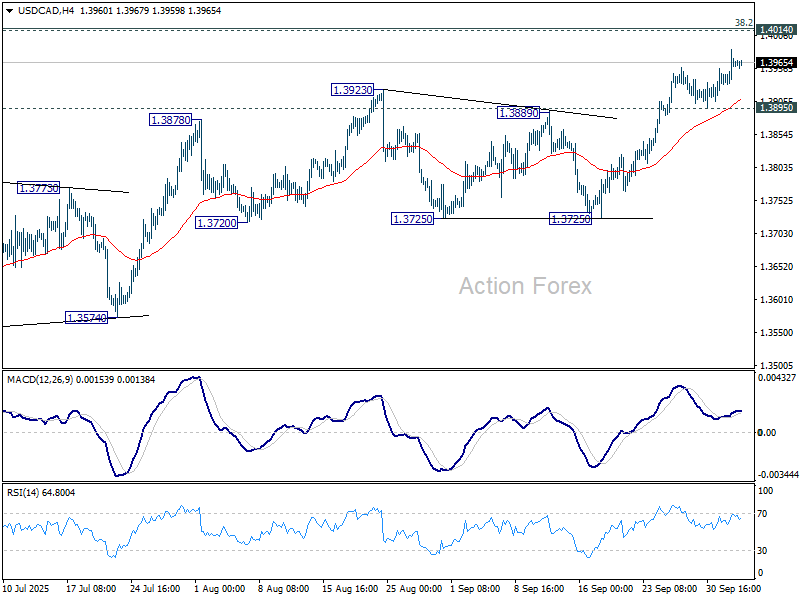
Intraday bias in USD/CAD remains on the upside and further rise could be seen. But strong resistance is expected from 1.4014 cluster to complete the corrective rebound from 1.3538. On the downside, break of 1.3895 support will turn bias back to the downside for 1.3725. However, sustained break of 1.4014 will carry larger bullish implications.
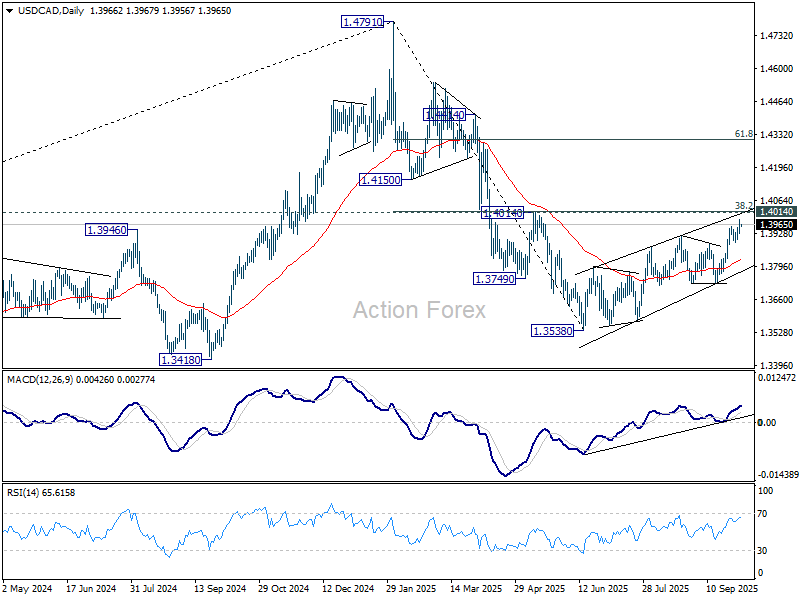
In the bigger picture, price actions from 1.4791 medium term top could either be a correction to rise from 1.2005 (2021 low), or trend reversal. In either case, further decline is expected as long as 1.4014 cluster resistance (38.2% retracement of 1.4791 to 1.3538 at 1.4017) holds. Next target is 61.8% retracement of 1.2005 (2021 low) to 1.4791 (2025 high) at 1.3069. However, sustained break of 1.4014 will argue that fall from 1.4791 has completed, and bring stronger rally to 61.8% retracement at 1.4312.
Gyrostat September Retirement Portfolio Resilience Assessment
September Retirement Portfolio Resilience Assessment Markets have fallen. The price of risk has risen. ... Read more
Does The West Have A Problem With Government Bonds
If you have been following the financial pages over the past few weeks, one theme has begun to stand out from the usual ... Read more
August Retirement Portfolio Resilience Assessment
Markets Are Higher. The Price of Risk Is Lower. Retirement invest... Read more
When The Wave Turns
Why Retirement Investing Is Moving Towards Resilience Jeremy Grantham’s latest market warnings have revived an old tru... Read more
Gyrostat Capital Management: July Retirement Portfolio Resilience Assessment
The Market Is Currently Presenting an Opportunity to Strengthen Retirement Portfolio Resilienc... Read more
The Invisible Risk That Decides Your Retirement
Why how investors behave matters more than what markets do and what disciplined port... Read more