

Japans Data Is Strengthening As Australias Weakens. Why Is AUD/JPY Rising?

TL;DR: Japan’s data is strengthening and Australia’s is weakening, yet AUD/JPY keeps rising — because the cross is trading on the global yield backdrop and carry differential, not on either country’s local fundamentals.
Domestic Data Point Clearly Lower for AUD/JPY
AUD/JPY has rebounded strongly even though this week’s data from both sides of the cross argue for the opposite move. Japan delivered firmer inflation and stronger business activity. Australia produced a weak jobs report and softer PMIs. On domestic fundamentals alone, that combination should favor the Yen over the Aussie.
Japan’s July core CPI rose from 1.6% to 1.8% y/y, while core-core CPI accelerated from 1.7% to 1.9% — a broadening that ActionForex covered in detail here, noting firmer services inflation and renewed energy pressure ahead of the BoJ’s September meeting. August PMIs strengthened as well: PMI Manufacturing rose from 54.5 to 55.1, while PMI Services climbed from 51.2 to 52.3 — part of a broader acceleration where overseas demand posted its strongest growth in more than eight-and-a-half years, led by semiconductor and AI-related industries. Those readings reinforce expectations the BoJ could raise rates again at its September meeting.
Australia moved in the opposite direction. Employment fell -15.8K in July, against expectations for an increase, while unemployment rose from 4.4% to 4.5%. August PMI Composite Output then eased from 53.2 to 52.5, while PMI Services Business Activity fell from 53.6 to 52.9. PMI Manufacturing Output slipped from 50.3 to 49.7, moving back into contraction, even as manufacturing orders improved and cost pressures accelerated.
Global Yields Are Overriding Local Fundamentals
That AUD/JPY is rising anyway is the more important signal. The cross is currently trading less on Australian and Japanese data than on the global yield backdrop.
The Yen briefly benefited after the US Treasury’s August 19 buyback announcement drove long-dated US yields sharply lower. That compressed yield differentials globally and temporarily reduced pressure on low-yield funding currencies. But the move didn’t last — US yields rebounded quickly on Thursday, with the 10-year Treasury yield returning toward 4.70% and the 30-year yield moving back above 5.20%. Other major sovereign yields also rose. As carry conditions improved again, the Yen returned to underperformance.
That mechanism matters more for AUD/JPY than the latest local data. When global yields rise, the opportunity cost of holding a low-yielding currency such as the Yen increases. Carry demand then tends to favor currencies offering substantially higher policy rates, including the Aussie.
BoJ Hike Bets Are Rising, But the Carry Gap Is Still Wide
Japan’s stronger CPI and PMI data still matter because they reinforce September BoJ hike expectations. But even another 25bp increase wouldn’t transform the relative-rate picture.
The RBA cash rate stands at 4.35%, compared with the BoJ policy rate at 1.00% — a gap of roughly 335bp. A BoJ hike to 1.25% would narrow it to around 310bp, still a substantial spread.
That helps explain why the Yen can weaken even as BoJ normalization expectations strengthen. Markets may be becoming more confident that Japan will hike, but the expected adjustment is still small relative to the existing carry advantage. Australia’s softer data could eventually narrow that gap from the other side if markets become convinced the RBA’s tightening bias won’t survive. But this week’s releases haven’t been enough to overpower the global yield move.
ActionForex’s Technical View on AUD/JPY
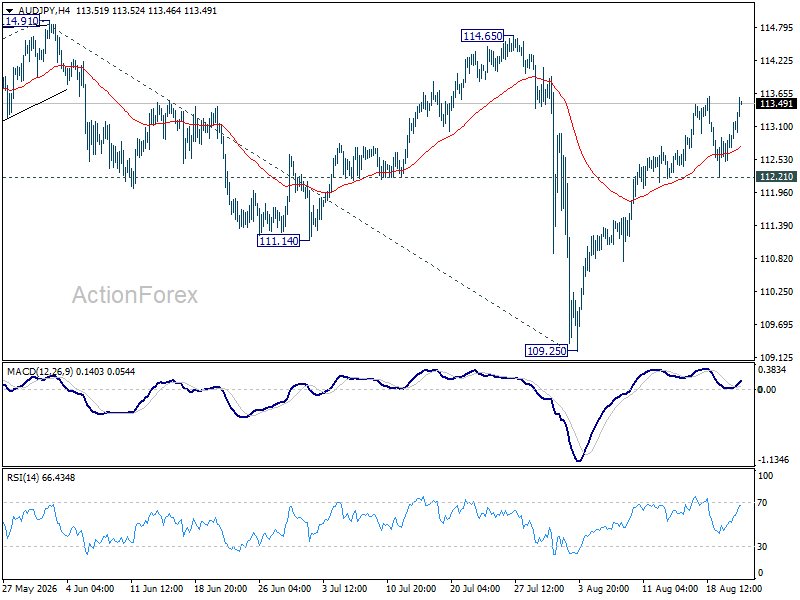
Technically, the current rebound supports the view that the correction from 114.91 completed with three waves down to 109.25. That decline held above 108.77, the bottom of wave four of a lesser degree. Support from the 55-day EMA also strengthens the bullish interpretation.
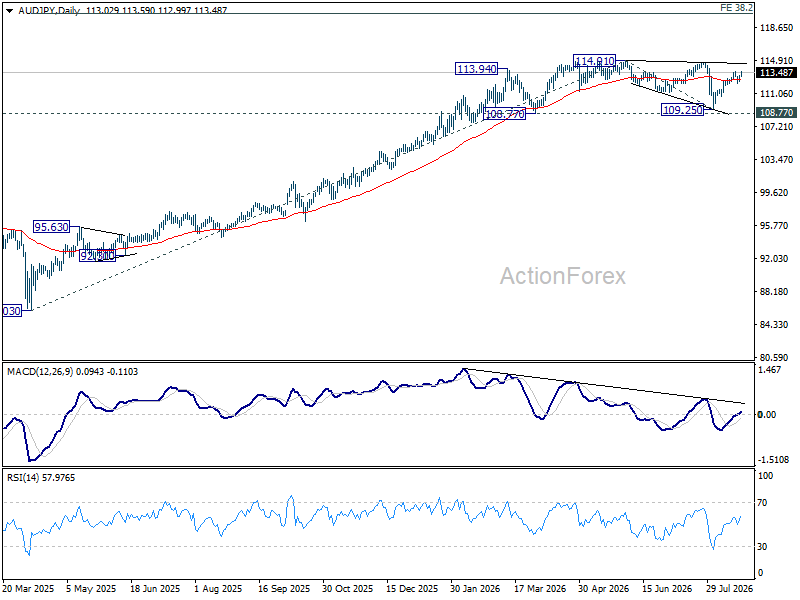
The near-term outlook stays bullish while 112.21 support holds. The next target is the 114.65–114.91 resistance zone.
A decisive break of 114.91 would be much more important. It would confirm resumption of the larger uptrend from 86.03, the 2025 low. The next upside target would then be the 38.2% projection of 86.03 to 114.91 from 109.25, at 120.28, putting the psychological 120 level directly into focus.
A move below 112.21 would delay the bullish case and suggest the correction from 114.91 is still unfolding, with another near-term decline possible before the broader uptrend resumes.
AUD/JPY Is Sending a Global, Not Domestic, Signal
The key takeaway isn’t that Australian fundamentals suddenly improved or that Japanese data failed to matter. It’s that both local stories are being overwhelmed by a larger market force. Japan is getting stronger. Australia is getting softer. Yet AUD/JPY is rising because global yields have reasserted the carry advantage over the Yen.
That makes the next move in US and global bond yields more important for this cross than another small change in local data. As long as carry pressure stays elevated and 112.21 holds, AUD/JPY can keep pressing toward 114.91 despite a domestic macro backdrop that, on paper, argues for the opposite.
Key Takeaways
- Japan’s core-core CPI accelerated to 1.9% and PMIs strengthened broadly, while Australia’s jobs report contracted and PMIs softened — a combination that should favor Yen, not Aussie.
- AUD/JPY’s rise despite this divergence signals the cross is trading on global yields and carry conditions, not local fundamentals, right now.
- The RBA-BoJ rate gap stands at roughly 335bp; even a September BoJ hike to 1.25% would only narrow it to around 310bp, preserving a substantial carry advantage for AUD.
- US yields briefly fell on the Treasury buyback announcement but rebounded quickly, restoring carry pressure on the Yen within days.
- AUD/JPY holds a bullish bias above 112.21 support, targeting 114.65-114.91; a break above 114.91 would open a path toward 120.28.
Gyrostat September Retirement Portfolio Resilience Assessment
September Retirement Portfolio Resilience Assessment Markets have fallen. The price of risk has risen. ... Read more
Does The West Have A Problem With Government Bonds
If you have been following the financial pages over the past few weeks, one theme has begun to stand out from the usual ... Read more
August Retirement Portfolio Resilience Assessment
Markets Are Higher. The Price of Risk Is Lower. Retirement invest... Read more
When The Wave Turns
Why Retirement Investing Is Moving Towards Resilience Jeremy Grantham’s latest market warnings have revived an old tru... Read more
Gyrostat Capital Management: July Retirement Portfolio Resilience Assessment
The Market Is Currently Presenting an Opportunity to Strengthen Retirement Portfolio Resilienc... Read more
The Invisible Risk That Decides Your Retirement
Why how investors behave matters more than what markets do and what disciplined port... Read more