

Is Brent Oils Gap Lower A Bull Trap In Disguise?

TL;DR: Brent crude gapped sharply lower to $85.50 as US and Iran refrained from further strikes over the weekend, but shipping data from the Strait of Hormuz and Bab el-Mandeb shows the physical supply crisis is far from resolved — raising the risk that this selloff is a bull trap rather than a genuine reversal.
Why This Matters
Brent crude opened the week with one of its sharpest downside gaps in recent months, plunging to as low as $85.50 from Friday’s close at $98.69 after the United States and Iran refrained from launching fresh attacks over the weekend. The absence of further military escalation prompted traders to rapidly unwind part of the geopolitical risk premium that had driven prices above $100 last week. Yet the sharp selloff appears to reflect improving sentiment more than improving fundamentals, as there has been little evidence that physical oil flows are returning to normal.
What has actually changed is limited. US airstrikes stopped on Friday and Saturday, with Sunday marking the second consecutive day without military action, while Iran said it had responded in kind. According to US Ambassador to the United Nations Mike Waltz, President Donald Trump decided to pause further strikes to allow more time for diplomacy. However, this pause falls well short of the June 17 interim agreement, which was formalized through a signed memorandum of understanding. Neither Washington nor Tehran has announced a ceasefire or any binding commitment to de-escalation. Instead, the current arrangement appears to be a fragile, conditional pause, with Iran continuing to describe its approach as “attack for attack” rather than a permanent shift toward negotiations.
What Shipping Data Actually Shows
The disconnect between market optimism and physical supply conditions is even more apparent in shipping data. Fewer than ten commodity vessels transited the Strait of Hormuz daily over the weekend, according to Kpler, compared with a pre-conflict average of more than one hundred crossings a day.
- Hormuz: Vessel traffic remains below 10 crossings per day, versus a pre-conflict average above 100.
- Bab el-Mandeb: Traffic fell to just eleven vessels on Sunday after Houthi forces expanded their campaign to strike Saudi Aramco’s onshore facilities at Jizan and Yanbu — a significant escalation beyond previous tanker attacks.
In other words, one critical chokepoint has yet to recover while another has deteriorated further, suggesting disruption is spreading beyond maritime transport to oil infrastructure itself.
Bull Trap or Genuine Reversal?
That divergence raises the possibility that Monday’s sharp decline proves to be a bull trap rather than the beginning of a sustained reversal. Financial markets can remove geopolitical risk premium within hours, but restoring confidence in global shipping networks typically takes much longer. Unless vessel traffic through Hormuz begins recovering meaningfully and conditions stabilize in the Red Sea, physical supply constraints will continue to limit how much geopolitical premium can realistically be removed. A quick recovery above the $90 mark would suggest Monday’s gap primarily flushed speculative long positions rather than signaling that the underlying supply shock has ended.
ActionForex’s Technical View on Brent Crude
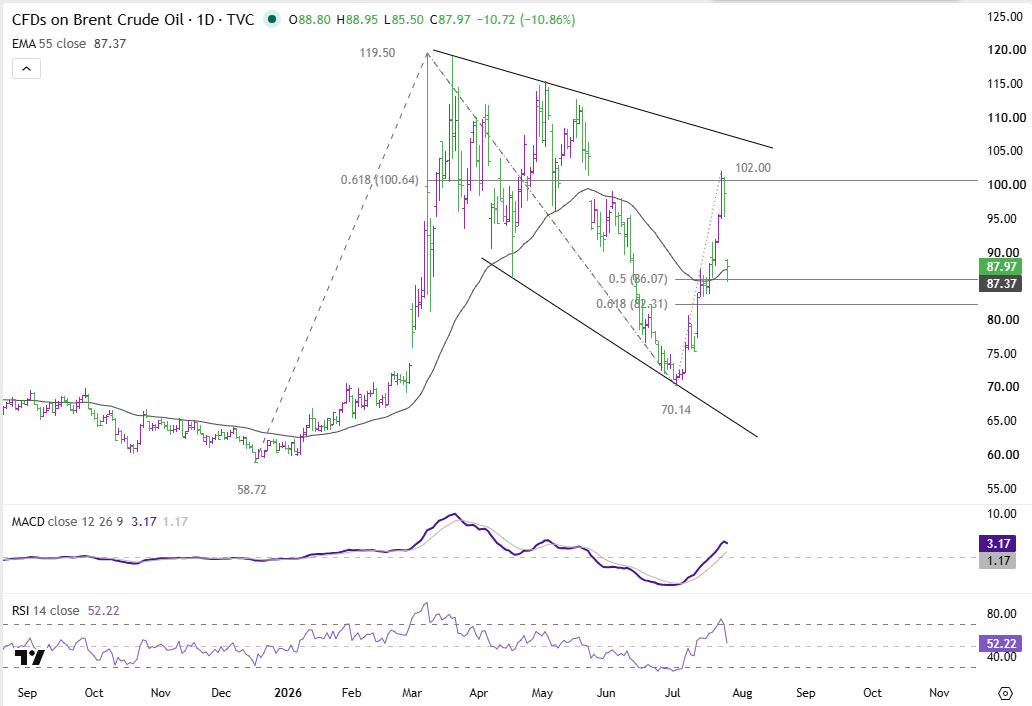
Technically, Brent was firmly rejected by the 61.8% retracement of the 119.50-70.14 decline at 100.64, triggering a steep pullback from last week’s high near 102. Even so, the broader bullish interpretation has not been invalidated. The advance from 70.14 is still viewed as the first impulsive wave of a larger long-term uptrend, while the current decline has retraced into the fourth-wave territory of a lesser degree between 83.71 and 87.55, a common corrective zone in Elliott Wave analysis. Selling pressure also paused just ahead of the 50% retracement of 70.14 to 102.00 at 86.07, with the 55 D EMA at 87.37 providing additional support.
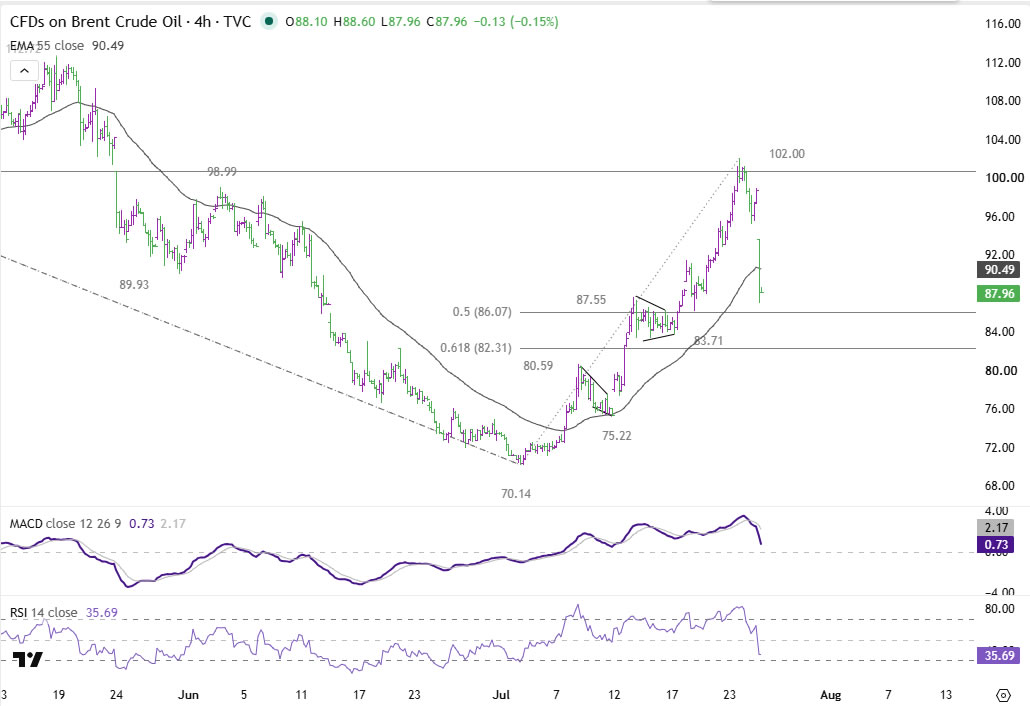
While consolidation below 102.00 is now likely, the near-term bias still favors another upside break provided physical supply conditions fail to improve. A swift rebound above 90 would strengthen the case that Monday’s selloff was largely a positioning washout before the broader advance resumes. Conversely, a decisive break below 86.07, accompanied by sustained trading beneath the 55 D EMA, would significantly weaken the bullish structure and shift focus back toward a deeper fall, potentially reopening the path to the 70.14 low.
Key Takeaways
- Brent’s gap from $98.69 to $85.50 reflects a rapid unwind of geopolitical risk premium, not evidence that physical supply has normalized.
- Vessel traffic through Hormuz remains below 10 crossings a day versus a pre-conflict average above 100, while Bab el-Mandeb traffic has fallen further after strikes on Saudi Aramco facilities.
- A quick reclaim of $90 would support the bull-trap thesis — a positioning washout rather than a real reversal.
- A decisive break below 86.07, with sustained trading under the 55 D EMA, would weaken the bullish structure and open the path back to 70.14.
- The broader advance from 70.14 is still treated as an impulsive first wave, keeping the long-term bullish structure intact for now.
Gyrostat September Retirement Portfolio Resilience Assessment
September Retirement Portfolio Resilience Assessment Markets have fallen. The price of risk has risen. ... Read more
Does The West Have A Problem With Government Bonds
If you have been following the financial pages over the past few weeks, one theme has begun to stand out from the usual ... Read more
August Retirement Portfolio Resilience Assessment
Markets Are Higher. The Price of Risk Is Lower. Retirement invest... Read more
When The Wave Turns
Why Retirement Investing Is Moving Towards Resilience Jeremy Grantham’s latest market warnings have revived an old tru... Read more
Gyrostat Capital Management: July Retirement Portfolio Resilience Assessment
The Market Is Currently Presenting an Opportunity to Strengthen Retirement Portfolio Resilienc... Read more
The Invisible Risk That Decides Your Retirement
Why how investors behave matters more than what markets do and what disciplined port... Read more