

Google Japan Goes Rogue With 5.4ft Long Keyboard
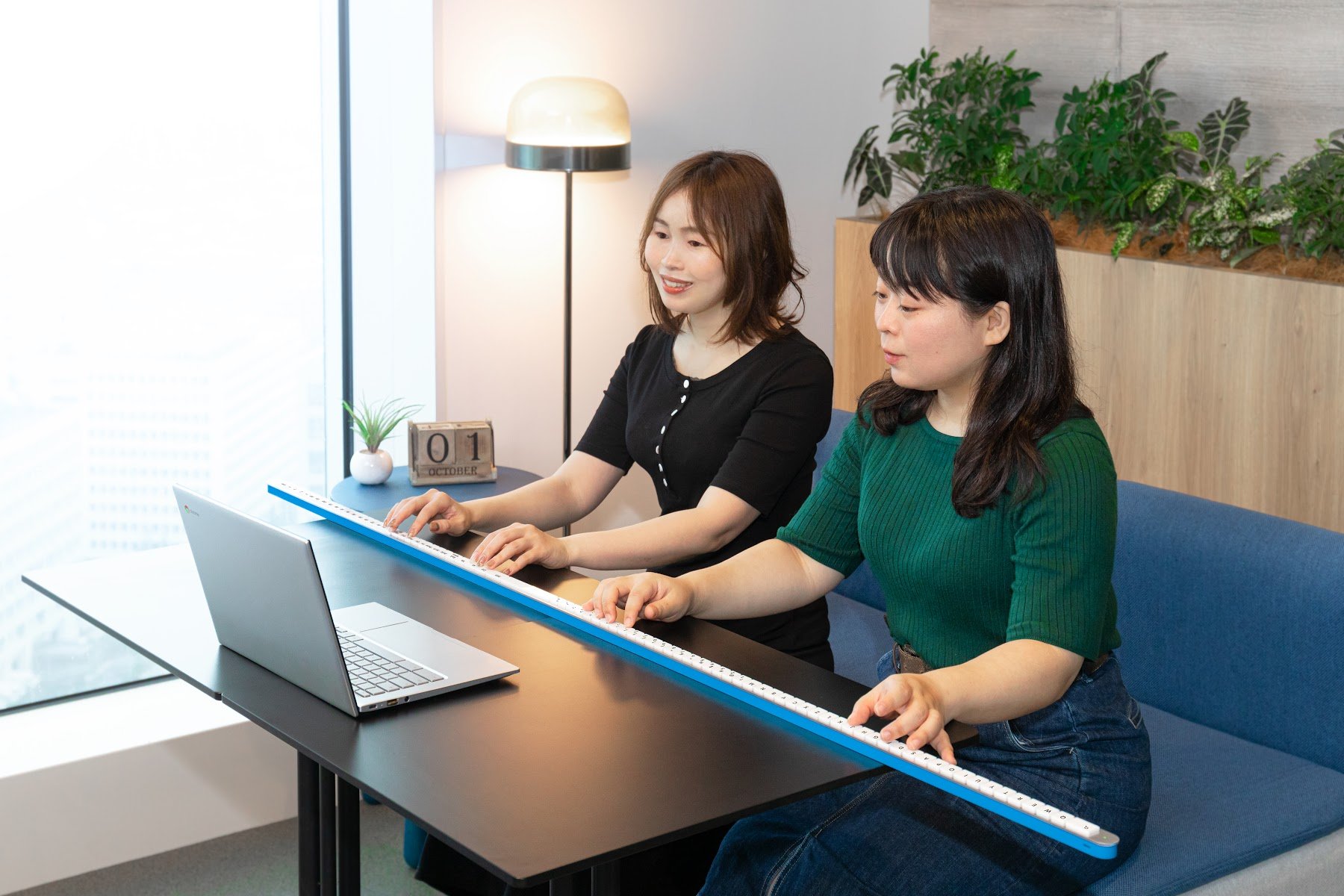
Google's Japan business appears to have ignored its semi-official "Don't be Evil" motto by publishing blueprints for the Gboard Bar, a 1.65m (5.4 feet) QWERTY keyboard.
As the search giant explains, the DIY hardware has keys arranged in a straight line "so you don't have to look around." And yes, it's not even alphabetical, which may or may not have helped locate keys more swiftly when the layout is longer than most desks are wide.
As someone who spends an inordinate amount of time using a keyboard for both work and leisure, I wracked my smooth brain for reasons why this could possibly be a good idea.
Thankfully, while the accompanying video comes across as sincere at first, it's clearly not meant to be taken seriously, although Japan is a strange and wonderful place with many idiosyncratic tastes, including in keyboards.
"The width is only 0.064mm, making it convenient even on desks where documents are piled up," a proud engineer tells us.
"The prototype was about 2,400mm long, but we have succeeded in making it more compact," the narrator adds earnestly.
"With this keyboard, it is very convenient to know immediately that the 16th letter from the left is 'G'," says one user.
"I remember it by length. Like 23cm from the left is 'S'," says another, helpfully getting a tape measure out to demonstrate the convenience.
- FYI: TikTok tracking pixels can be found all over the web – just like Meta, Google
- Google Translate dropped in mainland China
- Google delays execution of doomed Chrome extensions
- Google Cloud is super keen to keep certain customers on pricey Intel VMs
The video goes as far as to claim that pair programming on such a device doubles development speed, though I'd like to see how long it takes a couple of coders working on the Gboard to file for divorce.
Other suggested use cases include tightrope walking, reaching for light switches, fishing something out from under the couch, and a means to measure height. Google says you can even install a bug-fixing module, which is a net attached to the end.
So no, Google Japan hasn't actually gone off the deep end (we hope), it's just another concept from a company with too much time and money on its hands, like Stadia.
Unlike Stadia, however, Google has put the project on GitHub so anyone with a 3D printer and a bit of circuitry know-how can produce the monstrosity for themselves.
If you feel so inclined, remember to get in touch and show us how you made use of your Gboard.
The "Bar version" design follows on from a keyboard that doubled as a cup. Prior iterations all came out on April 1. Still, we can't wait to see the next project from what is clearly Google's most innovative unit. ®
Gyrostat Capital Management: Why Risk Management Is Not About Predicting Risk
Why Risk Management is Not About Predicting Risk Financial markets reward confidence, but they punish certai... Read more
Gyrostat January Outlook: Calm At Multiyear Extremes
This monthly Gyrostat Risk-Managed Market Outlook does not attempt to forecast market direction. Its p... Read more
Gyrostat December Outlook: The Market Does The Work
Harnessing Natural Volatility for Consistent Returns Markets have always moved more th... Read more
Gyrostat Capital Management: Why Advisers Must Scenario-Plan Both The Bubble And The Bust
The Blind Spot: Why Advisers Must Scenario-Plan Both The Bubble and The Bust In financial m... Read more
Gyrostat Capital Management: The Hidden Architecture Of Consequences
When Structures Themselves Become A Risk In portfolio construction, risk is rarely where we look for it.... Read more
Gyrostat November Outlook: The Rising Cost Of Doing Nothing
Through the second half of 2025, markets have delivered a curious mix of surface tranquillity and instabi... Read more