

Gold Price Holds 4,113 Support, But 4,235 And 4,335 Still Block The Bull Case

TL;DR: Gold’s rebound from 4,110.50 nearly tested the 4,113.82 Fibonacci projection to the tick, preserving the corrective interpretation of the decline from 4,697.07, but the 10-year Treasury yield stayed pinned near 5.30% despite softer PCE inflation—leaving 4,234.68 and 4,334.57 as the two resistance levels bulls still need to clear.
Why This Matters
Gold held the level that mattered, but the bond market refused to provide confirmation. A near-exact test of a key Fibonacci projection is technically significant, but it only tells half the story when the macro backdrop that should accompany a genuine reversal—falling long-term yields—hasn’t shown up yet. That gap between a clean technical bounce and an incomplete macro confirmation is the central tension shaping Gold’s next move, and it’s why “support held” and “bulls are back in control” remain two different claims.
Softer PCE Delays the Fed Debate, but Does Not End It
August PCE inflation came in softer than expected, with core PCE rising 0.2% m/m against 0.3% forecast and headline PCE increasing 0.3% against 0.4% expected. That pushed expectations for another Fed hike away from October and further toward December. The annual readings also came in below pre-release forecasts, although benchmark revisions contributed to the size of those misses.
The release reinforced New York Fed President John Williams’ message at the University at Buffalo on September 29 that, following September’s hike, there was “no need for urgency” and time remained to gather more information. Williams nevertheless said another increase could still be appropriate later this year if the economy develops broadly as expected.
But the broader Fed message was not uniformly dovish. Federal Reserve Governor Lisa Cook said at a Richmond Fed conference in Asheville, North Carolina, on September 30 that inflation had been “too high for too long.” Minneapolis Fed President Neel Kashkari, speaking the same day at a Council on Foreign Relations event in New York, said softer PCE had not materially changed his view that inflation remained too high.
The result is a Fed debate increasingly centered on timing rather than whether inflation has been defeated.
The Bond Market Is the Missing Confirmation
For Gold, the more important signal came from Treasuries. Despite the softer inflation numbers and reduced conviction in an October hike, the 10-year Treasury yield remained around the 5.30% area. That disconnect matters. Softer inflation normally eases the rates channel facing non-yielding Gold, but this time the long end did not follow the front-end repricing lower.
The implication is that markets are distinguishing between a less urgent Fed and genuinely easier long-term financial conditions. Strong consumer demand is one reason the PCE report was not cleanly dovish: personal spending surged 0.9% m/m and real PCE rose 0.6%, even as real disposable income was flat. The inflation surprise weakened the case for an immediate hike, but the activity data did not point to a sharp slowdown.
That leaves Gold facing an uncomfortable combination: Fed timing has become less hawkish, but the yield backdrop remains restrictive. This helps explain why the rebound from 4,110.50 has so far been restrained rather than explosive.
ActionForex’s Technical View on Gold
4,113 Support Passed an Important Test
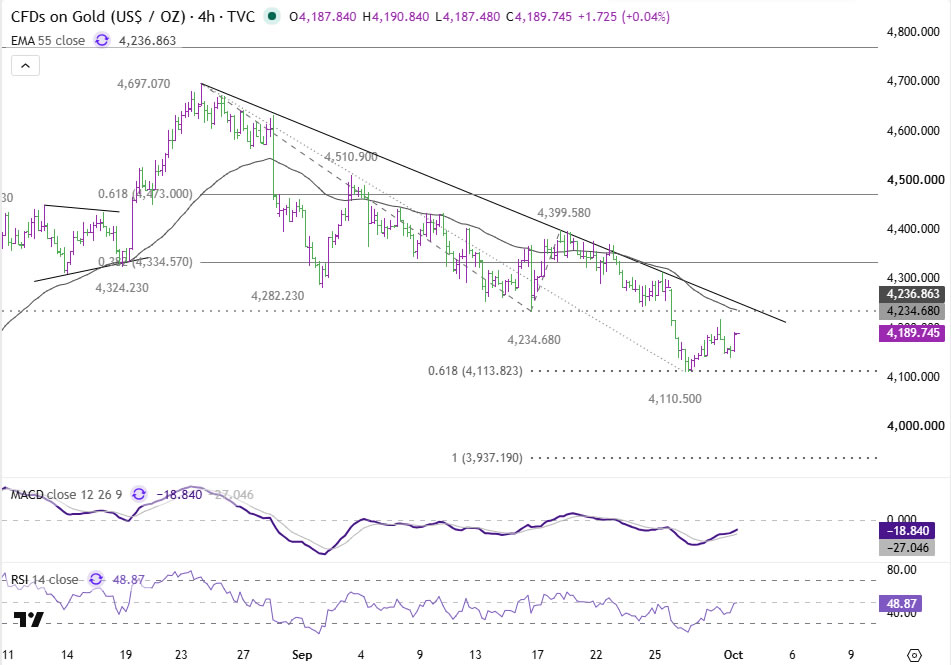
Technically, Gold did what bulls needed at the first major downside objective. The decline from 4,697.07 tested the 61.8% projection of the 4,697.07 to 4,234.68 decline, measured from 4,399.58. That projection sits at 4,113.82. The actual low was 4,110.50.
That near-exact test is significant because it preserves the preferred interpretation that the decline from 4,697.07 can still be treated as a corrective leg within a larger structure, rather than confirmation that a fresh impulsive selloff is already underway. Momentum is also stabilizing: on the four-hour chart, RSI has recovered from deeply oversold conditions toward neutral territory around 48, while MACD has turned higher from a deeply negative reading, though it remains below zero. That combination is consistent with bottoming pressure, but not yet with a confirmed bullish reversal.
First Hurdle: 4,235 Must Break
The first test is the 4,234.68 resistance area. This was previously support and now acts as resistance. It is reinforced by the four-hour 55 EMA near 4,236.86, creating a tight technical cluster around 4,235. A firm break above this zone would be the first convincing evidence that 4,110.50 has formed a meaningful short-term bottom. Until then, the current recovery can still be treated as a relief bounce inside the decline from 4,697.07—a distinction that matters because Gold has already produced several rebounds during the broader fall without changing the underlying structure.
Second Hurdle: 4,335 Is the Bigger Reversal Test
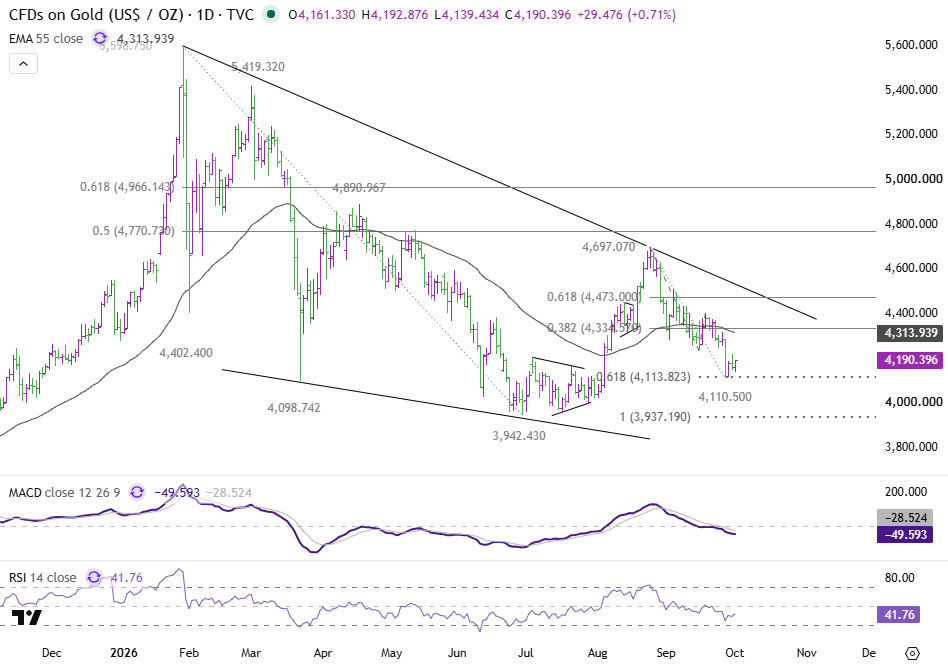
Even a break above 4,235 would not complete the bull case. The more important resistance lies at 4,334.57, the 38.2% retracement of the entire 4,697.07 to 4,110.50 decline. The daily 55 EMA around 4,313.94 sits just below it, creating a broader 4,314–4,335 resistance zone. A sustained break through that region would carry considerably more technical weight—it would argue that the whole decline from 4,697.07 may have completed and shift attention back toward higher resistance levels.
The hierarchy is therefore straightforward:
- Above 4,235, short-term bottoming becomes credible.
- Above 4,335, the case that the full corrective decline has ended becomes substantially stronger.
Gold has achieved neither yet.
A Break of 4,110 Would Reopen 3,937–3,942
The downside structure is equally clear. A renewed break below 4,110.50 would invalidate the immediate stabilization case and expose the 100% projection at 3,937.19. That level sits almost directly alongside the previous 3,942.43 low, creating a strong technical support cluster around 3,937–3,942. A move into that region would do more than simply extend the current pullback—it would raise the probability that the broader decline from the 5,598.75 high is still extending, rather than that the move from 4,697.07 represents a self-contained correction. That makes 4,110.50 an important dividing line for the current setup.
ISM and NFP Will Test Whether Yields Finally Follow the Data
The next catalysts sit directly on the fault line between the two technical paths. A firm ISM reading, followed by a stronger-than-expected NFP report, would reinforce the resilience side of the US story. If that pushes Treasury yields higher again and revives October or broader Fed-tightening expectations, Gold’s rebound could struggle below 4,235 and turn back toward 4,110.50.
Conversely, softer activity or labor data would matter most if the 10-year yield finally rolls over. That would provide the macro confirmation missing from Wednesday’s PCE reaction and give Gold a more credible route through 4,234.68, with 4,334.57 then becoming the larger reversal test. For Gold, therefore, the next signal may come less from whether ISM or NFP beat or miss in isolation than from how Treasury yields react to those numbers.
Support Held, but Bulls Still Need Confirmation
Gold has passed one meaningful technical test. The 4,113 projection held almost to the tick, momentum has begun to stabilize and the preferred corrective interpretation remains intact. But “support held” and “bulls are back in control” remain two different claims. The first threshold is 4,235. The second is 4,335. Until those levels give way, the rebound from 4,110.50 remains a recovery inside a structure that has not yet turned decisively bullish. And with long-term Treasury yields still elevated despite softer PCE, the macro confirmation for that reversal is still missing.
Key Takeaways
- Gold’s low at 4,110.50 nearly matched the 4,113.82 Fibonacci projection, preserving the view that the decline from 4,697.07 is corrective rather than a fresh impulsive selloff.
- Despite softer August PCE, the 10-year Treasury yield held near 5.30%, denying Gold the macro confirmation that typically accompanies a genuine reversal.
- The Fed debate has shifted to timing rather than direction, with Williams striking a patient tone while Cook and Kashkari pushed back against declaring inflation defeated.
- Bulls need a break above 4,234.68 for short-term bottoming to become credible, and above 4,334.57 for the full corrective decline to be considered over.
- A break below 4,110.50 would expose the 3,937–3,942 support cluster and raise the risk that the broader decline from 5,598.75 is still extending.
Gyrostat September Retirement Portfolio Resilience Assessment
September Retirement Portfolio Resilience Assessment Markets have fallen. The price of risk has risen. ... Read more
Does The West Have A Problem With Government Bonds
If you have been following the financial pages over the past few weeks, one theme has begun to stand out from the usual ... Read more
August Retirement Portfolio Resilience Assessment
Markets Are Higher. The Price of Risk Is Lower. Retirement invest... Read more
When The Wave Turns
Why Retirement Investing Is Moving Towards Resilience Jeremy Grantham’s latest market warnings have revived an old tru... Read more
Gyrostat Capital Management: July Retirement Portfolio Resilience Assessment
The Market Is Currently Presenting an Opportunity to Strengthen Retirement Portfolio Resilienc... Read more
The Invisible Risk That Decides Your Retirement
Why how investors behave matters more than what markets do and what disciplined port... Read more