

Gold Breaks $4,300—Dollar Indexs 99.86 Resistance Holds The Next Signal
TL;DR: Gold has broken below $4,300 even as oil surges and tech stocks selloff, because oil-driven inflation risk is feeding a sharply more hawkish Fed outlook that’s overpowering haven demand—and whether Dollar Index confirms that same story now hinges on its 99.86 resistance.
Gold Identifies the Dominant Market Channel
The Dollar is broadly higher, oil is surging, and technology stocks are selling off. Yet Gold has broken below $4,300 instead of attracting a defensive bid. That pairing is the clearest signal from Monday’s markets: oil-driven inflation risk and Fed repricing are overpowering haven demand, turning Gold’s decline into the diagnostic behind Dollar strength.
The session contains several major developments, but they don’t represent a collection of unrelated bullish-Dollar forces. The principal causal chain runs from worsening threats to energy supply through higher oil and inflation expectations into a more aggressive Fed path. The technology selloff adds a separate source of risk aversion, but it doesn’t drive the inflation or rates component of the move.
Gold shows which mechanism is dominating. If generalized fear were the primary force, geopolitical escalation and a global technology selloff would normally provide at least some support for precious metals. Instead, Gold fell as the Dollar strengthened and markets increased their Fed hike expectations. That doesn’t prove haven demand is absent, but it indicates that the rate-and-Dollar channel is currently stronger.
Three Energy Routes Under Pressure
The renewed oil surge followed a weekend in which risks intensified around three parts of the global energy system: the Strait of Hormuz, Bab el-Mandeb, and Saudi Arabia’s alternative export infrastructure.
The Salalah meeting scheduled for September 14 to discuss a temporary Hormuz shipping framework between Iran and Gulf Cooperation Council states was postponed the night before. Omani Foreign Minister Badr Albusaidi attributed the decision to “the interests of consensus,” while Iran described it as a joint Tehran–Muscat decision made at the request of other regional countries.
The postponement removed an anticipated opportunity for de-escalation. Separate maritime incidents reinforced the continuing threat to shipping. The United Kingdom Maritime Trade Operations confirmed a vessel was struck by a projectile in the Strait of Hormuz on Sunday, causing a fire and forcing the crew to evacuate. A separate attack on an Iranian commercial vessel left one person dead and four wounded.
Risk also increased around the Red Sea. Houthi advances through Mocha and Perim, also known as Mayyun island, strengthened the group’s position around Bab el-Mandeb. A fresh Houthi attack on a Saudi military airbase at Khamis Mushait was presented as retaliation for Saudi airstrikes on Yemen, confirming the confrontation had already moved beyond the stage of threatened military action.
Saudi Crown Prince Mohammed bin Salman met US Central Command chief Admiral Brad Cooper on Monday and sought direct US military assistance against the Houthis, according to the supplied reporting. US President Donald Trump declined to authorize direct strikes but agreed to provide intelligence-sharing and targeting support.
At the same time, Saudi Arabia’s East–West pipeline stayed closed after Friday’s drone strike. The pipeline has capacity equivalent to as much as approximately 4% of global oil supply, making its continued closure important even if the amount of disrupted current flow is smaller than its maximum capacity. Without a restart, the Red Sea export terminal at Yanbu reportedly has only five to seven days of inventory cover.
The result is a coordinated pressure point across the region: Hormuz shipping faces continuing attacks, Houthi advances are increasing the threat around Bab el-Mandeb, and the pipeline designed to bypass Hormuz is unavailable.
Oil Closes the Chain Through Inflation Expectations
Energy prices responded accordingly. At 07:00 GMT on Monday, Brent was up 2.8% at $107.54, while WTI gained 2.9% to $102.93. Oil had already risen approximately 8% during the previous week and was trading above $100 for the first time since July. US diesel prices reached a fresh record above $6.20 per gallon on Sunday.
Those moves matter for the Dollar because the oil shock is no longer being treated only as a geopolitical or supply story. It’s feeding directly into expectations for US inflation and monetary policy.
The September 14 Reuters survey explicitly connected crude prices well above $100 and record diesel costs with surging inflation expectations. That comes after a sequence in which producer prices and core consumer inflation had already pushed markets toward expecting tighter policy.
The proper causal sequence is therefore: energy disruption raises oil and fuel prices. Higher energy costs lift inflation expectations. Persistent inflation increases pressure on the Fed to tighten. Higher expected US rates support the Dollar and weigh on Gold.
Inflation expectations and Fed expectations aren’t two independent explanations for Monday’s move. The former is transmitting the oil shock into the latter.
The Fed Poll Shows How Far Expectations Have Shifted
The latest Reuters survey demonstrates the speed of that transmission. Of 101 economists surveyed after Friday’s CPI report, 86, or 85%, expected the Fed to hike on Wednesday. That completely reversed the previous week’s poll, in which more than two-thirds of respondents had expected rates to remain unchanged.
The change now extends beyond the immediate decision. Among 70 economists answering the longer-term question, 37, or 53%, expected at least one further hike by the end of March 2027. The survey no longer showed a majority expecting lower rates at any point during 2027.
Futures markets have moved even further, assigning approximately 90% probability to Wednesday’s increase and pricing around four cumulative hikes by the end of July 2027.
This isn’t a separate catalyst arriving alongside the oil shock. It’s the measurable result of the same chain. Higher energy costs have intensified inflation concerns at a time when recent PPI and CPI data were already reducing the Fed’s room to remain on hold.
Bank of America economist Stephen Juneau argued Federal Reserve Chair Kevin Warsh had “boxed himself into” a position in which the data needed to be very soft for the Fed to avoid following through with a hike. BMO economist Scott Anderson said the Fed’s “inflation-fighting credentials are on the line,” suggesting a surprise hold could steepen the Treasury curve rather than produce a straightforward relief rally.
Reuters compared the speed of the poll reversal with September 2024, when another late shift in expectations preceded a larger policy move than the final consensus anticipated. That comparison doesn’t imply the Fed will deliver a comparable surprise this week, but it illustrates how quickly a seemingly settled policy expectation can change when incoming data alter the inflation calculus.
AI Derisking Adds a Separate Source of Risk Aversion
The technology selloff is distinct from the oil-to-Fed chain.
Anthropic Chief Executive Officer Dario Amodei published an essay on Saturday calling for AI laboratories to slow capability development. OpenAI Chief Executive Officer Sam Altman and xAI Chief Executive Officer Elon Musk publicly supported the proposal, while Altman separately confirmed OpenAI was shelving its planned initial public offering for the year because of safety concerns.
The developments followed the previous week’s resignation of Anthropic researcher Jacob Coxon over AI-risk concerns. A colleague subsequently estimated a greater than 10% probability of an extinction-level AI outcome within a decade, intensifying questions about whether the industry’s development trajectory could continue without interruption.
Technology shares fell across Asia, Europe, and US premarket trading. Reuters reported that SoftBank dropped as much as 13.2% intraday, while another report put the decline closer to 10%, reflecting different market snapshots. Kioxia fell 9.8%, SK Hynix lost between 5.3% and 6%, and Samsung declined between 3.7% and 4%. In Europe, ASML fell more than 4%, Nokia lost 5%, and Infineon dropped more than 6%. US premarket trading showed Micron down 5%, Intel down 6%, and Nvidia down 2%. Nasdaq futures fell 1.3% during Asian trading.
The selloff reflects the importance of uninterrupted technical progress to AI valuations. Saxo strategist Charu Chanana argued those valuations assume both strong demand and a relentless pace of technological development, making even a possible delay sufficient to trigger profit-taking.
Investor Michael Burry offered a more skeptical interpretation, describing the warnings as “hype and puffery” that could be covering weaker underlying growth. Either interpretation produces the same immediate market result: investors are reducing exposure to technology shares whose valuations depend on continued rapid capability development.
However, AI derisking should remain in its analytical lane. It adds to risk aversion and may contribute to defensive Dollar demand, but it doesn’t explain higher inflation expectations or the more aggressive Fed path.
Where the Forces Actually Converge
Monday’s developments meet most clearly in risk appetite, not across every market channel.
Oil and geopolitical escalation raise the risk of persistent inflation and weaker growth. Fed repricing pressures duration-sensitive assets and high-growth equities by increasing expected discount rates. AI-specific concerns add a separate reason to reduce exposure to technology shares.
The common outcome is weaker risk appetite. But only the energy shock transmits directly through inflation expectations into the Fed outlook.
That distinction also prevents the Gold analysis from becoming internally contradictory. Ordinary AI derisking doesn’t necessarily imply lower Gold. It could generate haven demand, encourage cash-driven liquidation, or have little direct effect. Gold is falling because the rate-and-Dollar pressure generated by the energy and Fed channel is currently overwhelming whatever defensive demand the wider risk-off environment is producing.
ActionForex’s Technical View on Gold: Below $4,300 Is the Diagnostic
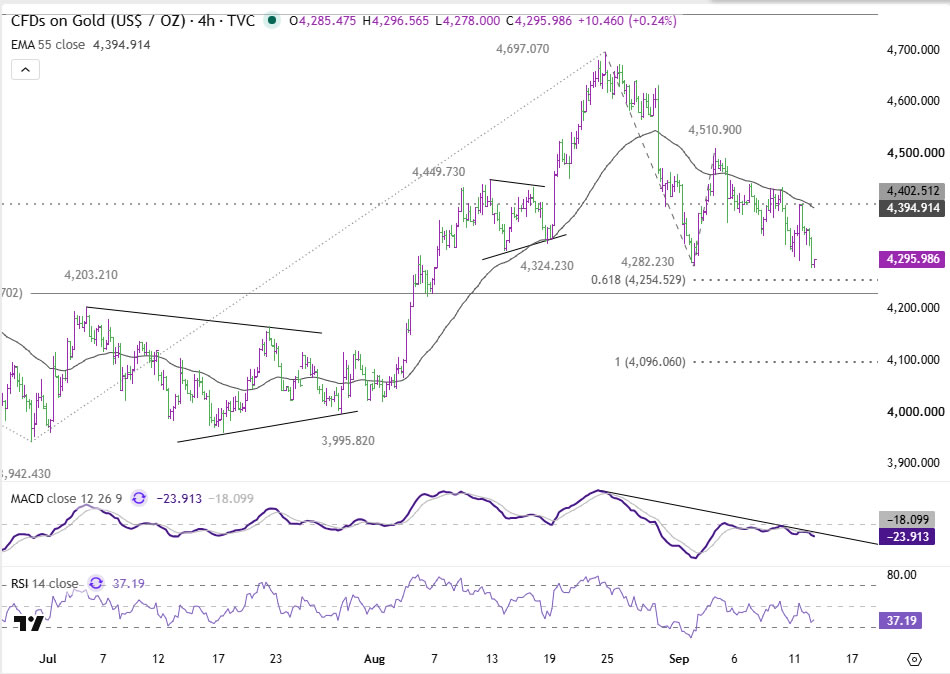
Gold fell 1.27% to $4,292.21 intraday, breaking below the $4,300 round number. The latest four-hour chart showed a modest recovery toward $4,296, but the metal was still below the psychological threshold.
The move extended Gold’s decline to 2.62% over the week and 14.22% over six months, confirming Monday’s weakness was part of a broader correction rather than an isolated reaction.
The counterfactual makes the move analytically useful. A session combining worsening threats to energy supply, maritime attacks, and a sharp global technology selloff might ordinarily be expected to support Gold. Its failure to attract a sustained bid indicates that Fed repricing, higher yields, and Dollar strength are dominating the haven channel.
Gold is therefore not a second asset attached to a Dollar article. It provides independent market evidence for the mechanism driving the Dollar itself.
Gold’s break below $4,300 shifts attention toward a genuine support confluence at $4,230–$4,254. The 61.8% projection of the decline from 4,697.07 to 4,282.23, measured from 4,510.90, stands at 4,254.53. The 61.8% retracement of the broader rise from 3,942.43 to 4,697.07 lies at 4,230.70.
Gold briefly slipped beneath the previous 4,282.23 low before recovering, keeping pressure on the support zone without confirming a decisive breakdown.
Momentum hasn’t reached clear exhaustion. Four-hour RSI is around 37, approaching but not yet inside oversold territory. Daily RSI at approximately 44 leaves room for additional weakness. The four-hour MACD also remains below its signal line, indicating downside momentum hasn’t yet stabilized.
On the upside, resistance is concentrated around 4,394.91–4,402.51, where the 55-period four-hour EMA converges with horizontal resistance. Risk stays on the downside while that area holds.
A decisive break below 4,230 would open the 100% projection at 4,096.06. Continued Fed repricing accompanied by a stronger Dollar and Treasury yields would provide the most coherent catalyst for that move.
ActionForex’s Technical View on Dollar Index: Building a Prospective Double Bottom
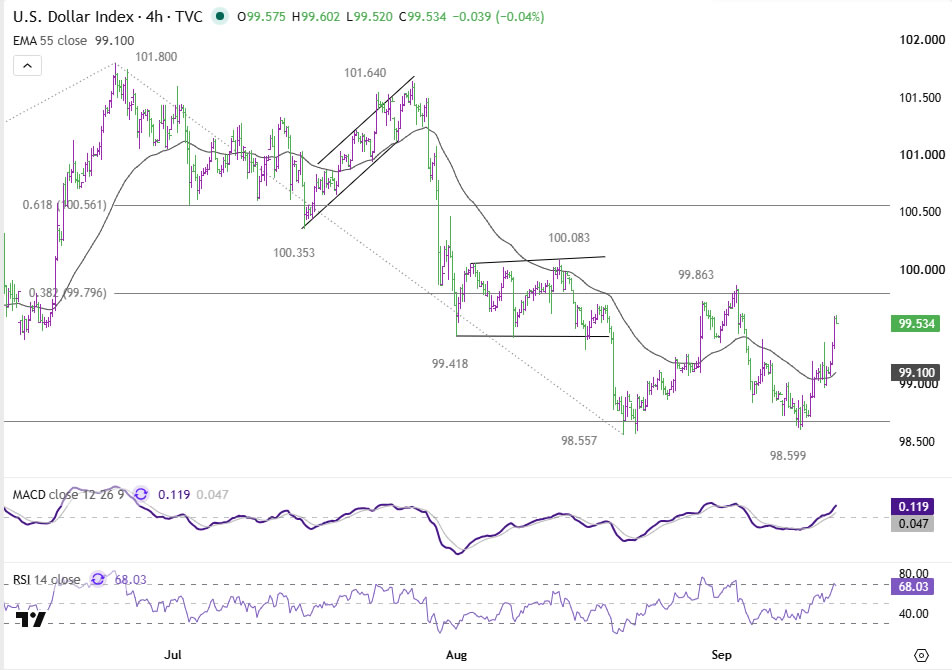
DXY’s rebound from 98.599 accelerated on Monday after the index had previously bottomed at 98.557. The two lows are sufficiently close to form a prospective double bottom around 98.55–98.60.
The pattern isn’t yet complete. DXY must still clear the resistance cluster at 99.79–99.86, which combines the 38.2% retracement of the decline from 101.80 to 98.55 at 99.79 with horizontal resistance at 99.86.
Momentum supports another test. DXY has reclaimed the 55-period EMA on the four-hour chart around 99.10. Four-hour RSI has climbed to approximately 68, elevated but not yet overbought. MACD is positive and continues to separate from its signal line.
A decisive break above 99.86 would complete the double bottom and target the 61.8% retracement at 100.56. Until that occurs, the rebound weakens but doesn’t fully invalidate the alternative scenario of another fall through 98.55 toward 97.93 and 97.62.
That’s why 99.86 holds the next signal. Gold has already broken its psychological threshold; the Dollar has yet to confirm Monday’s advance is becoming a broader technical reversal.
DXY 99.86 Holds the Next Cross-Asset Signal
The Dollar and Gold levels should be treated as mutually reinforcing conditions rather than mechanically linked triggers.
A rejection of DXY from 99.79–99.86 would indicate the Dollar’s rebound remains contained. That could allow Gold to stabilize before reaching $4,230, particularly if oil or Fed expectations also begin to moderate.
A decisive DXY break above 99.86 would complete the prospective double bottom and increase the risk of Gold testing the $4,230–$4,254 support zone. If DXY subsequently clears 100.56 while Gold breaks $4,230, the two markets would jointly confirm a stronger Dollar recovery and a deeper Gold correction toward approximately $4,100.
The relationship could still change if the technology selloff develops into a disorderly US equity unwind. A broader “sell America” dynamic—particularly with the US 10-year yield near the politically sensitive 5% threshold and fiscal credibility already under scrutiny—could weaken the Dollar even as risk aversion intensifies. Gold might then recover despite continuing stress elsewhere.
For now, the opposite pattern is in control. Gold is falling as the Dollar strengthens, indicating the rate-and-Dollar channel is dominating the session. Gold has delivered the first signal below $4,300. DXY must now clear 99.86 to show the move is developing into something larger.
Key Takeaways
- Gold broke below $4,300, falling 1.27% intraday despite surging oil and a global tech selloff, signaling the rate-and-Dollar channel is overpowering haven demand.
- Escalation across three energy chokepoints (Hormuz, Bab el-Mandeb, and Saudi Arabia’s closed East-West pipeline) pushed Brent up 2.8% to $107.54 and US diesel to a record $6.20/gallon.
- A Reuters poll flipped from two-thirds expecting a Fed hold to 85% expecting a Wednesday hike, with futures now pricing roughly 90% odds and four cumulative hikes by mid-2027.
- An unrelated AI-industry derisking selloff (SoftBank down as much as 13.2%) added risk aversion but doesn’t explain the inflation or Fed-repricing side of the move.
- DXY’s 99.86 resistance is the next cross-asset signal; a break would complete a prospective double bottom and increase the risk of Gold testing 4,230-4,254 support.
Does The West Have A Problem With Government Bonds
If you have been following the financial pages over the past few weeks, one theme has begun to stand out from the usual ... Read more
August Retirement Portfolio Resilience Assessment
Markets Are Higher. The Price of Risk Is Lower. Retirement invest... Read more
When The Wave Turns
Why Retirement Investing Is Moving Towards Resilience Jeremy Grantham’s latest market warnings have revived an old tru... Read more
Gyrostat Capital Management: July Retirement Portfolio Resilience Assessment
The Market Is Currently Presenting an Opportunity to Strengthen Retirement Portfolio Resilienc... Read more
The Invisible Risk That Decides Your Retirement
Why how investors behave matters more than what markets do and what disciplined port... Read more
Gyrostat Capital Management: The Missing Allocation In Retirement Portfolio Construction?
For decades, retirement portfolios have largely been constructed using combinations of growth assets a... Read more