

GBP/JPY Finds Three Reasons To Rebound As BoE And BoJ Risks Converge

TL;DR: GBP/JPY enters a back-to-back central-bank week with three independent arguments for a rebound—the BoE’s hawkish bloc has little room to retreat, a fully priced BoJ hike may give Yen no new information, and the pair is oversold at a two-layer technical support zone—creating an asymmetric setup where the bullish threshold is lower than the bearish one.
Three Independent Arguments, One Cross
GBP/JPY enters a back-to-back central-bank week with three independent forces pointing toward a potential rebound. The Bank of England’s widening hawkish bloc leaves limited room for a materially dovish shift, while the Bank of Japan may struggle to deliver anything beyond a rate increase already reflected in Yen. At the same time, GBP/JPY is oversold and attempting to establish a floor within a layered technical support zone.
None of the three arguments guarantees the pair has completed its decline from 219.56. Together, however, they create an asymmetric setup. A Sterling-supportive BoE assessment and a non-committal BoJ would reinforce a technical rebound that requires only a break of minor resistance at 209.01. Renewed downside acceleration would require a decisive breach of substantially deeper support at 206.10.
That makes GBP/JPY more than a convenient way to combine two central-bank meetings. It’s the cross where separate UK and Japanese policy risks compound rather than offset each other.
Yen Has Run Ahead of the BoJ’s Likely Message
Yen has risen sharply this month ahead of the BoJ’s September 18 meeting. However, the move in the currency appears more aggressive than the additional near-term tightening embedded in the rates market.
A September increase from 1.00% to 1.25% is already fully priced. The OIS-implied rate for the October 30 meeting stands at approximately 1.28%, only marginally above the level the September hike alone would produce. That implies roughly a 10–15% probability of another increase at the immediately following meeting.
Markets are therefore not genuinely positioned for back-to-back hikes, despite broader expectations that the BoJ will tighten faster than previously assumed. The near-term curve points instead toward a September move followed by a pause.
Takuji Aida, a reflationist adviser to Prime Minister Sanae Takaichi, provides a useful reference point. Aida brought his own forecast for the next BoJ increase forward to September, but expects the subsequent hike in January 2027. He then anticipates a return to an approximately six-month pace. His forecast supports further normalization while stopping well short of an uninterrupted sequence of rapid increases.
The Hike May Offer Yen Little New Information
The principal risk for Yen isn’t that the BoJ fails to raise rates. It’s that the expected hike arrives without an incremental signal about what follows.
Bank of Japan Governor Kazuo Ueda is expected to avoid committing to a timetable for another increase. He could repeat the conditional message delivered in July that the BoJ could move faster if economic and inflation conditions warrant. But conditional optionality wouldn’t constitute new forward guidance.
That distinction matters because Yen has already benefited from the buildup toward the September hike and the continuing possibility of intervention. If the BoJ delivers the expected move but offers no clearer guidance, investors would receive confirmation of an event already priced, rather than a fresh reason to extend Yen’s advance.
The result could be a sell-the-fact reaction. This is a near-term event-risk argument, not a rejection of the broader BoJ tightening cycle. The same Reuters panel shows that 89% of economists expect the policy rate to reach at least 1.50% by the end of March 2027, while 62% expect at least 1.75% by mid-2027. Medium-term normalization can remain intact even if Yen retreats after Friday’s decision.
The BoE’s Hawkish Bloc Has Little Room to Retreat
Sterling approaches the Bank of England’s September 17 meeting with a different asymmetry. The expected decision is another hold, but the Monetary Policy Committee’s voting pattern has become progressively more hawkish.
Bank of England Chief Economist Huw Pill was the sole member to support a hike in April, producing an 8–1 vote. External Monetary Policy Committee member Megan Greene joined him in June, narrowing the majority to 7–2. External Monetary Policy Committee member Catherine Mann then joined the dissent in July, producing a 6–3 split.
The progression is more informative than the expected headcount alone. Each of the past three meetings added one official to the hawkish camp. For any member of the dissenting trio to return to a hold vote in September would require a reversal of recently expressed policy conviction rather than a routine fluctuation in the vote.
The energy backdrop raises that hurdle. The July dissent already cited the inflation uncertainty created by developments in the Middle East. With oil now above $100 and higher than it was at the July meeting, the most obvious external inflation risk has intensified rather than faded.
That doesn’t make a hike this week the base case. It does, however, reduce the likelihood that the dissenting bloc will shrink or that the committee will collectively sound more relaxed about inflation.
With No New Forecasts, the Minutes Carry the Signal
An unchanged 6–3 vote would protect Sterling against a dovish repricing, but it might not provide a strong new bullish catalyst because markets already expect the dissenting trio to hold its position.
The more important test will be the language used by the six-member majority. September brings no new Monetary Policy Report, leaving the BoE without a fresh set of growth and inflation projections. The next full forecast round won’t arrive until November 5.
That makes the minutes the principal vehicle through which neutral members can signal whether higher energy costs have changed their assessment. A stronger emphasis on second-round inflation risks, wage transmission, or the possibility of further tightening would indicate concern is spreading beyond the established hawkish minority. More balanced language that stresses the growth consequences of higher oil prices would limit the Sterling response.
The vote establishes a relatively firm floor beneath Sterling expectations. The majority’s description of the risks will determine whether the meeting also provides an upside catalyst.
Why GBP/JPY Is the Cleaner Expression
Sterling’s reaction may be less straightforward against the Dollar. If the Fed’s own projections validate a broader US tightening cycle, higher US yields could offset or dominate a hawkish BoE message. GBP/USD would therefore require investors to judge two potentially supportive rate stories at once.
EUR/GBP captures the BoE side of the argument but lacks the complementary Japanese event risk. GBP/JPY combines both elements: limited room for a dovish BoE surprise and the possibility that a fully priced BoJ hike fails to give Yen another incremental boost.
The expected moves are modest rather than dramatic. The BoE doesn’t need to signal an imminent hike, and the BoJ doesn’t need to abandon its normalization path. GBP/JPY would benefit if the BoE preserves its hawkish pressure while the BoJ declines to endorse a rapid follow-up move.
Mild Sterling upside risk and mild Yen downside risk therefore compound on the same cross.
ActionForex’s Technical View on GBP/JPY: A Two-Layer Support Structure
The technical case was established independently of the central-bank analysis, but it arrives at a similar conclusion.
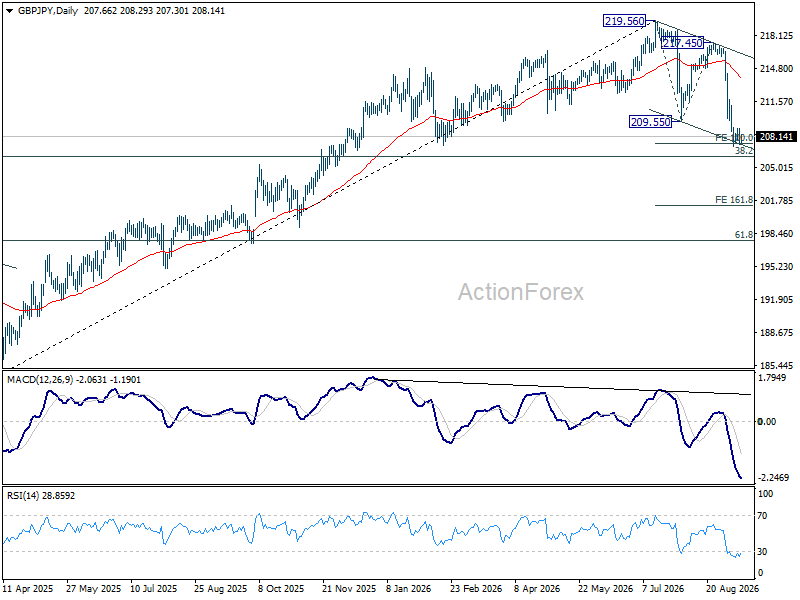
GBP/JPY’s fall from 219.56 reached a temporary low at 207.06 last week. That low sits inside a near-term support cluster formed by the falling channel floor around 207.25 and the 100% projection of the decline from 219.56 to 209.55, measured from 217.45, at 207.44.
A second and more important layer stands at 206.10. This represents the 38.2% retracement of the entire advance from 184.35 to 219.56. The resulting structure is therefore not a single narrow confluence zone, but two adjacent layers: initial support at 207.06–207.44 and medium-term protection at 206.10.
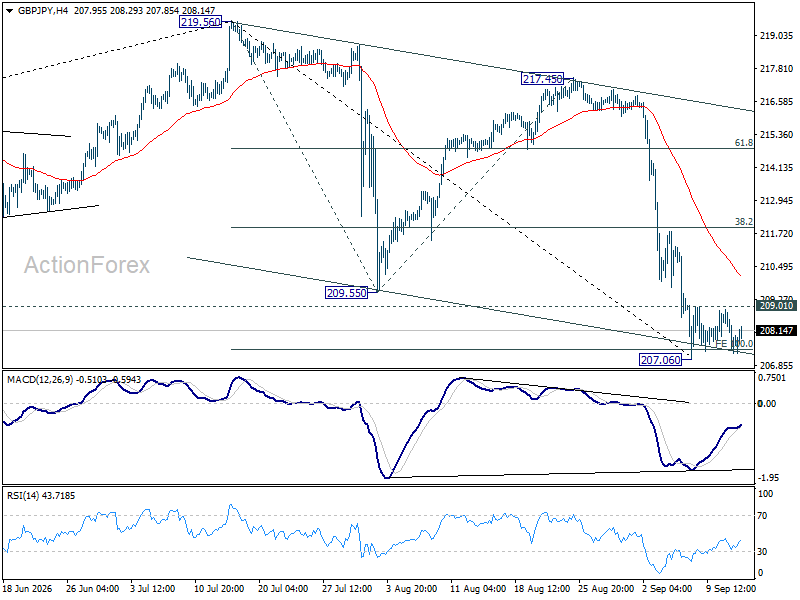
Momentum conditions support the possibility of stabilization. Daily RSI has fallen to approximately 28.86, placing it in oversold territory. On the four-hour chart, RSI has recovered to around 43.7 after dropping below 30. The four-hour MACD is also recovering from deeply negative territory and displays bullish divergence against price.
Those signals don’t confirm a bottom is in place. They indicate downside momentum is losing force as the pair tests an important support structure.
The Rebound Has the Lower Technical Threshold
The base case is for a corrective rebound from the current area, possibly after one more brief dip. Confirmation would require a break above 209.01 minor resistance, which would turn the near-term bias upward.
The first objective would then be the 55-period EMA on the four-hour chart, currently around 210.13. A firm break above that average would open the 38.2% retracement of the decline from 219.56 to 207.06, at 211.83.
Such a move would remain corrective. GBP/JPY wouldn’t need to establish a full bullish reversal or recover the entire decline from 219.56 for the rebound thesis to work.
The bearish threshold is more demanding. A decisive break below 206.10 would invalidate the two-layer support structure and suggest the decline is accelerating. The next downside projection would then be the 161.8% extension of 219.56 to 209.55 from 217.45, at 201.25.
This creates an important structural asymmetry. The rebound requires GBP/JPY to clear minor resistance at 209.01. The bearish continuation scenario requires a decisive break of deeper medium-term support at 206.10.
How the BoE–BoJ Sequence Maps Onto the Chart
Both technical thresholds will remain live across the Thursday–Friday central-bank sequence.
A stable 6–3 BoE vote accompanied by firmer language from the majority would increase the probability of GBP/JPY testing 209.01. If the BoJ then delivers its fully priced hike without offering a clearer timetable for the next move, a sell-the-fact reaction in Yen could provide the additional push needed to break that resistance.
The opposite sequence would threaten the support structure. A softer BoE assessment, particularly if one of the three hawks returns to a hold vote, would weaken Sterling’s policy support. If the BoJ then signals another increase could arrive substantially sooner than the curve currently implies, GBP/JPY could retest 207.06 and ultimately challenge 206.10.
The technical setup didn’t arise because of the fundamental argument. Its importance comes from reaching the same conditional conclusion independently: the pair has a lower barrier to initiating a corrective rebound than to confirming another accelerated decline.
Three Reasons, One Conditional Base Case
GBP/JPY enters the central-bank sequence with three reasons to rebound. The BoE’s increasingly hawkish voting pattern limits the scope for a dovish surprise. The fully priced BoJ hike may struggle to deliver an incremental catalyst for further Yen strength. The pair itself is oversold and attempting to stabilize above a two-layer support structure.
The case remains conditional. A break above 209.01 would provide the first confirmation and open 210.13, followed by 211.83. A decisive break below 206.10 would overturn the setup and expose 201.25.
For now, the fundamental and technical risks converge around a rebound from the current area or after one more brief decline. That convergence—not simply the presence of two central-bank meetings—is what makes GBP/JPY the cross to watch.
Key Takeaways
- The BoE’s hawkish dissent has widened for three consecutive meetings (8-1 to 7-2 to 6-3), making it politically harder for any dissenter to revert to a hold vote in September.
- A September BoJ hike to 1.25% is fully priced, but the OIS curve implies only a 10-15% chance of a follow-up move in October, leaving Yen little new information to trade on.
- Neither central bank has fresh forecasts this meeting; the BoE’s minutes and the BoJ’s press conference tone will carry more signal than the decisions themselves.
- GBP/JPY sits at a two-layer support structure (207.06-207.44 and 206.10), with daily RSI oversold at 28.86 and 4H MACD showing bullish divergence.
- The setup is asymmetric: a break above 209.01 confirms a rebound toward 210.13 and 211.83, while only a decisive break of the deeper 206.10 support would open 201.25.
Does The West Have A Problem With Government Bonds
If you have been following the financial pages over the past few weeks, one theme has begun to stand out from the usual ... Read more
August Retirement Portfolio Resilience Assessment
Markets Are Higher. The Price of Risk Is Lower. Retirement invest... Read more
When The Wave Turns
Why Retirement Investing Is Moving Towards Resilience Jeremy Grantham’s latest market warnings have revived an old tru... Read more
Gyrostat Capital Management: July Retirement Portfolio Resilience Assessment
The Market Is Currently Presenting an Opportunity to Strengthen Retirement Portfolio Resilienc... Read more
The Invisible Risk That Decides Your Retirement
Why how investors behave matters more than what markets do and what disciplined port... Read more
Gyrostat Capital Management: The Missing Allocation In Retirement Portfolio Construction?
For decades, retirement portfolios have largely been constructed using combinations of growth assets a... Read more