

Euro Slides Again As French Bond Relief Lasts One Day, EUR/CAD Kisses 1.6000 Goodbye

TL;DR: Euro flipped from the strongest to the weakest major currency in a single session as French bond relief proved short-lived—the OAT-Bund spread widened back toward 137bp—and EUR/CAD has now broken decisively below 1.6000, with 1.5887 the next key test.
Why This Matters
The Euro is back under pressure, reversing Tuesday’s rebound as relief in French government bonds proves short-lived. At 08:00 GMT on Wednesday, Euro was the weakest of the eight major currencies on the ActionForex Currency Heat Map, falling against all seven peers after ranking as the strongest major a day earlier. That swing in a single session is the clearest sign that Tuesday’s calm was relief, not resolution—France’s fiscal credibility problem hasn’t gone anywhere, and EUR/CAD is where the renewed pressure is now showing up most clearly on the charts.
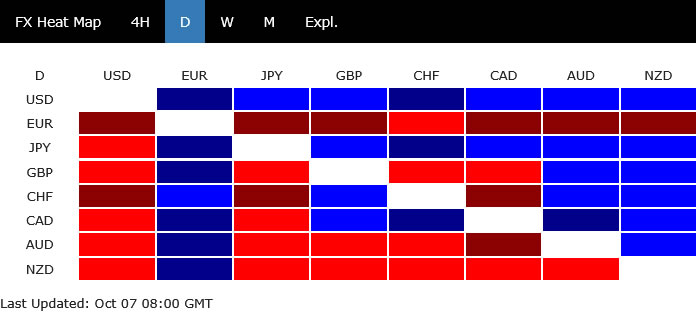
French Bond Relief Lasts One Session
The reversal is again centered on France. The French 10-year yield rose to around 4.864%, up roughly 7.8bp on the session, while the OAT-Bund spread widened back toward 137bp from around 130bp at Tuesday’s close. The relative move matters: US Treasuries, gilts and Bunds were also under pressure, but French yields were rising considerably faster.
Tuesday’s narrowing from Monday’s roughly 150bp intraday peak therefore looks more like temporary relief than a shift in the underlying story. The global bond rally helped French debt recover, but France’s fiscal position and the market’s demand for a larger risk premium did not materially change.
France’s Fiscal Credibility Remains the Core Problem
The structural backdrop remains difficult. France’s budget deficit stood at 5.1% of GDP last year, while public debt had risen to 119% of GDP by the end of June. France is also subject to the EU’s excessive deficit procedure, with the bloc recommending that the deficit be brought back within agreed limits by 2029.
Borrowing costs have responded accordingly. The French 10-year yield has risen sharply this year and now trades above those of Italy and Greece, while investors increasingly demand a larger premium over German Bunds.
UBS Chief Executive Sergio Ermotti, speaking to CNBC’s Squawk On The Street on Tuesday, argued that France needs “hard measures” rather than incremental adjustments. His message was blunt: “Incremental small changes are not going to be enough to resolve the big debt pile.”
Federated Hermes’ Mitch Reznick made the market consequence equally clear, saying French debt is increasingly being priced “less like core Europe and more like the periphery.” Investors shifting toward Bunds reinforces that divergence by widening the OAT-Bund spread further.
For now, Reznick still sees direct ECB intervention as unlikely. But he noted that the central bank’s language could start to change if spreads continue to gap wider. That keeps ECB intervention as an escalation risk rather than the current base case.
Higher French Yields Are Hurting, Not Helping, the Euro
The important distinction for FX is that higher French yields are being interpreted as a risk premium, not as an attractive rates advantage. That helps explain why French yields can rise while the Euro falls. Investors are demanding more compensation to hold French debt because of fiscal and political uncertainty, rather than repricing stronger Eurozone growth or a meaningfully tighter ECB outlook.
The rates channel is also turning less supportive. Expectations for future ECB tightening have moderated, while the short-end differential against the Dollar remains heavily negative. EUR/USD was trading around 1.1236 earlier Wednesday, leaving downside risks intact if renewed French stress continues to push capital toward Bunds and the Dollar.
The Euro’s move from the strongest major on Tuesday to the weakest on Wednesday captures the speed at which the temporary relief has unwound.
ActionForex’s Technical View on EUR/CAD
EUR/CAD Breaks the 1.6000 Floor
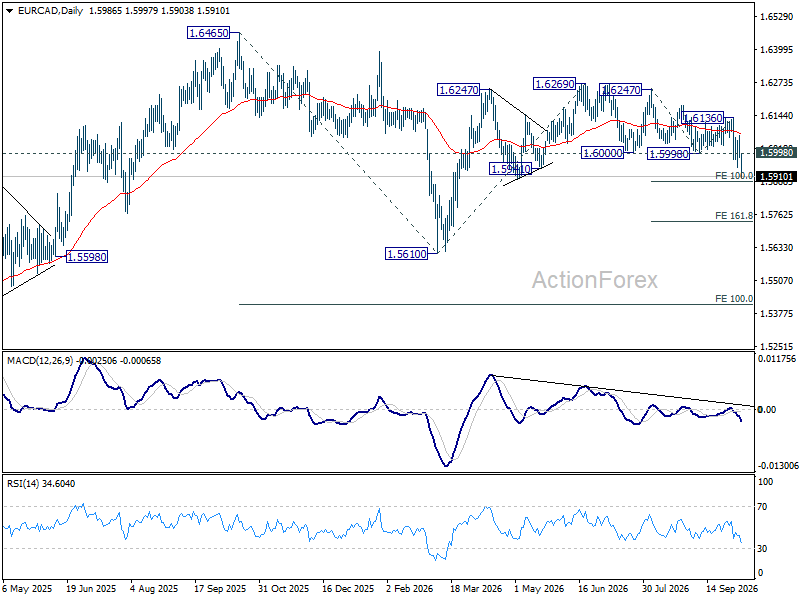
EUR/CAD’s decline from 1.6269 is finally showing some conviction, with the cross breaking clearly below the 1.5998–1.6000 support zone. That area should now turn into resistance, and near-term risks will remain on the downside as long as 1.6000 holds.
The immediate test is 1.5887, the 100% projection of the decline from 1.6247 to 1.5998 measured from 1.6136. This is more than just another short-term target. A firm break of 1.5887, particularly if accompanied by renewed downside acceleration, would strengthen the bearish structure and target the 161.8% projection at 1.5732.
Daily momentum is consistent with further weakness. RSI has fallen to around 34.6, while MACD is below its signal line and remains capped beneath a descending trendline. A recovery back above 1.6000 would weaken the immediate bearish case, while a move through 1.6136 would more clearly indicate that the breakdown had failed.
Break of 1.5887 Could Turn the Decline Into a Bigger Move
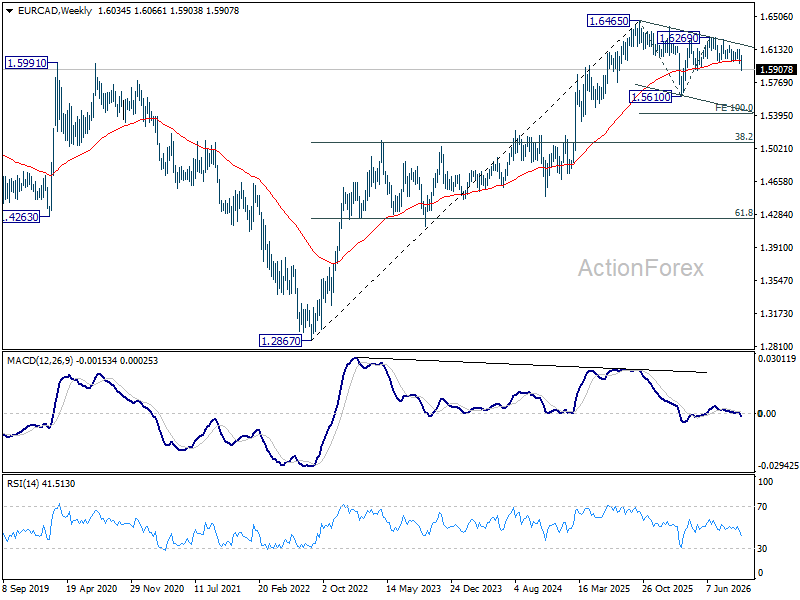
The weekly chart raises the stakes. EUR/CAD is also trading below its 55-week EMA, although Friday’s close is still needed to confirm a sustained break of that support. More importantly, the developing structure suggests that the fall from 1.6269 could be the third leg of the broader decline from the 1.6465 2025 high. The first leg fell from 1.6465 to 1.5610, before a substantial rebound to 1.6269.
That makes 1.5887 the key bridge between the short-term breakdown and the medium-term bearish case. A decisive break with accelerating downside momentum would raise the probability that the larger decline from 1.6465 is resuming. Attention would then move through 1.5732 toward the pivotal 1.5610 low. A break of 1.5610 would further confirm the larger bearish structure and put the 1.5414 equality projection, based on a 100% projection of the 1.6465 to 1.5610 decline from 1.6269, into focus.
France Is the Cause, EUR/CAD Is the Expression
The near-term calendar could still disturb the move. FOMC minutes are due at 18:00 GMT Wednesday, making US yields and the Dollar an immediate volatility risk. Canada’s employment report on Friday will then arrive shortly before EUR/CAD’s weekly close.
But the underlying chain remains straightforward. Tuesday’s bond rally temporarily relieved the pressure without resolving France’s fiscal credibility problem. French spreads are widening again, Euro has slipped back to the bottom of the major-currency table, and EUR/CAD has lost a support level that had held the recent range.
France is the cause, the Euro is the transmission, and EUR/CAD is where the renewed pressure is showing up.
Key Takeaways
- Euro flipped from the strongest to the weakest major currency within 24 hours as the OAT-Bund spread widened back to 137bp, confirming Tuesday’s calm was relief rather than resolution.
- France’s deficit (5.1% of GDP) and debt (119% of GDP) remain the core problem; UBS’s Ermotti says only “hard measures,” not incremental fixes, will resolve it.
- Higher French yields are being priced as risk premium, not rate attractiveness—which is why French yields can rise while the Euro falls.
- EUR/CAD has broken below the 1.5998–1.6000 support zone, with 1.5887 now the key bridge between a short-term breakdown and a bigger medium-term bearish move toward 1.5610.
- Wednesday’s FOMC minutes and Friday’s Canadian jobs report are near-term risks that could disturb the move, but the underlying driver remains France’s unresolved fiscal credibility problem.
Gyrostat September Retirement Portfolio Resilience Assessment
September Retirement Portfolio Resilience Assessment Markets have fallen. The price of risk has risen. ... Read more
Does The West Have A Problem With Government Bonds
If you have been following the financial pages over the past few weeks, one theme has begun to stand out from the usual ... Read more
August Retirement Portfolio Resilience Assessment
Markets Are Higher. The Price of Risk Is Lower. Retirement invest... Read more
When The Wave Turns
Why Retirement Investing Is Moving Towards Resilience Jeremy Grantham’s latest market warnings have revived an old tru... Read more
Gyrostat Capital Management: July Retirement Portfolio Resilience Assessment
The Market Is Currently Presenting an Opportunity to Strengthen Retirement Portfolio Resilienc... Read more
The Invisible Risk That Decides Your Retirement
Why how investors behave matters more than what markets do and what disciplined port... Read more