Markets have spent the past 24 hours receiving what should have been overwhelmingly Dollar-negative news. Negotiators from Washington and Tehran reportedly finalized a draft framework that would extend the current ceasefire, reopen the Strait of Hormuz, lift restrictions on Iranian oil exports, and reduce one of the largest geopolitical risks hanging over global markets. The development triggered another decline in oil prices, with Brent crude nearing a break below $90 per barrel. Meanwhile, enthusiasm surrounding artificial intelligence continued to drive global equities higher, pushing major U.S. and Asian stock indices to fresh records.
Despite all that, the Dollar remains remarkably resilient. The reason may be that foreign exchange traders are not buying the peace narrative as aggressively as equity investors. The proposed framework remains conditional on political approval, and both sides continue to communicate cautiously. Currency markets appear unwilling to completely remove the geopolitical risk premium until a formal agreement is signed and implementation begins. The memory of repeated setbacks throughout the conflict is keeping traders from abandoning defensive positioning entirely.
More importantly, the market is increasingly focused on the inflation consequences of the conflict rather than its potential resolution. The Middle East war already pushed energy prices sharply higher for several months, and the resulting inflation pressures have now appeared in official data, forcing the Federal Reserve to move away from any easing bias. Even if oil prices continue to fall from here, that does not erase the inflation already recorded or the Fed’s need to ensure inflation expectations remain anchored. In that environment, U.S. yields remain elevated and continue supporting Dollar demand.
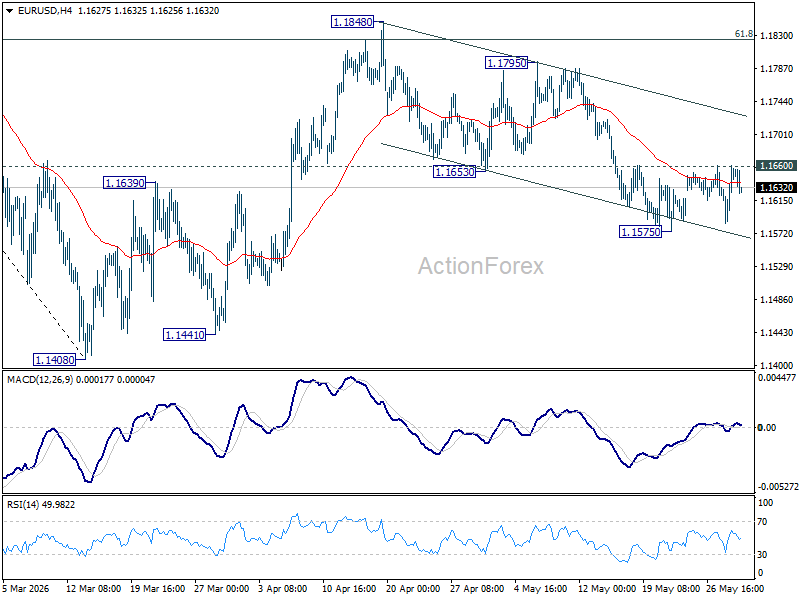
That dynamic helps explain why EUR/USD remains trapped in a relatively narrow range despite favorable conditions for Euro. The pair has recovered from 1.1575 but remains unable to clear 1.1660 resistance. As long as that barrier holds, the recovery can still be viewed as a consolidation within a broader decline from 1.1848.
On the downside, firm break through 1.1575 would reinforce the bearish case and target a return toward 1.1408 low.
Conversely, decisive break above 1.1660 would suggest the fall from 1.1848 has already completed as a correction at 1.1575, and open the way for a stronger recovery toward the falling channel resistance (now at 1.1725) at least.