

EUR/CAD Slides To 15-Month Low As BoC Reinforces Loonie Rally — Is 1.5000 Coming Into View?

TL;DR: EUR/CAD broke to a 15-month low after the BoC hiked to 2.50% and sharply revised its inflation forecast higher, reinforcing a Canadian Dollar rally that was already underway. With OIS pricing ~52% odds of a December follow-up hike and the cross testing 1.5414 support, a break opens the door toward the psychological 1.5000 level.
Why This Matters
EUR/CAD extended its decline to a 15-month low on Thursday, breaking through 1.5610 support and the previous 1.5598 low from mid-2025. The cross fell as low as 1.5572 during the Asian session before trading around 1.5589. The latest weakness was driven primarily by Canadian Dollar strength following the Bank of Canada’s rate hike and upward revisions to its inflation outlook, rather than a fresh wave of Euro selling. Importantly, the BoC decision reinforced a Loonie rally already underway, with EUR/CAD having fallen approximately 2.3% since October 9.
BoC Tightening Outlook Reinforces Canadian Dollar Strength
The BoC raised its overnight rate by 25bps from 2.25% to 2.50% on Wednesday, broadly matching market expectations. The more significant development was its revised inflation outlook:
- CPI expected to reach ~3.5% by end-2026
- Inflation to remain above 3% through much of 2027, averaging ~3%—roughly one percentage point above the BoC’s July forecast
- A return close to the 2% target only by mid-2028
The deterioration reflects persistent energy costs and expectations that businesses will increasingly pass higher production, transportation and imported input costs on to consumers. Meanwhile, stronger-than-expected economic activity prompted the BoC to upgrade its GDP growth forecasts to 1.0% for 2026 and 2.0% for both 2027 and 2028. The combination of stronger growth and more persistent inflation provides greater justification for maintaining monetary restraint, even though current core inflation measures remain close to 2%.
Governor Tiff Macklem reinforced the tightening bias by indicating that Governing Council had considered both holding and raising rates, but ultimately judged that inflation risks had increased and there was less scope for monetary accommodation. He left open the possibility of further hikes while emphasizing that decisions would be taken one meeting at a time, with no predetermined policy path.
The latest OIS pricing reflects expectations for additional tightening:
- December meeting: ~52% probability of another hike
- Implied policy rate: 2.92% by March 2027, 3.17% by June 2027
- BoC’s estimated neutral-rate midpoint: 2.75%
These expectations extend beyond the BoC’s neutral-rate estimate, suggesting that investors increasingly anticipate a move into restrictive territory.
However, the outlook is not without limits. If core inflation remains contained and energy prices moderate, expectations for rates rising substantially above neutral could be scaled back, potentially restraining further CAD appreciation.
BoC Validates an Existing CAD Rally, While Euro Holds Its Ranges
The Canadian Dollar’s advance began well before Wednesday’s policy decision. Between October 9 and 23, USD/CAD fell approximately 1.8% as expectations for a BoC hike increased sharply, supported by Governor Macklem’s earlier comments and rising oil prices. EUR/USD was broadly unchanged during that period, indicating that CAD strength was already the principal driver of EUR/CAD’s decline.
The BoC’s decision subsequently reinforced that trend. Since the October 23 close, CAD has strengthened against Euro, Sterling, Swiss Franc, Japanese Yen and New Zealand Dollar, while showing slight weakness against Australian Dollar. USD/CAD was trading near 1.3995, back below the 1.4000 level.
In contrast, the Euro has not experienced a comparable fresh deterioration. EUR/USD was holding around 1.1146, above last week’s 1.1111 low, while EUR/CHF remained above 0.9193 and EUR/GBP stayed within its recent range. French sovereign-market pressure was also relatively stable, with the 10-year OAT–Bund spread holding in a narrow band: around 162bps on Tuesday, 155bps on Wednesday, and 154bps on Thursday.
The evidence therefore points to broad CAD strength rather than renewed Euro-specific selling as the main force behind EUR/CAD’s latest breakdown. The distinction matters because the cross’s next move will depend not only on whether BoC tightening expectations continue to strengthen, but also on the ECB’s ability to sustain its own policy outlook.
Could the BoC–ECB Policy Gap Determine the Depth of the Correction?
The ECB’s policy decision later today will provide the next test of that divergence. A hold is widely expected, while the supplied OIS snapshot indicates approximately 76% probability of a December hike. That suggests investors are not assuming the ECB’s tightening cycle has ended, potentially limiting the scope for sustained Euro weakness.
Nevertheless, the two central banks face different constraints. The BoC is responding to stronger growth and the prospect of prolonged inflationary cost pass-through, while the ECB must also contend with uneven domestic economic conditions and fiscal uncertainty in parts of the Eurozone.
A further extension of the BoC’s tightening cycle into restrictive territory, combined with growing constraints on additional ECB hikes, could deepen EUR/CAD’s correction. Conversely, a firmer ECB policy outlook or a reassessment of the BoC’s projected rate path toward neutral could help stabilize the cross.
Canadian GDP data on Friday and the BoC’s December 9 decision will provide further evidence on whether current tightening expectations are justified.
ActionForex’s Technical View: EUR/CAD, 1.5414 Guards the Path to 1.5000
EUR/CAD’s break of 1.5610 support suggests that the fall from 1.6465 high is resuming. Next target is 100% projection of 1.6465 to 1.5610 from 1.6269 at 1.5414. On the upside, however, above 1.5720 resistance will bring consolidations first.
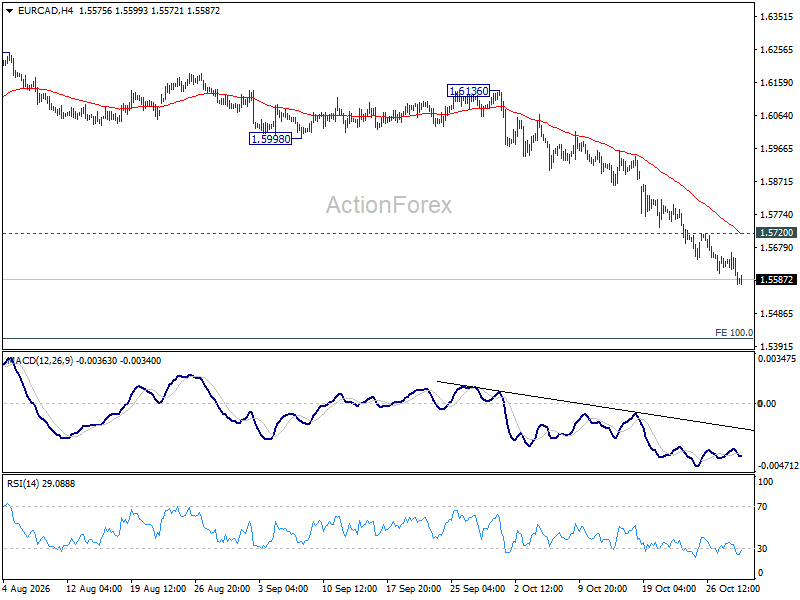
Daily RSI has fallen to around 17.5, indicating deeply oversold conditions. Some near-term consolidation or recovery could therefore be seen, but the broader downside momentum remains intact.
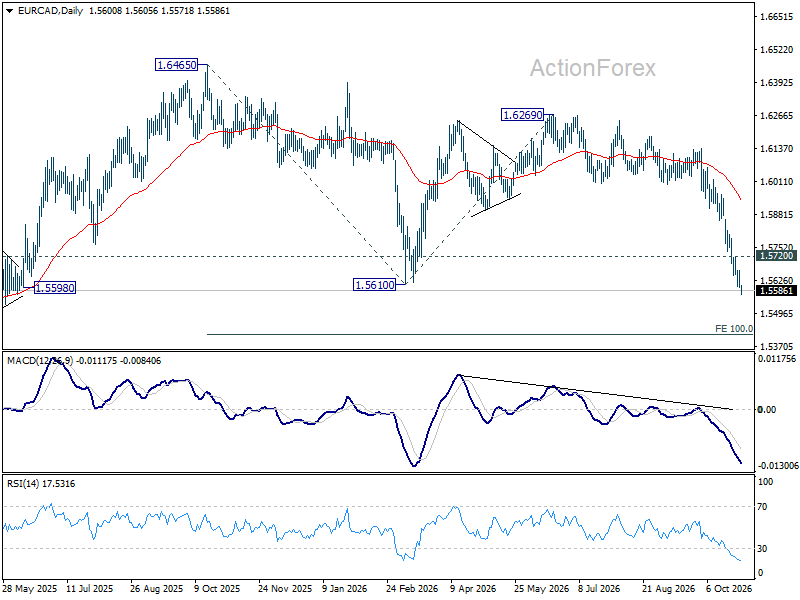
In the bigger picture, the fall from 1.6465 is seen as a correction in the broader uptrend from 1.2867 (2022 low), rather than a trend reversal. Some support could be seen around the 1.5414 projection level, which is close to the medium-term falling channel floor, to complete the correction.
However, firm break of 1.5414 will set up a deeper decline to 38.2% retracement of 1.2867 to 1.6465 at 1.5091, which is close to the psychological 1.5000 level.
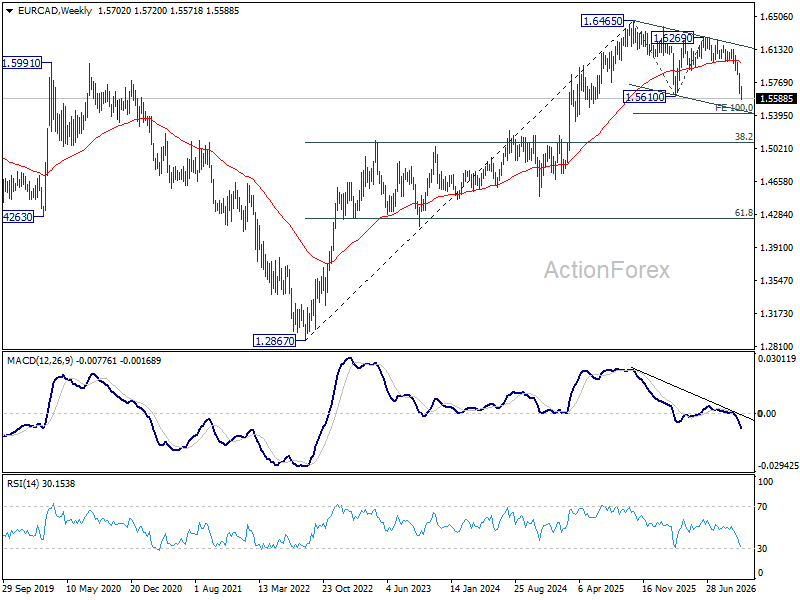
Such a scenario could materialize if the BoC’s tightening cycle extends well into restrictive territory while the ECB’s scope for further hikes is constrained by domestic economic and fiscal problems.
For now, the BoC’s tightening outlook continues to reinforce CAD strength and EUR/CAD’s correction. The immediate technical test is 1.5414, while a decisive break there would bring the possibility of a deeper decline toward 1.5000 into focus.
Key Takeaways
- EUR/CAD hit a 15-month low, falling ~2.3% since October 9—driven overwhelmingly by CAD strength, not fresh Euro selling (EUR/USD was broadly flat over the same stretch).
- The BoC hiked to 2.50% and sharply upgraded its inflation forecast (~3.5% by end-2026, averaging ~3% through 2027, ~1pp above its July projection), while also raising GDP growth forecasts to 1.0% (2026) and 2.0% (2027–28).
- OIS pricing shows ~52% odds of a December BoC hike, with the implied rate path (2.92% by March, 3.17% by June 2027) already extending past the Bank’s 2.75% neutral-rate estimate.
- Today’s ECB decision is the key swing factor: a hold is expected, but ~76% odds of a December hike mean the ECB’s own cycle isn’t seen as over—limiting how far Euro weakness can extend.
- EUR/CAD’s key technical level is 1.5414; a firm break opens the 38.2% retracement at 1.5091, just above the psychological 1.5000 level, while daily RSI near 17.5 leaves room for a near-term bounce first.
Behavioural & Retirement Portfolio Resilience
Behavioural Survivability and Retirement Portfolio Resilience Why the lived experience of market recovery matters as mu... Read more
Australia's Rate Rise Bites: Highest In 15 Years
The Reserve Bank of Australia has lifted interest rates to their highest level since 2011, and its governor admits the w... Read more
October Retirement Portfolio Resilience Assessment
Markets stabl Read more
Gyrostat September Retirement Portfolio Resilience Assessment
September Retirement Portfolio Resilience Assessment Markets have fallen. The price of risk has risen. ... Read more
Does The West Have A Problem With Government Bonds
If you have been following the financial pages over the past few weeks, one theme has begun to stand out from the usual ... Read more
August Retirement Portfolio Resilience Assessment
Markets Are Higher. The Price of Risk Is Lower. Retirement invest... Read more