

Dollar Strengthens, Risk Tone Softens Ahead Of US-China Trade Talks

Risk sentiment turned slightly softer again, as Asian equities pulled back following Wall Street’s modest decline overnight. Investors took a more cautious stance after recent rallies, with profit-taking emerging ahead of key global data and fresh developments on the U.S.–China trade front. Nikkei 225 led the regional retreat, slipping after its record-breaking run earlier this week driven by optimism over newly appointed Prime Minister Sanae Takaichi’s pro-stimulus policy stance.
While sentiment toward Takaichi’s leadership remains positive, markets appear to be digesting earlier gains, with 50,000 level acting as a strong psychological barrier for the Nikkei. The pullback is viewed as a technical correction following an extraordinary advance rather than a reversal in momentum. Investors are waiting for more clarity on the new administration’s fiscal measures and trade posture before re-engaging at higher levels.
Elsewhere in the region, South Korea’s KOSPI initially jumped to a new record high after the Bank of Korea held its benchmark interest rate steady at 2.50%, extending a policy pause that began in May. The index later trimmed gains, mirroring the broader regional tone as risk appetite faded into the afternoon session.
On the trade front, U.S. President Donald Trump struck a cautiously optimistic tone, saying he expected to reach several agreements with Chinese President Xi Jinping when they meet in South Korea next week — including possible soybean purchase commitments and nuclear arms limits. Meanwhile, Treasury Secretary Scott Bessent and Trade Representative Jamieson Greer headed to Malaysia for talks aimed at easing tensions over China’s rare earth export curbs. Bessent said he was optimistic that two days of “fulsome” discussions would lay the groundwork for a productive leaders’ meeting, though U.S. officials have prepared additional measures should talks stall.
In currency markets, Dollar extended its lead while Loonie and Aussie followed. Japanese Yen remained the weakest performer, trailed by Swiss Franc and New Kiwi, while Sterling and Euro stayed mid-pack.
In Asia, at the time of writing, Nikkei is down -1.46%. Hong Kong HSI is down -0.19%. China Shanghai SSE is down -0.83%. Singapore Strait Times is down -0.03%. Japan 10-year JGB yield is up 0.001 at 1.656. Overnight, DOW fell -0.71%. S&P 500 fell -0.53%. NASDAQ fell -0.93%. 10-year yield fell -0.010 to 3.953.
WTI climbs Past 60 after US sanctions on Russia Fall from 78.87 run its course?
Oil prices rebounded sharply today, with WTI crude rising back above the 60 mark, as geopolitical tensions re-entered focus after the Trump administration imposed new sanctions on Russia’s two largest oil producers, Rosneft and Lukoil.
The U.S. Treasury said the move was in response to Moscow’s “lack of serious commitment” to a peace process to end the war in Ukraine. Announcing the sanctions, Treasury Secretary Scott Bessent said “now is the time to stop the killing and for an immediate ceasefire,” warning that Washington is prepared to “take further action if necessary.” He urged U.S. allies to join in applying pressure on Moscow. Reports suggested that the new round of sanctions followed the collapse of a planned Trump–Putin meeting in Budapest, which had raised hopes for progress toward de-escalation.
The sanctions created a short-covering wave across crude futures, helping oil snap its recent losing streak. While demand signals remain mixed, the reemergence of supply-side uncertainty has stabilized sentiment, halting a multi-week slide that had dragged prices persistently.
Technically, the rebound has taken on added significance. The firm break above 59.47 resistance confirms that a short-term bottom has likely formed at 56.44, accompanied by bullish convergence in 4H MACD after testing the channel floor.
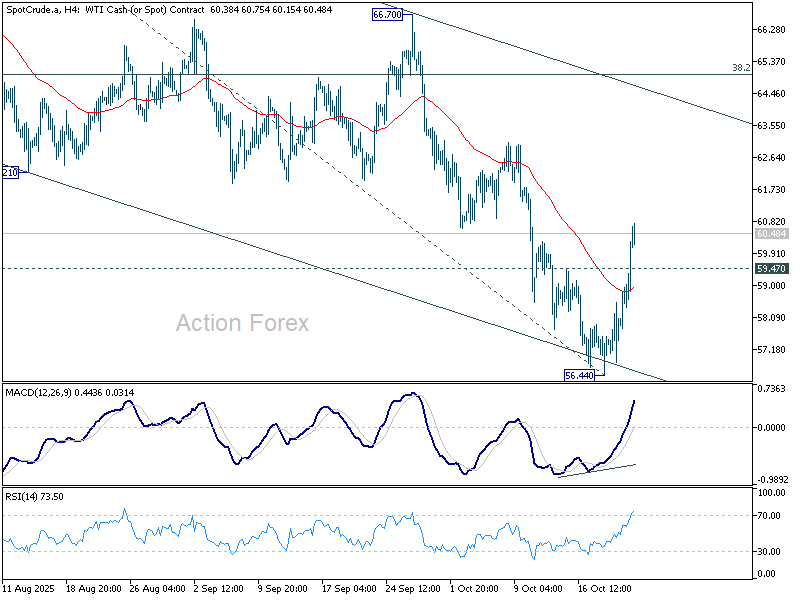
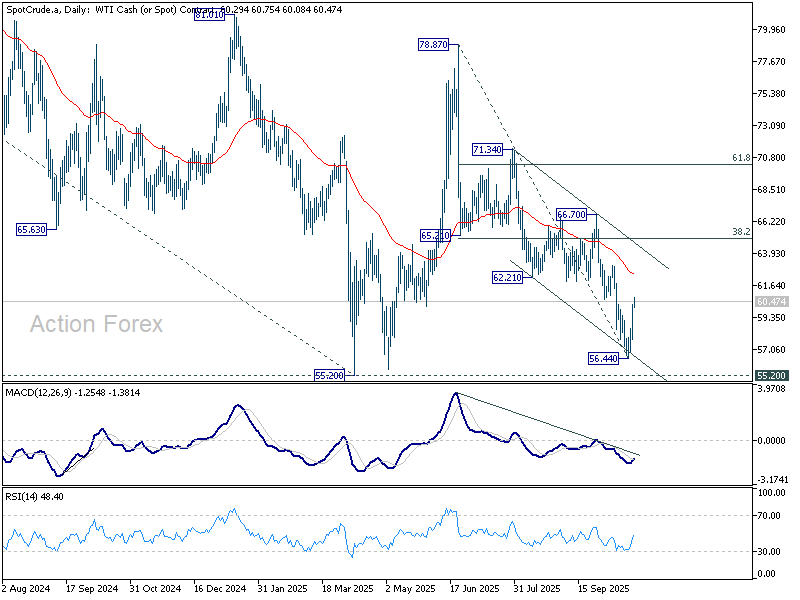
The focus now shifts to whether the fall from 78.87 has completed as a corrective move as second leg of the broader pattern from 55.20 (2025 low made in April).
In either case, further gains are favored toward key resistance zone between 62.21 support turned resistance and 55 EMA (now at 62.46). Sustained break above this area would strengthen the case for near-term bullish reversal, opening the way to 38.2% retracement of 78.87 to 56.44 at 65.00.
However, failure to clear this zone would suggest the rebound remains corrective, keeping risks skewed toward another dip back toward 55.20 before a more durable bottom forms.
USD/JPY Daily Outlook
Daily Pivots: (S1) 151.62; (P) 151.84; (R1) 152.18; More…
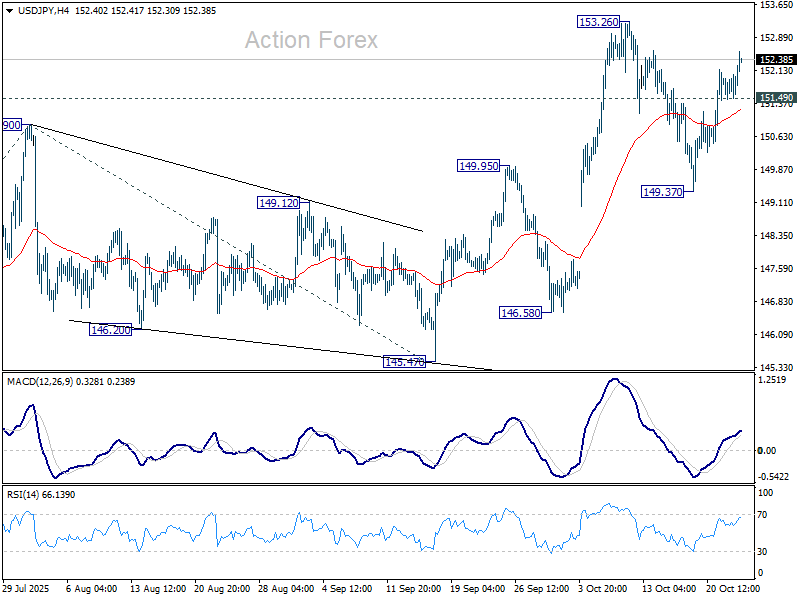
Intraday bias in USD/JPY remains on the upside for retesting 153.26 resistance. Break there will resume larger rally from 139.87 to 100% projection of 142.66 to 150.90 from 145.47 at 153.71. Firm break there would prompt upside acceleration to 161.8% projection at 158.80. On the downside, below 151.49 minor support will turn intraday bias neutral again first.
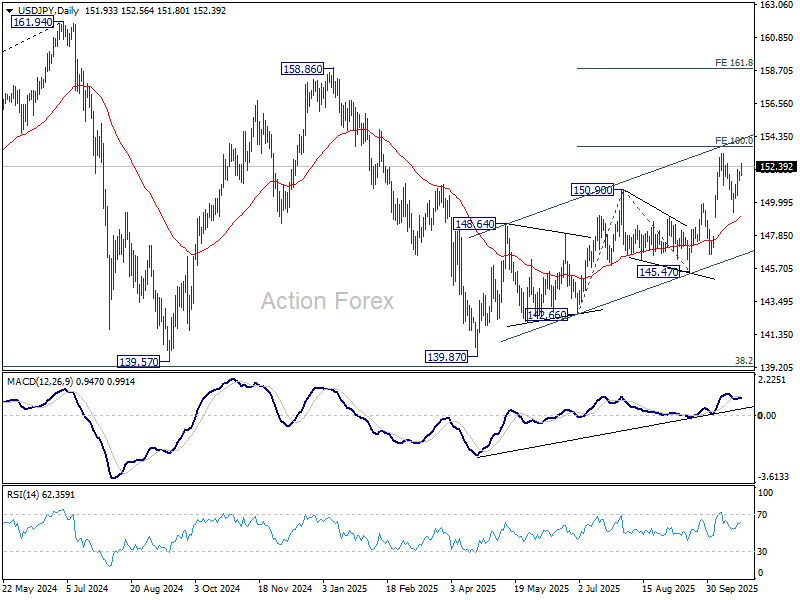
In the bigger picture, current development suggests that corrective pattern from 161.94 (2024 high) has completed with three waves at 139.87. Larger up trend from 102.58 (2021 low) could be ready to resume through 161.94 high. On the downside, break of 145.47 support will dampen this bullish view and extend the corrective pattern with another falling leg.
Gyrostat September Retirement Portfolio Resilience Assessment
September Retirement Portfolio Resilience Assessment Markets have fallen. The price of risk has risen. ... Read more
Does The West Have A Problem With Government Bonds
If you have been following the financial pages over the past few weeks, one theme has begun to stand out from the usual ... Read more
August Retirement Portfolio Resilience Assessment
Markets Are Higher. The Price of Risk Is Lower. Retirement invest... Read more
When The Wave Turns
Why Retirement Investing Is Moving Towards Resilience Jeremy Grantham’s latest market warnings have revived an old tru... Read more
Gyrostat Capital Management: July Retirement Portfolio Resilience Assessment
The Market Is Currently Presenting an Opportunity to Strengthen Retirement Portfolio Resilienc... Read more
The Invisible Risk That Decides Your Retirement
Why how investors behave matters more than what markets do and what disciplined port... Read more