

Dollar Rises As Strong Payrolls Reinforce Fed Patience, USD/JPY Clears 160

Dollar strengthened broadly in early US session after a much stronger-than-expected US employment report reinforced confidence in the resilience of the labor market. Non-farm payrolls rose 172k in May, nearly double expectations, while April’s gain was revised sharply higher to 179k. Unemployment held steady at 4.3%, and wage growth remained contained, with average hourly earnings rising 0.3% mom and annual growth slowing from 3.6% yoy to 3.4% yoy. The combination of strong hiring and moderating wage pressures is likely to be welcomed by Federal Reserve officials.
Importantly, the report does not fundamentally change the Fed’s current stance. Policymakers have increasingly shifted their focus away from labor-market concerns and toward inflation risks linked to elevated energy prices and the ongoing US-Iran conflict. Strong payroll growth confirms that employment remains resilient, while slower annual wage growth suggests there is still no clear evidence of a renewed wage-price spiral. For the Fed, the data provide additional room and time to assess how the oil shock is feeding through the broader economy before considering any policy response.
Markets interpreted the report as modestly supportive for the hawkish side of the policy debate. Pricing for a 25bps Fed rate hike by year-end rose to around 60% following the release. Yet the increase in tightening expectations was measured rather than dramatic, reflecting the view that one employment report is unlikely to force the Fed away from its wait-and-see approach. Instead, the data mainly strengthen the argument that policymakers can afford to remain patient while monitoring inflation developments.
The move in Treasury yields may prove just as important as the payrolls report itself. US 10-year yields climbed back above 4.5% level, providing Dollar with an additional tailwind. If yields continue to rise in coming hours, the greenback could find broader support beyond the initial post-NFP reaction. Attention is now turning to whether Dollar can break decisively higher against Euro before the weekly close and signal a more sustained bullish momentum.
Meanwhile, strong market reaction was also seen against Yen. USD/JPY surged above the psychologically important 160 level following the payrolls release, pushing back through Japan’s unofficial intervention red line. The move came despite continued warnings from Japanese officials. Earlier on Friday, reserve data showed Japan’s foreign reserves fell by around USD 75 billion in May, broadly matching the Ministry of Finance’s disclosure that roughly USD 73.4 billion was spent on intervention operations during the Golden Week period.
Finance Minister Satsuki Katayama reiterated that authorities would respond “appropriately at any time when necessary” and retained the right to take “decisive action” against excessive volatility. She also emphasized that Tokyo remains in close communication with Washington regarding currency developments. With USD/JPY once again above 160, markets are now focused on whether Japan will step back into the market or tolerate a fresh leg higher in the pair.
For the week so far, Dollar stands as the strongest major currency, followed by Sterling and Euro. At the other end of the table, Kiwi is the weakest performer, followed by Swiss Franc and Aussie. Loonie and Yen are positioned in the middle, reflecting support from stronger domestic data in Canada and ongoing intervention concerns in Japan.
US Non Farm Payrolls Crush Expectations with 172k Growth
The May payrolls report delivered exactly the outcome the Fed wanted to see: strong hiring, stable unemployment, and no major wage surprise. Payroll growth nearly doubled expectations, while April’s figure was revised sharply higher. The result does not guarantee another rate hike, but it gives policymakers greater freedom to focus on inflation risks rather than labor-market weakness. Read More.
Canada Employment Surges 87.8K, Unemployment Falls to 6.6%
Canada’s labor market delivered a surprise comeback in May. Employment surged by 87,800, unemployment fell to 6.6%, and full-time hiring jumped by 154,000. After losing 112,000 jobs during the first four months of the year, the report suggests the labor market may be far more resilient than recent data had implied. Read More.
Eurozone Economy Contracts -0.2% qoq in Q1 as Trade and Investment Drag Growth Lower
The Eurozone economy contracted in the first quarter of 2026 as trade and investment weakened significantly. Household spending and government consumption continued to support activity, but not enough to offset falling capital expenditure and weaker external demand. Annual growth slowed to just 0.3%, underscoring the increasingly difficult balance facing the ECB as inflation remains elevated while economic momentum fades. Read More.
Japan Wage Growth Surges to 34-Year High Streak, Consumption Still Lags
Japan’s long-awaited wage revival is gaining momentum. Real wages rose for a fourth consecutive month in April, while nominal wage growth exceeded 3% for a third straight month for the first time in more than three decades. The figures strengthen the case for further BoJ normalization, although household spending remains too weak to declare victory just yet. Read More.
USD/JPY Daily Outlook
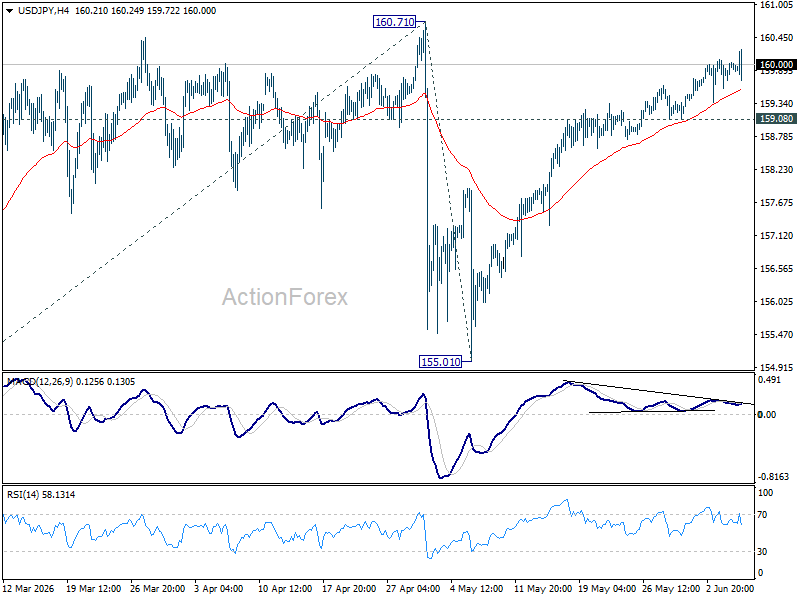
USD/JPY’s rally from 155.01 is still in progress and intraday bias stays on the upside. As this rise is viewed as the second leg of the corrective pattern from 160.71, strong resistance should emerge there to cap upside. Break of 159.08 minor support will turn bias back to the downside for 55 D EMA (now at 158.56) and below. However, decisive break of 160.71 will confirm up trend resumption. That should push USD/JPY through 161.94 to 100% projection of 152.25 to 160.71 from 155.01 at 163.47 next.
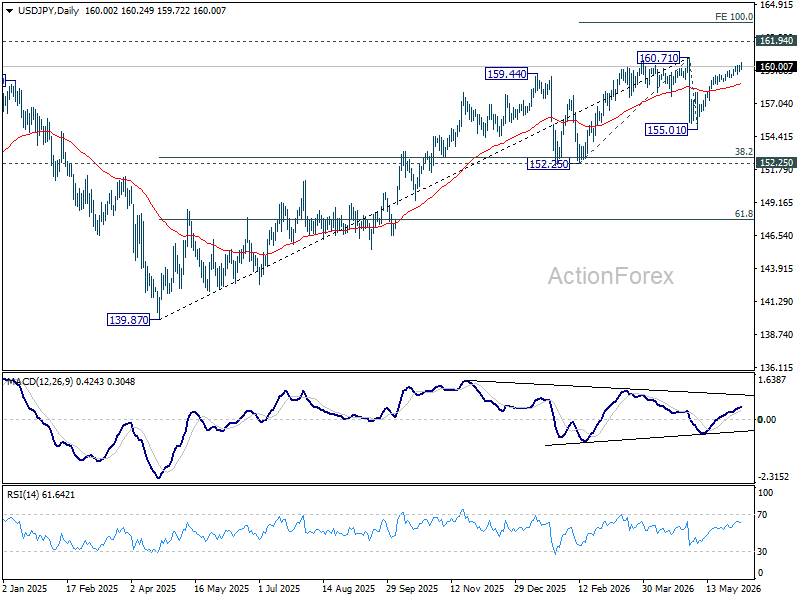
In the bigger picture, for now, corrective pattern from 161.94 (2024 high) is still seen as completed at 139.87. Rise from there is seen as resuming the long term up trend. So, break of 161.94 is expected at a later stage to resume the long term up trend. However, sustained break of 55 W EMA (now at 154.55) will dampen this view and bring deeper fall back towards 139.87 to extend the pattern from 161.94.
Gyrostat September Retirement Portfolio Resilience Assessment
September Retirement Portfolio Resilience Assessment Markets have fallen. The price of risk has risen. ... Read more
Does The West Have A Problem With Government Bonds
If you have been following the financial pages over the past few weeks, one theme has begun to stand out from the usual ... Read more
August Retirement Portfolio Resilience Assessment
Markets Are Higher. The Price of Risk Is Lower. Retirement invest... Read more
When The Wave Turns
Why Retirement Investing Is Moving Towards Resilience Jeremy Grantham’s latest market warnings have revived an old tru... Read more
Gyrostat Capital Management: July Retirement Portfolio Resilience Assessment
The Market Is Currently Presenting an Opportunity to Strengthen Retirement Portfolio Resilienc... Read more
The Invisible Risk That Decides Your Retirement
Why how investors behave matters more than what markets do and what disciplined port... Read more