

Dollar Rises As Oil And Yields Climb, France Pushes Euro To Bottom Ahead Of Fed Minutes

Three Pressure Points, Energy, Long-End Yields and French Fiscal Stress, Converge Into the FOMC Minutes
What’s happening: The Dollar is leading the majors into the FOMC minutes, with DXY at 102.401, up 0.55% at the time of writing, and the Dollar stronger against all seven major peers. Oil is holding above $100, long-end bond yields are climbing across major markets, and renewed stress in French government debt has pushed the Euro to the bottom of the currency table.
Why it matters: This is broader than a US rates story. European yields are rising too, and French yields are rising much faster than US Treasuries, which means France is adding a separate sovereign-risk premium that hits the Euro disproportionately hard. Heading into the Fed minutes, energy, long-end yields and French fiscal stress are all pressing at once.
The Dollar is leading the majors into the FOMC minutes, but Wednesday’s move is broader than a simple US rates story. Oil is holding above $100, long-end bond yields are climbing across major markets, equities and metals are under pressure, and renewed stress in French government debt has pushed the Euro to the bottom of the currency table.
DXY was at 102.401, up 0.55% at the time of writing, with the Dollar stronger against all seven major peers. The ActionForex Currency Heat Map at 12:15 GMT shows the defensive character of the move clearly: the Euro is the weakest major, while the Yen and Swiss Franc are holding up much better despite the Dollar’s broad strength.
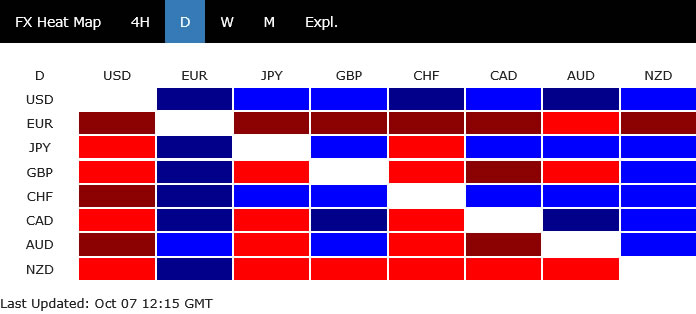
The distinction matters because European yields are rising as well—and French yields are rising much faster than US Treasuries. Oil is keeping the global inflation and term-premium problem alive, but France is adding a separate sovereign-risk premium that is hitting the Euro disproportionately hard. That leaves the market heading into the Fed minutes with three pressure points converging at once: energy, long-end yields and French fiscal stress.
Oil Holds Above $100 as Geopolitical Risk Offsets Improving Supply
Oil and Middle East Data Points
- Brent: back above the psychological $100 level
- Houthis: attacked Aden airport with missiles and drones
- Bab el-Mandeb Strait: fighting intensified in the area
- Saudi East-West Pipeline: carrying 5.8 million barrels per day as of Tuesday morning
Brent is back above the psychological $100 level. The important development is the persistence of the Middle East risk premium. Yemen’s Houthis attacked Aden airport with missiles and drones, while fighting intensified around the Bab el-Mandeb Strait. Saudi-led forces also reported intercepting missiles, while the Houthis separately claimed attacks on Saudi targets that were not all immediately confirmed.
Bab el-Mandeb has become more important as restrictions around the Strait of Hormuz disrupt normal trade routes. CNBC also reported renewed concern over tanker attacks around Hormuz, even as physical supply conditions improve. Saudi Arabia’s East-West Pipeline was carrying 5.8 million barrels per day as of Tuesday morning.
That leaves oil caught between better physical supply and persistent geopolitical risk. For bonds, the second part of that equation is enough to keep inflation concerns alive even without a large daily rise in crude.
Long-End Yields Keep Climbing
US Treasury yields are rising again, but the shape of the move is important. The 2-year yield was 4.814%, up 1.6bp, while the 10-year climbed to 5.345%, up 5.9bp, and the 30-year to 5.725%, up 6.4bp.
US Treasury Yields Across the Curve
| Maturity | Yield | Change |
|---|---|---|
| 2-year | 4.814% | Up 1.6bp |
| 10-year | 5.345% | Up 5.9bp |
| 30-year | 5.725% | Up 6.4bp |
The heavier pressure at the long end supports the view that energy risk, inflation uncertainty, debt supply and term premium are doing more work than immediate Fed repricing. The US 10-year had already touched a 24-year high this week, while bond yields have been selling off for roughly six weeks.
Borrowing Costs and Supply
- US 30-year mortgage rate: rose 19bp to 7.49% in the week ended October 2, its highest since November 2023
- US mortgage applications: fell 4.2%
- US 10-year Treasury auction: $39bn today
That pressure is already feeding into household borrowing costs. The average US 30-year mortgage rate rose 19bp to 7.49% in the week ended October 2, its highest since November 2023, while mortgage applications fell 4.2%.
Today’s $39bn US 10-year Treasury auction will therefore be another test of how much yield investors require to absorb duration before attention shifts to the FOMC minutes.
France Pushes Euro to the Bottom
The Euro is the weakest major on the day, and the French bond market provides the clearest explanation.
Currency and French Bond Data Points
- DXY: 102.401, up 0.55% at the time of writing
- Dollar: stronger against all seven major peers
- Euro: weakest major on the ActionForex heat map at 12:15 GMT
- Yen and Swiss Franc: holding up much better despite the Dollar’s broad strength
- OAT-Bund spread: widened to 141.2bp, up sharply from 129.7bp at Tuesday’s close
- OAT-Bund spread: had narrowed sharply from Monday’s roughly 150bp intraday peak
The OAT-Bund spread had widened to 141.2bp, up sharply from 129.7bp at Tuesday’s close. Tuesday’s relief therefore lasted one session. The spread had narrowed sharply from Monday’s roughly 150bp intraday peak, but the underlying fiscal problem never changed.
IMF Managing Director Kristalina Georgieva, speaking to CNBC on Wednesday on the sidelines of an event in Singapore, said France needs to reduce its deficit and restore fiscal credibility, while also stressing that Europe now has stronger institutional safeguards than during the earlier sovereign debt crisis. Her message to France was simple: “get your house in order.”
That reinforces the signal already coming from private-sector investors. UBS CEO Sergio Ermotti has argued that incremental adjustments are unlikely to be sufficient, while Federated Hermes’ Mitch Reznick sees French debt increasingly being priced more like the European periphery than the core.
The FX consequence is straightforward: French yields are rising for the wrong reason for the Euro. Investors are demanding compensation for fiscal and political risk, rather than pricing stronger growth or a more aggressive ECB.
Fed Minutes Test How Broad September’s Hawkishness Really Was
The next major event is the FOMC minutes at 18:00 GMT, covering the September 15-16 meeting when the Fed raised its target range by 25bp to 3.75–4.00%.
FOMC Minutes Backdrop
- Minutes release: 18:00 GMT, covering the September 15-16 meeting
- September decision: Fed raised its target range by 25bp to 3.75–4.00%, unanimously
- Dot projections: 16 of 18 officials projected one more hike this year
- October 27-28 meeting: about a 78% probability of no change, according to CME data
- September CPI: arrives before the October decision
The decision itself was unanimous, while 16 of 18 officials projected one more hike this year. But the minutes may show a much broader debate underneath that vote.
The key question is whether officials saw September as the start of a steady tightening sequence or as a move that could be followed by greater patience. Dallas Fed President Lorie Logan has argued that at least two more hikes may be needed, while New York Fed President John Williams and Fed Vice Chair Philip Jefferson have stressed there is no need for urgency.
Markets currently price about a 78% probability of no change at the October 27-28 meeting, according to CME data. September CPI will arrive before that decision.
The timing is important. The minutes describe a meeting held before softer September employment data and more encouraging inflation readings. Even a relatively hawkish discussion would therefore have to be interpreted against information that arrived later.
A hawkish reading could add pressure to front-end yields, metals and the Euro while extending Dollar strength. A more patient tone could pull the 2-year yield and the Dollar lower, although the long end may remain tied more closely to oil, inflation risk and Treasury supply.
Two Ways to Read the Minutes
| Tone of the minutes | Likely market effect |
|---|---|
| Hawkish reading | Added pressure on front-end yields, metals and the Euro; extends Dollar strength |
| More patient tone | Could pull the 2-year yield and the Dollar lower, although the long end may stay tied to oil, inflation risk and Treasury supply |
Oil, France and the Fed Are the Three Levels to Watch
For the remainder of the session, the market has three clear reference points.
Three Reference Points
- Brent: holding above $100 keeps the global inflation and rates backdrop uncomfortable
- French spread and yield: the OAT-Bund spread holding above 140bp, with France’s 10-year approaching 5.00%, would reinforce the Euro-specific stress story
- EUR/USD: needs to recover above the 1.1185 Fibonacci projection level on a daily closing basis to counter the latest bearish signal
Brent holding above $100 keeps the global inflation and rates backdrop uncomfortable. The French spread holding above 140bp, with France’s 10-year approaching 5.00%, would reinforce the Euro-specific stress story. EUR/USD also needs to recover above the 1.1185 Fibonacci projection level on a daily closing basis to counter the latest bearish signal.
Then comes the Fed.
For now, oil is sustaining the global yield problem, France is pushing the Euro to the bottom of the currency table, and the FOMC minutes will determine whether the Dollar gets an additional policy catalyst or remains primarily a beneficiary of the defensive backdrop.
Related Coverage
FX, Metals and the Fed
- Euro Slides Again as French Bond Relief Lasts One Day, EUR/CAD Kisses 1.6000 Goodbye: the cross-rate view of the Euro’s weakness, with a decisive break of 1.5887 needed to turn the decline into a larger bearish third leg.
- Silver’s Deficit May Be Narrowing, But 58.68–62.30 Will Decide the Next Move: Deutsche sees physical tightness easing, but the chart still decides the next move, with 59.66 and 58.68 in focus below 62.30.
- Fed Daly: AI, Tariffs and Oil Could Compound Into a More Persistent Inflation Shock: a Fed official warning that these shocks could stop being temporary if they persist or reinforce each other, keeping further tightening on the table.
Japan: BOJ and Wages
- BOJ Dove Sato Sounds Less Dovish Than Her September Vote Suggested: Takaichi-appointed board member Ayano Sato backs gradual hikes while warning that consumption remains weak.
- Japan Real Wages Rise for Eighth Month as Base Pay Holds Firm Despite Headline Slowdown: wage growth cooled to 3.8%, but bonuses drove the slowdown while base pay stayed firm and real wages remained positive.
FAQ
Why is the Dollar firm and the Euro the weakest major if this is not just a US rates story?
Oil is holding above $100, long-end yields are climbing across major markets, and European yields are rising as well. French yields are rising much faster than US Treasuries, so France is adding a separate sovereign-risk premium on top of the global inflation and term-premium problem. That is hitting the Euro disproportionately hard, while the Yen and Swiss Franc hold up much better despite the Dollar’s broad strength. DXY was at 102.401, up 0.55%, with the Dollar stronger against all seven major peers.
Why did French bond relief last only one session?
The OAT-Bund spread widened to 141.2bp, up sharply from 129.7bp at Tuesday’s close. It had narrowed from Monday’s roughly 150bp intraday peak, but the underlying fiscal problem never changed. IMF Managing Director Kristalina Georgieva told France to “get your house in order,” while UBS CEO Sergio Ermotti argues incremental adjustments are unlikely to be sufficient and Federated Hermes’ Mitch Reznick sees French debt increasingly priced like the European periphery.
What could the FOMC minutes mean for the Dollar?
The minutes cover the September 15-16 meeting, held before softer September employment data and more encouraging inflation readings, so even a hawkish discussion has to be read against later information. A hawkish reading could add pressure to front-end yields, metals and the Euro while extending Dollar strength. A more patient tone could pull the 2-year yield and the Dollar lower, although the long end may stay tied to oil, inflation risk and Treasury supply. Markets price about a 78% probability of no change at the October 27-28 meeting.
Key Takeaways
- The Dollar is leading the majors into the FOMC minutes, with DXY at 102.401, up 0.55%, and the Dollar stronger against all seven major peers.
- Energy, long-end yields and French fiscal stress are converging, with Brent back above $100 and the Middle East risk premium persisting despite improving physical supply.
- US yields are rising with the heaviest pressure at the long end: the 2-year is up 1.6bp to 4.814%, the 10-year up 5.9bp to 5.345% and the 30-year up 6.4bp to 5.725%.
- The average US 30-year mortgage rate rose 19bp to 7.49%, its highest since November 2023, making today’s $39bn 10-year auction another test of required yield.
- The Euro is the weakest major because French yields are rising faster than US Treasuries, with the OAT-Bund spread at 141.2bp versus 129.7bp at Tuesday’s close.
- The minutes describe a September meeting held before softer employment data and more encouraging inflation readings, so a hawkish tone has to be interpreted against later information.
- EUR/USD needs a daily close above the 1.1185 Fibonacci projection level to counter the latest bearish signal.
What to Watch Next
Today’s $39bn US 10-year auction comes first, followed by the FOMC minutes at 18:00 GMT, which will show whether the Dollar gets an additional policy catalyst or remains mainly a beneficiary of the defensive backdrop. Beyond the minutes, September CPI arrives before the October 27-28 meeting, where markets price about a 78% probability of no change.
Across markets, watch whether Brent holds above $100, whether the OAT-Bund spread holds above 140bp with France’s 10-year approaching 5.00%, and whether EUR/USD can recover above 1.1185 on a daily closing basis.
Gyrostat September Retirement Portfolio Resilience Assessment
September Retirement Portfolio Resilience Assessment Markets have fallen. The price of risk has risen. ... Read more
Does The West Have A Problem With Government Bonds
If you have been following the financial pages over the past few weeks, one theme has begun to stand out from the usual ... Read more
August Retirement Portfolio Resilience Assessment
Markets Are Higher. The Price of Risk Is Lower. Retirement invest... Read more
When The Wave Turns
Why Retirement Investing Is Moving Towards Resilience Jeremy Grantham’s latest market warnings have revived an old tru... Read more
Gyrostat Capital Management: July Retirement Portfolio Resilience Assessment
The Market Is Currently Presenting an Opportunity to Strengthen Retirement Portfolio Resilienc... Read more
The Invisible Risk That Decides Your Retirement
Why how investors behave matters more than what markets do and what disciplined port... Read more