

Dollar Gains As Oil And CPI Lift Fed Hike Bets, But Risk Appetite Holds Firm

Dollar strengthened broadly today as rising oil prices and firmer-than-expected US inflation data continued pushing markets toward a more hawkish Federal Reserve outlook. However, the overall move remained relatively measured as broader risk sentiment stayed resilient, with investors still reluctant to fully embrace defensive positioning ahead of the Trump-Xi summit later this week.
Oil prices remained a key driver. Brent crude climbed back above %107 while WTI traded above %100 as stalled US-Iran peace negotiations continued sustaining geopolitical risk premium in energy markets. Nevertheless, both benchmarks remain largely trapped within the broad consolidation ranges established after the sharp March spike, suggesting traders still see the Hormuz crisis as unresolved but not yet spiraling into a full-scale crisis. The eventual direction of the Strait of Hormuz situation may depend heavily on the outcome of Thursday’s Trump-Xi summit.
The second major support for Dollar came from US inflation data. April CPI showed headline inflation accelerating from 3.3% yoy to 3.8% yoy, while core CPI rose from 2.6% yoy to 2.8% yoy, both slightly above expectations. The firmer core readings in particular raised concern that energy-driven inflation pressures may now be spreading more broadly into underlying consumer prices. Fed fund futures subsequently pushed further toward pricing no rate cuts this year, while implied odds of a rate hike rose toward 28%.
Still, Dollar’s rally remained restrained overall. US equities held relatively firm, and broader risk appetite continued receiving support from ongoing optimism surrounding AI-related investment themes and semiconductor demand. The market tone suggests investors are pricing higher inflation risk without yet fully shifting toward outright crisis positioning.
Sterling was among the weakest major currencies earlier in the session as UK political concerns intensified following the first ministerial resignation calling for Prime Minister Keir Starmer to step down. Markets had already become uneasy after Labour’s poor local election results last week, but Miatta Fahnbulleh’s resignation turned the leadership crisis into a more immediate market concern. However, the Pound later stabilized after senior Cabinet ministers rallied behind Starmer following a critical internal meeting where he insisted he would not resign voluntarily without a formal leadership challenge.
Yen also experienced significant intraday volatility. Initially, the currency weakened alongside rising oil prices, continuing the recent pattern where higher energy costs pressure Japan’s import-heavy economy. However, Yen later rebounded strongly after US Treasury Secretary Scott Bessent reaffirmed that both the United States and Japan believe excessive currency volatility is undesirable.
Speaking after meeting Prime Minister Sanae Takaichi, Bessent said Washington remained in close contact with Japanese authorities on exchange rate developments and expressed confidence that BOJ Governor Kazuo Ueda would successfully avoid falling behind the curve on inflation. The remarks were interpreted by markets as broad US support for Japan’s recent Yen-buying intervention efforts. The comments followed similar remarks earlier from Japanese Finance Minister Satsuki Katayama, who confirmed close coordination with Washington on currency market developments.
In the currency markets, Dollar is the strongest one for the day so far, followed by Kiwi, and then Loonie. Sterling is the worst, followed by Swiss Franc, and then Aussie. Euro and Yen are positioning in the middle of the pack.
In Europe, at the time of writing, FTSE is down -0.30%. DAX is down -0.95%. CAC is down -0.57%. UK 10-year yield is up 0.105 at 5.11. Germany 10-year yield is up 0.049 at 3.092. Earlier in Asia, Nikkei rose 0.52%. Hong Kong HSI fell -0.22%. China Shanghai SSE fell -0.25%. Singapore Strait Times rose 0.07%. Japan 10-year JGB yield rose 0.019 to 2.544.
US CPI Hits Highest Since 2023, Core Inflation Beats Expectations
April’s US CPI report reinforced the “higher for longer” inflation narrative as both headline and core prices accelerated faster than expected. Rising gasoline, shelter, and food costs suggest inflation pressures are broadening beyond energy alone, further reducing expectations for Fed rate cuts this year. Read More.
EUR/GBP Surges as Markets Price “Zombie Government” Risk as Starmer Crisis Deepens
Sterling came under intense pressure after the first ministerial resignation demanding Keir Starmer’s departure transformed Labour’s political crisis into a broader market concern. With more than 80 MPs reportedly calling for a leadership transition, traders are increasingly pricing “zombie government” risk into UK assets. Read More.
German ZEW Sentiment Rises to -10.2, But Economy Still Burdened by Energy Shock
Germany’s ZEW survey showed investor sentiment recovering modestly in May as markets increasingly hoped for eventual de-escalation in the Iran conflict. However, weak industrial activity, rising energy costs, and deteriorating current conditions continued highlighting the fragile state of Europe’s largest economy. Read More.
BoJ Summary Shows Growing Support for Near-Term Rate Hike
The BOJ’s April meeting summary revealed a noticeably more hawkish debate inside the board, with several policymakers openly discussing the possibility of another rate hike as the Iran-driven oil shock lifts inflation risks. Markets are increasingly pricing a potential move as early as June. Read More.
Australia NAB Survey Shows Cost Growth Jumps to 4.5% as Margin Squeeze Intensifies
Australia’s April NAB survey painted an increasingly stagflationary picture as purchase cost growth surged to 4.5% following the Middle East energy shock. While firms continued facing rising input costs, weaker trading, employment, and activity indicators suggested margin pressure is beginning to weigh more heavily on the broader economy. Read More.
GBP/USD Mid-Day Outlook
Daily Pivots: (S1) 1.3555; (P) 1.3603; (R1) 1.3656; More…
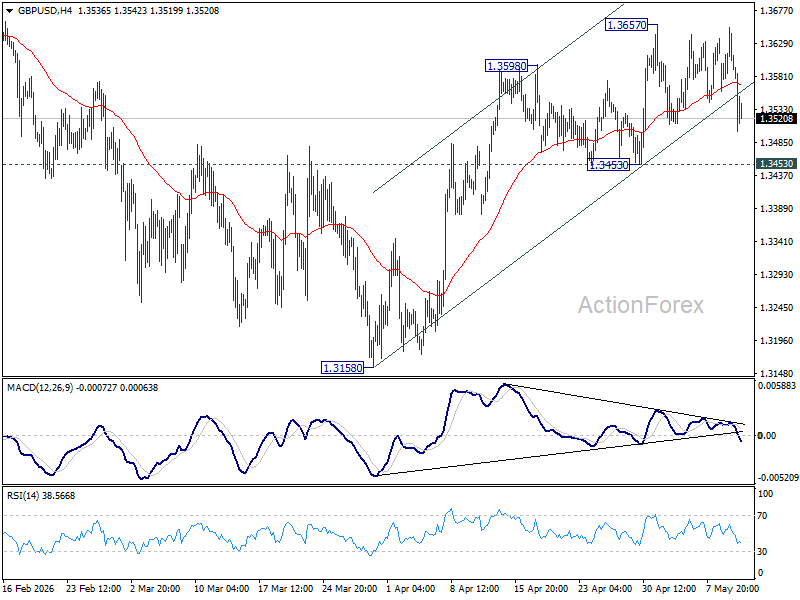
GBP/USD falls notably today but stays above 1.3453 support. Intraday bias remains neutral and further rally is in favor. On the upside, firm break of 1.3657 will resume the rally fro 1.3158 to retest 1.3867 high. However, decisive break of 1.3453 will argue that the rebound has already completed, and turn bias to the downside for retesting 1.3158 instead.
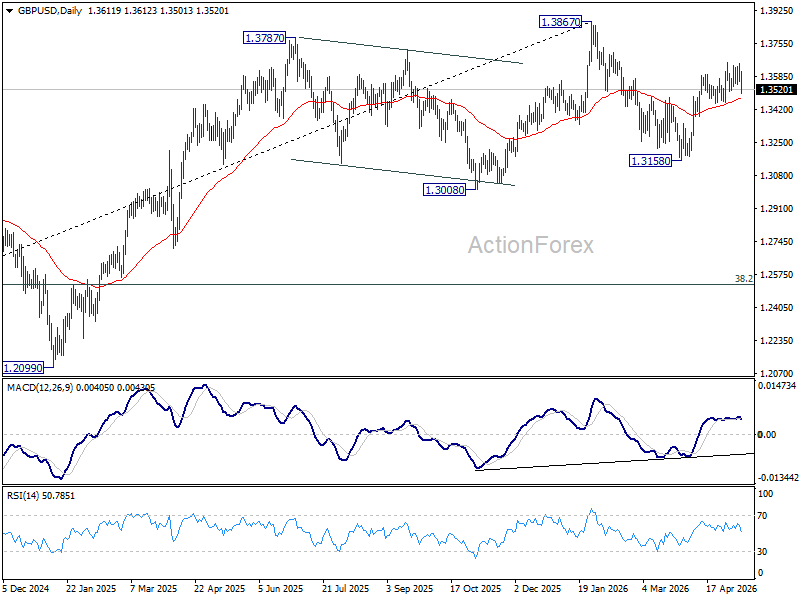
In the bigger picture, current development suggests that price actions from 1.3867 are merely a corrective pattern within the broader up trend from 1.0351 (2022 low). With 1.3008 support intact, medium term bullishness is maintained and break of 1.3867 is in favor for a later stage, towards 1.4248 key resistance (2021 high).
Gyrostat September Retirement Portfolio Resilience Assessment
September Retirement Portfolio Resilience Assessment Markets have fallen. The price of risk has risen. ... Read more
Does The West Have A Problem With Government Bonds
If you have been following the financial pages over the past few weeks, one theme has begun to stand out from the usual ... Read more
August Retirement Portfolio Resilience Assessment
Markets Are Higher. The Price of Risk Is Lower. Retirement invest... Read more
When The Wave Turns
Why Retirement Investing Is Moving Towards Resilience Jeremy Grantham’s latest market warnings have revived an old tru... Read more
Gyrostat Capital Management: July Retirement Portfolio Resilience Assessment
The Market Is Currently Presenting an Opportunity to Strengthen Retirement Portfolio Resilienc... Read more
The Invisible Risk That Decides Your Retirement
Why how investors behave matters more than what markets do and what disciplined port... Read more