

Brent Oil Price Tops $99 As Saudi Attack Widens The Oil Risk Map. Is This War Spike Different?

TL;DR: Brent pushed through $99 on a confirmed Houthi attack on Saudi Arabia and a more specific Iranian exclusion-zone threat, giving this spike more concrete backing than prior ones — but whether it’s genuinely different will likely be decided at 104.23, where both the fundamental and technical stories face their real confirmation test.
Brent Pushes Through 99 as the Risk Map Widens
Brent has produced plenty of war-driven spikes during the six-month Middle East conflict. Tuesday’s push through 99 deserves closer attention because both the news behind the move and the technical structure ahead are beginning to look different.
The immediate catalyst was a confirmed Houthi attack on southern Saudi Arabia that wounded more than 73 people across four cities and triggered fires at some energy facilities. The significance isn’t simply another increase in regional tension — it’s the opening of a more active Saudi front, adding a second source of physical energy-supply risk alongside the Iran-US confrontation and disruption around the Strait of Hormuz.
At the same time, Iran has made its threatened Gulf exclusion zone more specific. Mohsen Rezaei, secretary of Iran’s Supreme National Security Council, said the zone would begin where the US blockade of Iran starts and extend into Gulf waters, with vessels entering it potentially placed on an Iranian sanctions list. Maps and full implementation details haven’t yet been released, so the proposal remains short of an operational restriction. But the threat has moved from broad rhetoric toward a stated mechanism.
That combination helps explain why Brent’s latest move has more substance than another reaction to an unspecified escalation. The question now is whether price can confirm that distinction. The first test is 102.00. The more important one sits just beyond it at 104.23.
Saudi Arabia Adds a New Front to the Oil Risk Story
The Houthi attack matters because markets have spent months adapting to a familiar geopolitical framework centred on Iran, US forces, and the Strait of Hormuz. Those risks haven’t disappeared. But repeated tanker incidents, threats against shipping, and exchanges involving military assets have become increasingly familiar inputs for oil traders. Tuesday added something less familiar.
The Iran-backed Houthis carried out attacks across southern Saudi Arabia, with energy facilities among the sites affected. The Saudi-led coalition responded by saying it would take the operational measures necessary to deter the group.
The Houthis have already been conducting a campaign against Saudi Arabia since declaring a naval blockade against Riyadh in July, including attacks linked to Red Sea shipping. But a confirmed attack producing casualties and fires at energy facilities raises the question of whether the Saudi dimension of the conflict is becoming materially more important.
That matters because Saudi Arabia isn’t simply another regional participant — it’s one of the world’s most important oil producers and exporters. The market therefore has to consider not only disruption to transit through Hormuz, but the possibility that production and energy infrastructure on Saudi territory face a more persistent threat.
Monday’s reported strike on Saudi Aramco’s 400,000-barrel-per-day Jizan refinery remains relevant background, although responsibility was still unclear in the initial reporting and damage was being assessed. That distinction should be preserved. Monday raised concern about Saudi infrastructure. Tuesday provided clearer evidence that the Houthi-Saudi front itself is active.
Iran’s Exclusion Zone Is Becoming More Concrete
The second source of support for Brent isn’t an attack but a threat that has become more defined. Iran had previously discussed establishing an exclusion zone in response to US pressure. Rezaei’s latest remarks added mechanics to that threat, saying it would begin where the US blockade starts and extend into Gulf waters, while vessels entering the area could face Iranian sanctions. The absence of maps and implementation details remains important.
There’s a large difference between announcing a maritime restriction and physically enforcing one. That gives oil markets a clear sequence to monitor: threat → defined mechanism → implementation. Iran appears to have moved from the first stage toward the second. The third remains unproven.
That distinction is likely to be crucial because roughly one-fifth of global oil and LNG shipments moved through the Strait of Hormuz before the war. Even incremental changes in the perceived probability of further disruption therefore carry disproportionate implications for energy prices.
Iran has also sharpened its military rhetoric, while the missile reportedly launched toward US warships over the weekend has now been identified as a Qassem Basir ballistic missile. The US military maintains that its ships avoided any attack. For Brent, however, the most important next development isn’t the name of the weapon — it’s whether the threatened exclusion zone begins affecting actual vessel movements.
ActionForex’s Technical View on Brent: 102 Is the First Test, 104.23 Is the Bigger One
Brent oil broke above $99 today and is showing fresh signs of upward acceleration, as seen in the 4H MACD. Further rally is now expected as long as 93.91 support holds, toward 102.00 resistance first, and then the 61.8% projection of 70.14 to 102.00 from 84.56, at 104.23, next.
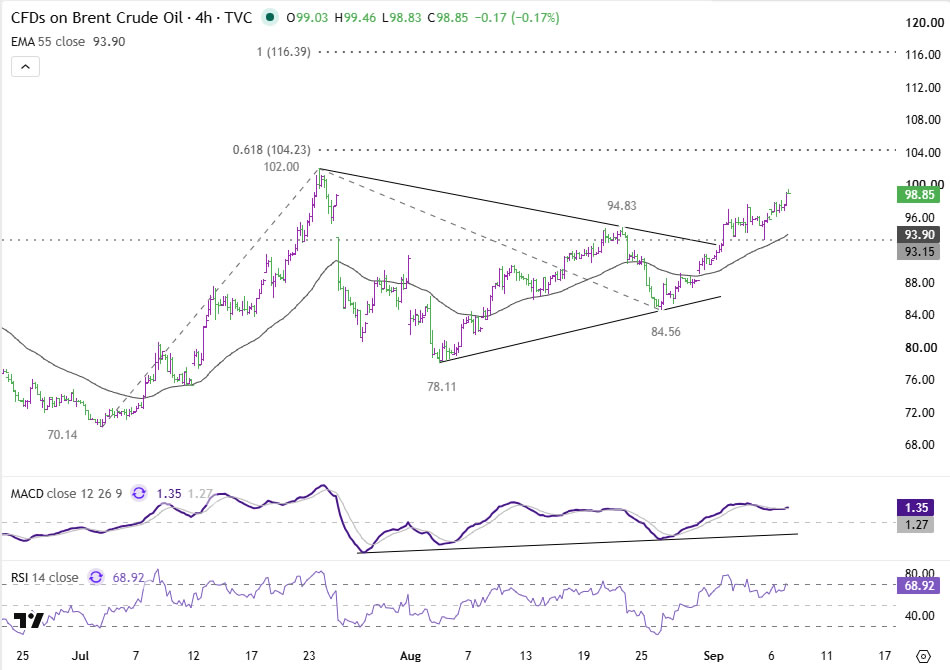
The reaction from that projection level would be crucial to the near-term outlook. Overbought conditions in the 4H RSI might cap upside at 104.23 on the initial attempt. However, a strong break of 104.23, with a persistent overbought signal (RSI above 70), would be an indication that the whole rise from 70.14 is developing into an impulsive move. In that case, the 100% projection at 116.39 would be next.
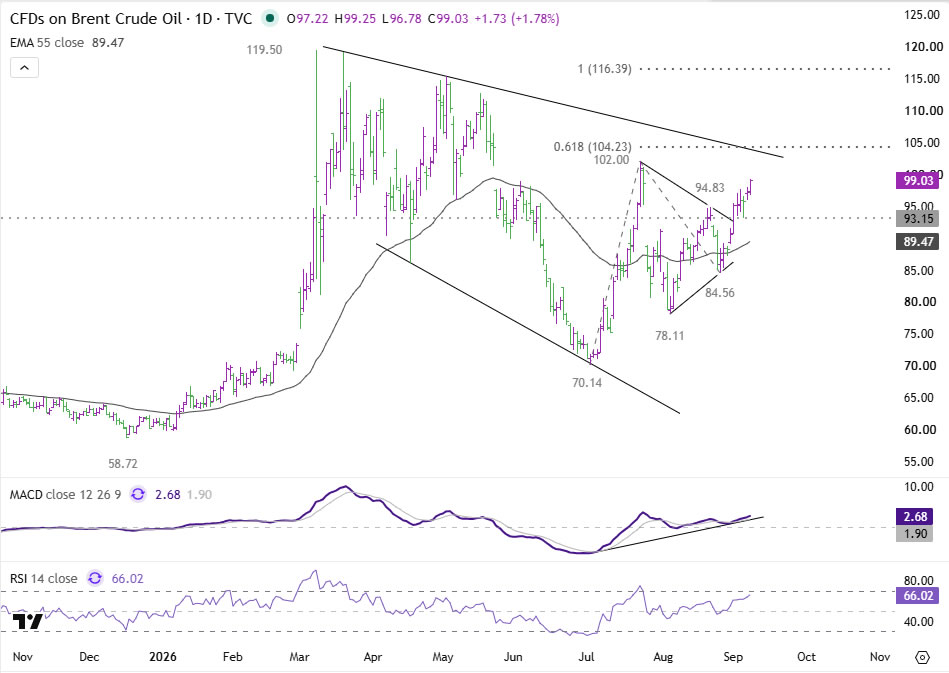
More importantly, upside acceleration through 104.23 and the falling trendline resistance on the daily chart would solidify the case that the correction from 119.50 has completed with three waves down to 70.14. The larger uptrend could then be ready to resume through 119.50.
Fundamentals Now Have Their Own Confirmation Test
The geopolitical side of the story has a similarly clear threshold. Iran has given its exclusion-zone threat more detail. The next step is implementation. Does Tehran produce maps? Are vessels actually denied access or placed under the threatened sanctions regime? Does shipping activity change in a measurable way? If the answers start becoming yes, the physical-market implications would be much harder to dismiss as rhetoric.
The Saudi front has a similar test. Tuesday’s Houthi attack has widened the geographic scope of risk. What matters next is whether it develops into a continuing campaign against Saudi energy infrastructure or whether the coalition response contains the escalation.
These are the developments capable of supporting a sustained move through 102–104.23. Without them, the market may once again discover that geopolitical momentum fades faster than technical momentum can sustain the rally.
104.23 Will Tell Us Whether This Spike Is Different
That leaves Brent with an unusually clean convergence between fundamentals and technicals. The latest rally has more concrete backing than many previous spikes. Saudi territory and energy facilities have been hit in an attributed attack, while Iran has provided more detail around its proposed Gulf exclusion zone. But that doesn’t yet prove the market has entered a different regime. The confirmation tests lie ahead.
Fundamentally, Iran needs to turn its exclusion-zone proposal into actual implementation, while the Houthi-Saudi front would need to show Tuesday’s attack is part of a broader escalation rather than an isolated burst.
Technically, Brent first needs to clear 102.00 and then confront the much more important 104.23 projection and descending trendline. A rejection there, particularly as momentum rolls over from overbought territory, would leave room for another familiar war-driven spike-and-fade. A decisive break, accompanied by sustained momentum, would make a much stronger case that the recovery from 70.14 has become impulsive and that the larger correction from 119.50 may be over.
Brent has broken 99. Whether this war spike is genuinely different will probably be decided a few dollars higher.
Key Takeaways
- Brent’s break above $99 is backed by two concrete developments: a confirmed Houthi attack on Saudi energy infrastructure and a more specific Iranian exclusion-zone threat.
- Iran’s exclusion zone has moved from vague rhetoric to a stated mechanism, but still lacks maps or evidence of actual implementation affecting vessel movements.
- The Saudi front’s significance hinges on whether Tuesday’s attack becomes a sustained campaign against energy infrastructure or remains an isolated incident.
- 102.00 is the first technical test, but 104.23, the 61.8% projection of the 70.14-102.00 rally, is the more important level for confirming an impulsive move.
- A rejection at 104.23 from overbought conditions would fit the pattern of prior spike-and-fade episodes, while a decisive break would open 116.39 and revive the case for a resumed uptrend toward 119.50.
Does The West Have A Problem With Government Bonds
If you have been following the financial pages over the past few weeks, one theme has begun to stand out from the usual ... Read more
August Retirement Portfolio Resilience Assessment
Markets Are Higher. The Price of Risk Is Lower. Retirement invest... Read more
When The Wave Turns
Why Retirement Investing Is Moving Towards Resilience Jeremy Grantham’s latest market warnings have revived an old tru... Read more
Gyrostat Capital Management: July Retirement Portfolio Resilience Assessment
The Market Is Currently Presenting an Opportunity to Strengthen Retirement Portfolio Resilienc... Read more
The Invisible Risk That Decides Your Retirement
Why how investors behave matters more than what markets do and what disciplined port... Read more
Gyrostat Capital Management: The Missing Allocation In Retirement Portfolio Construction?
For decades, retirement portfolios have largely been constructed using combinations of growth assets a... Read more