

Bitcoins Next Stop Could Be $60k. The Bigger Risk May Be $40k.

Bitcoin is flashing increasingly bearish signals at a time when many traditional risk assets continue to look remarkably resilient. The cryptocurrency plunged below $70,000 this week, accelerating a decline that has already erased much of the recovery from February’s lows. The divergence with equity markets is becoming difficult to ignore. While investors continue pushing technology shares and AI-related stocks toward record highs, Bitcoin is behaving as though the macro environment is becoming steadily more hostile.
Part of the explanation lies in energy markets. The renewed uncertainty surrounding US-Iran negotiations has kept oil prices elevated even without a full-scale escalation in hostilities. Investors are worried that prolonged disruption around the Strait of Hormuz could sustain inflation pressures through higher transportation and energy costs. That in turn raises the prospect of interest rates staying higher for longer. While stock markets remain focused on earnings and AI investment themes, Bitcoin appears to be reacting more directly to concerns about liquidity and monetary conditions.
Institutional flows have amplified the weakness. More than $4.2 billion has exited digital asset investment products over the last three weeks, reversing one of the key sources of support that fueled Bitcoin’s earlier rally. Spot ETF redemptions require fund managers to sell physical Bitcoin into the market, creating a persistent stream of supply. With fewer institutional buyers stepping in, normal market volatility has become harder to absorb.
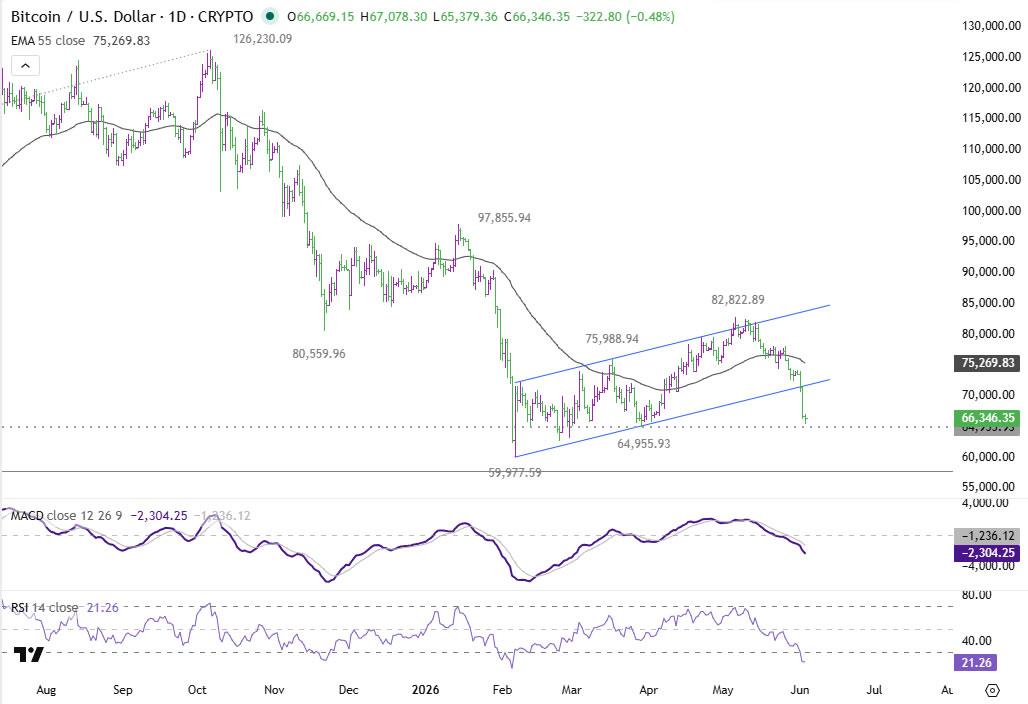
The technical damage is also becoming harder to dismiss. Bitcoin has broken decisively below a rising daily channel, indicating that the rebound from 59,977 likely ended with three waves up to 82,822. As long as prices remain below 55 D EMA (now at 75,260), the path of least resistance points lower. Support around 64,955 may slow the decline initially, but a decisive break would open the door to a retest of the 59,977 low.
In the bigger picture, the downtrend from 126,230 is not yet complete. Rejection by 55 W EMA (now at 84,352) reinforced the bearish medium-term outlook. As the down trend extends, Bitcoin will likely dive through 61.8% retracement of 15,479 (2022 low) to 12,6230 (2025 high) at 57,786 to 78.6% retracement at 39,180.
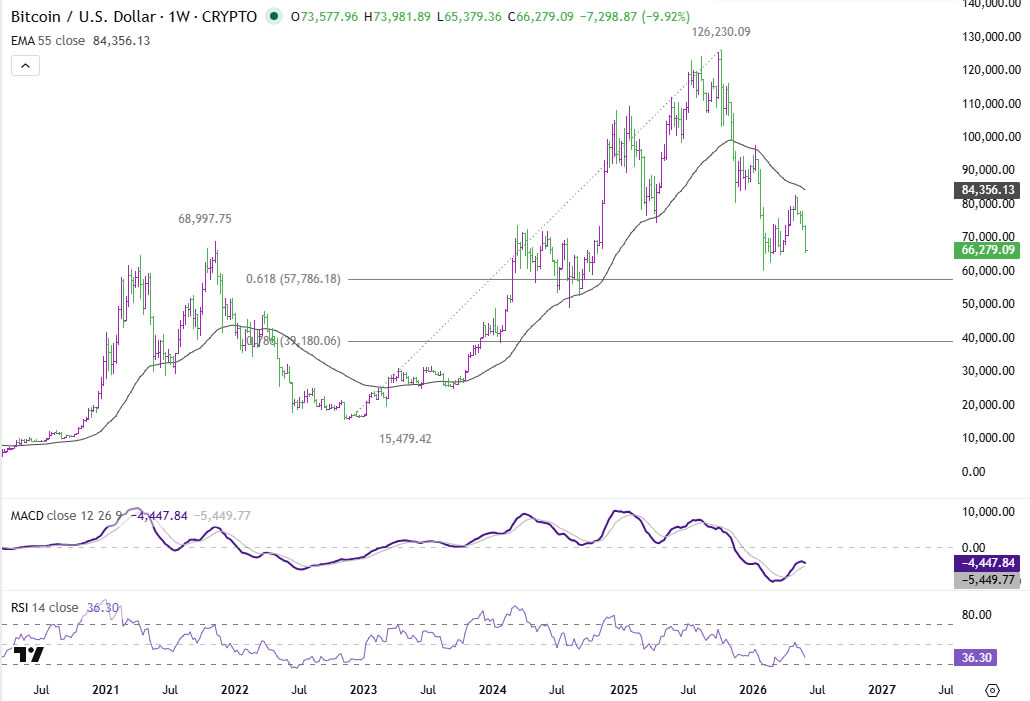
For now, a move toward $60,000 appears to be the most immediate risk. But if macro pressures persist, ETF outflows continue, and technical support levels fail, the conversation could shift rapidly toward the possibility of a much deeper decline. In that scenario, the $40,000 area may become a far more relevant target than many investors currently expect.
Gyrostat September Retirement Portfolio Resilience Assessment
September Retirement Portfolio Resilience Assessment Markets have fallen. The price of risk has risen. ... Read more
Does The West Have A Problem With Government Bonds
If you have been following the financial pages over the past few weeks, one theme has begun to stand out from the usual ... Read more
August Retirement Portfolio Resilience Assessment
Markets Are Higher. The Price of Risk Is Lower. Retirement invest... Read more
When The Wave Turns
Why Retirement Investing Is Moving Towards Resilience Jeremy Grantham’s latest market warnings have revived an old tru... Read more
Gyrostat Capital Management: July Retirement Portfolio Resilience Assessment
The Market Is Currently Presenting an Opportunity to Strengthen Retirement Portfolio Resilienc... Read more
The Invisible Risk That Decides Your Retirement
Why how investors behave matters more than what markets do and what disciplined port... Read more