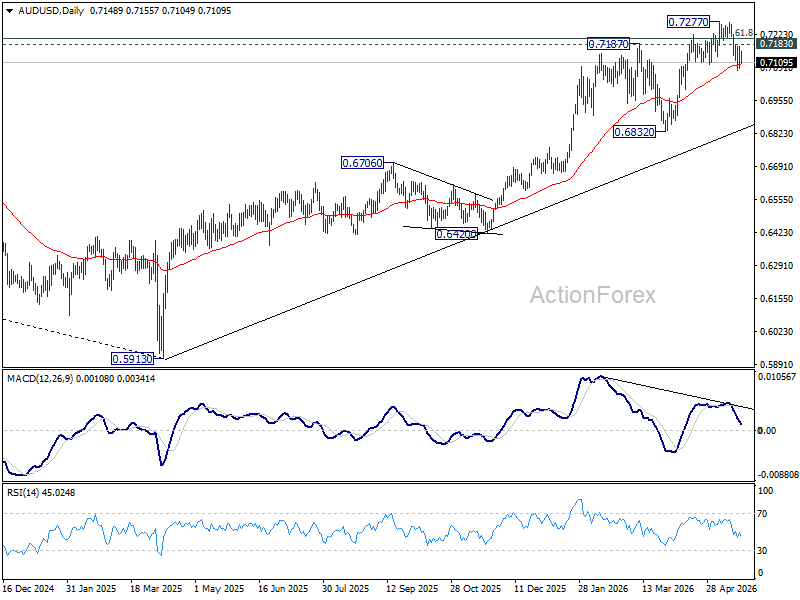
The Aussie tried to rally on improving global sentiment. Australia’s economy had other ideas.
AUD/USD bounced earlier today as markets reacted positively to signs that Washington and Tehran may be moving closer toward a diplomatic breakthrough. President Donald Trump’s claim that the US was in the “final stages” of negotiations with Iran helped cool fears surrounding the Strait of Hormuz and triggered a sharp retreat in oil prices, with Brent falling back below $106 after briefly surging above $112 earlier this week. Asian stocks rebounded, safe-haven Dollar demand eased, and the Aussie initially joined the relief rally.
But the recovery quickly lost momentum once Australia’s weak labor market data hit the wires. Employment unexpectedly contracted by -18.6k in April instead of rising by the expected 15.2k, while unemployment rate jumped from 4.3% to 4.5%. The report reinforced growing signs that the RBA’s aggressive tightening campaign — combined with the broader global slowdown and prolonged energy shock — is finally starting to bite into domestic demand and hiring conditions.
That shift matters because the RBA had spent much of this year maintaining a relatively hawkish posture amid concerns about inflation expectations and energy-driven price pressures. Now the narrative could be changing. The central bank has all the justification it needs to pause in June and reassess conditions rather than continue tightening immediately. The weak jobs report effectively shut down remaining speculation about another near-term hike.
The result is an Aussie Dollar caught in a classic macro tug-of-war. On one side, improving global risk sentiment and falling oil prices support commodity-linked currencies. On the other, weakening domestic fundamentals increasingly undermine confidence in Australia’s own economic outlook. So far, neither side has fully won — but the domestic story is starting to look heavier.
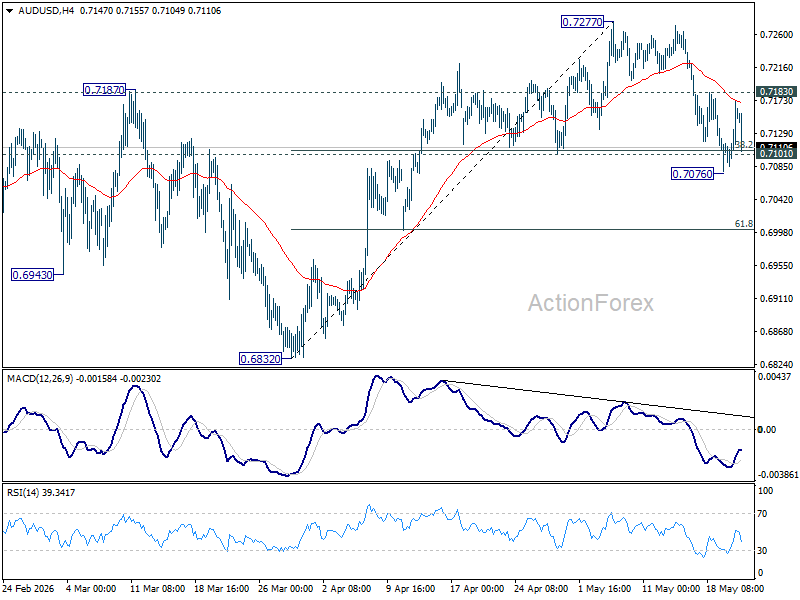
Technically, AUD/USD is also showing signs that rallies are increasingly being sold into rather than extended. The pair’s rejection at the 55 4H EMA (now at 0.7168) keeps short-term bias pointed lower, while a break below 0.7076 would resume the decline from 0.7277.
More importantly, bearish divergence on the D MACD strengthens the case that 0.7277 may already have marked a medium-term top. If downside momentum accelerates through 55 D EMA (now at 0.7104) decisively, AUD/USD would likely shift into a broader corrective phase against the entire rise from 0.5913, opening the door toward 0.6832 support next.