

AUD/NZD Breaks Higher As RBNZ Surprise Widens RBA Policy Divergence

TL;DR: AUD/NZD surged through 1.2489/93 resistance after two policy shocks 30 minutes apart: Australia’s CPI jumped to 4.3%, reinforcing a November RBA hike, while the RBNZ unexpectedly held at 2.75% in a narrow 4–3 vote. The move is overwhelmingly an NZD story—not an AUD one—with the cross now targeting 1.2624 and potentially 1.2845.
Why This Matters
AUD/NZD surged sharply today as two monetary policy developments, arriving just 30 minutes apart, reinforced expectations for a near-term divergence between the RBA and RBNZ. Australia’s inflation data strengthened the case for another RBA rate hike in November, while the RBNZ unexpectedly held rates despite widespread expectations for further tightening. The cross broke decisively through the 1.2489/93 resistance zone, briefly reaching 1.2600 before easing back.
The rally was overwhelmingly driven by New Zealand Dollar weakness rather than exceptional Australian Dollar strength. As of around 03:35 GMT, NZD/USD was down approximately 1.30%, while AUD/USD was up just 0.12%. This distinction matters because the market is primarily repricing the RBNZ’s decision to delay tightening, rather than adopting a substantially more aggressive outlook for the RBA.
Australian Inflation Reinforces November RBA Hike Expectations
Australia’s September CPI accelerated from 4.0% to 4.3% y/y, exceeding expectations of 4.2%, while Q3 headline inflation rose 1.3% q/q. More importantly, quarterly trimmed-mean inflation increased 1.0%, above the RBA’s August forecast of 0.8%, reinforcing concerns that underlying price pressures remain persistent.
The inflation details were nevertheless mixed:
- Services inflation: 3.7% → 4.1% (continued domestic price pressure)
- Automotive fuel: +9.4% m/m, following August’s +14.8% surge
- New dwelling inflation: 5.4% → 4.7% (moderating)
The figures pointed to an inflation problem extending beyond fuel, without suggesting that every component was accelerating.
For further details, see Australia CPI Rises to 4.3% as Underlying Inflation Exceeds Forecasts.
According to OIS pricing reported immediately after the release, expectations for a November 3 RBA hike increased from around 60% to 79%. However, the relatively modest rise in AUD/USD suggests that considerable tightening was already anticipated. The data reinforced the RBA’s existing inflation concerns, rather than establishing an entirely new policy outlook.
RBNZ Surprise Delays Tightening, but Breman Keeps Hawkish Risks Alive
The RBNZ delivered the larger surprise by holding its Official Cash Rate at 2.75% in a narrow 4–3 vote, against widespread expectations for a 25bp increase to 3.00%. The majority preferred to assess the effects of previous tightening, supported by softer-than-expected Q3 inflation and subdued domestic demand. However, all seven committee members agreed that further tightening would likely be required, conditional on the outlook.
For the full decision analysis, see RBNZ Surprises with 4–3 Hold at 2.75%, but Further Rate Hikes Remain Likely.
At the subsequent press conference, Governor Anna Breman reinforced that the decision should not be interpreted as an end to the tightening cycle. According to Stuff’s reporting, she warned that if domestic inflation pressures proved more persistent, “further tightening will be needed, even into restrictive territory.” The Committee had also discussed the possibility of future rate increases being larger than previously indicated in September.
Breman additionally explained that September’s CPI figures arrived after the RBNZ’s pre-decision blackout period had begun, describing the timing as “a bit unfortunate.” The remarks highlighted the difficulty of assessing incoming inflation evidence around the meeting, while her comments on restrictive policy emphasized that the surprise hold did not eliminate the possibility of a more forceful tightening response later.
AUD/NZD Reprices the Policy Timing Gap
The immediate divergence is now clearer. The RBA’s cash rate stands at 4.60%, with another increase heavily priced for November 3. The RBNZ has held its OCR at 2.75%, with its next scheduled decision on December 9 and further tightening remaining conditional on incoming economic evidence.
This difference in timing provides a fundamental explanation for AUD/NZD’s breakout. However, the divergence is not necessarily one of longer-term policy direction, as both central banks continue to face elevated inflation pressures and retain tightening concerns.
There are also limits to further repricing. The RBA’s prospective November increase is already substantially anticipated, while stronger New Zealand data could revive expectations for an RBNZ hike in December. Breman’s willingness to contemplate restrictive policy also suggests that markets should not assume the RBNZ’s pause will necessarily persist.
Today’s heavyweight global events, including the FOMC rate decision, could generate near-term volatility across currency markets without necessarily changing the underlying AUD/NZD policy divergence.
ActionForex’s Technical View: AUD/NZD Targets 1.2624, Then 1.2845
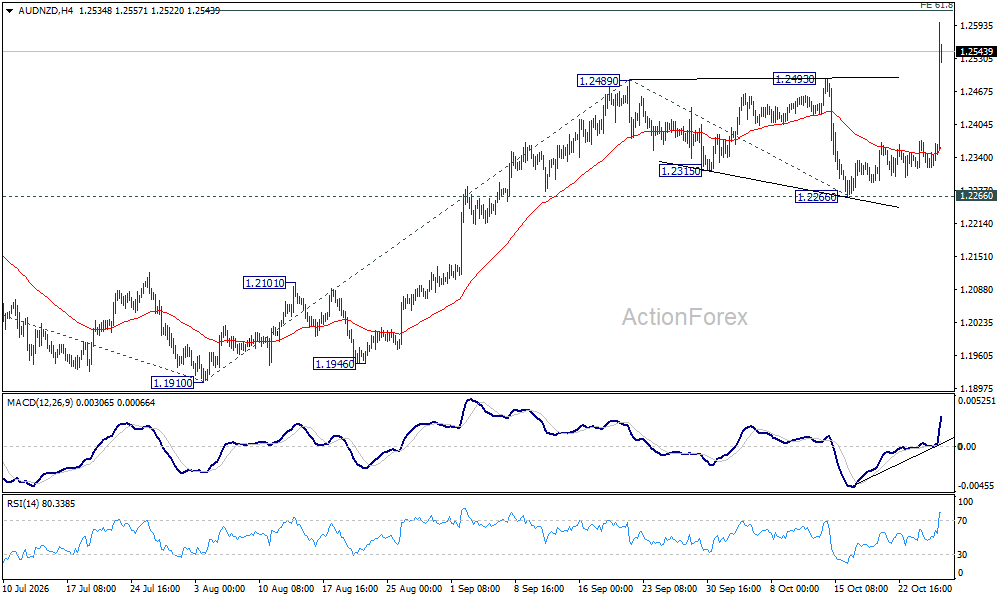
AUD/NZD’s uptrend resumed with a powerful surge through the 1.2489/93 resistance zone.
Immediate focus is now on 61.8% projection of 1.1910 to 1.2489 from 1.2266 at 1.2624. Decisive break there could prompt upside acceleration to 100% projection at 1.2845.
Some jitters could be seen in the near term, given the number of heavyweight global events, including today’s FOMC rate decision. But even in case of a pullback, outlook will remain bullish in AUD/NZD as long as 1.2266 support holds.
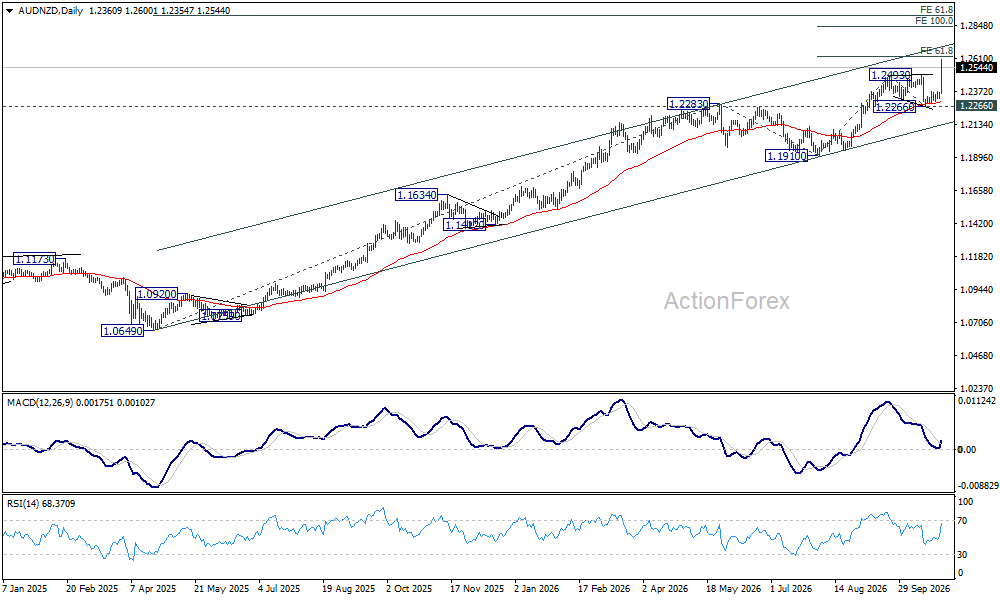
For the medium term, AUD/NZD could now be targeting 61.8% projection of 1.0649 to 1.2283 from 1.1910 at 1.2920, or simply the psychological 1.3000 level, subject to its reaction to the rising channel ceiling.
Overall, the technical breakout is consistent with the sharp repricing of near-term RBA–RBNZ policy timing. However, Breman’s comments reinforce that the RBNZ has delayed tightening rather than abandoned it, potentially limiting how far the divergence can extend without further economic evidence.
Key Takeaways
- AUD/NZD’s breakout through 1.2489/93 is overwhelmingly an NZD story: NZD/USD fell ~1.30% while AUD/USD rose just 0.12% on the day.
- Australia’s September CPI jumped to 4.3% y/y (vs. 4.2% expected) with trimmed-mean inflation at 1.0% q/q, above the RBA’s 0.8% forecast, pushing November hike odds from 60% to 79%.
- The RBNZ’s surprise 4–3 hold at 2.75% wasn’t a dovish pivot—all seven committee members agreed further tightening is likely, and Governor Breman explicitly raised the prospect of moving into “restrictive territory.”
- The divergence is one of timing, not direction: the RBA’s November move is already heavily priced, and stronger NZ data could revive RBNZ hike bets for the December 9 meeting.
- AUD/NZD’s next technical target is 1.2624, with a break opening 1.2845; the bullish bias holds as long as 1.2266 support is intact, even through today’s FOMC-driven volatility.
Behavioural & Retirement Portfolio Resilience
Behavioural Survivability and Retirement Portfolio Resilience Why the lived experience of market recovery matters as mu... Read more
Australia's Rate Rise Bites: Highest In 15 Years
The Reserve Bank of Australia has lifted interest rates to their highest level since 2011, and its governor admits the w... Read more
October Retirement Portfolio Resilience Assessment
Markets stabl Read more
Gyrostat September Retirement Portfolio Resilience Assessment
September Retirement Portfolio Resilience Assessment Markets have fallen. The price of risk has risen. ... Read more
Does The West Have A Problem With Government Bonds
If you have been following the financial pages over the past few weeks, one theme has begun to stand out from the usual ... Read more
August Retirement Portfolio Resilience Assessment
Markets Are Higher. The Price of Risk Is Lower. Retirement invest... Read more