

AUD/CAD Risks Deeper Correction If RBA Tightening Bias Doesnt Survive

TL;DR: The RBA’s Tuesday hold is a formality — what matters for AUD/CAD is whether its tightening bias survives, and the setup is asymmetric: preserving it offers limited support, while confirming the cycle has ended could trigger a deeper correction.
Why the Rate Decision Itself Won’t Move Markets
The RBA is widely expected to leave the cash rate unchanged at 4.35% on Tuesday, making the decision itself largely a formality. After softer-than-expected Q2 inflation, Australia’s Big Four banks now agree rates are likely to stay on hold through the rest of 2026, while broadly expecting the next move to be a cut sometime in 2027.
That pushes market focus away from the rate decision and toward a narrower question: how much of the RBA’s tightening bias survives? For the Australian Dollar, the setup is asymmetric — keeping another hike theoretically alive may offer limited support, while clearer confirmation that the tightening cycle has ended could have a larger negative impact.
The First Signal: Policy Statement Language
The first signal will come from the policy statement. Every RBA statement this year has retained some version of the line that “the Board remains attentive to upside risks to inflation.” Keeping that language would amount to a hawkish hold, but it would largely preserve existing policy optionality rather than make another hike materially more likely.
More consequential would be a shift toward language suggesting policy is sufficiently restrictive, or removal of explicit emphasis on upside inflation risks. Such a change would give markets their clearest indication yet that 4.35% is the peak rate.
The Bigger Signal: The Quarterly Statement on Monetary Policy
The more important signal should come from the quarterly Statement on Monetary Policy (SoMP). May forecasts had trimmed-mean inflation returning to the top of the 2–3% target band during 2027, but the Q2 reading subsequently undershot the RBA’s own projection at 3.6%.
If August forecasts maintain that disinflation path or bring the return to target forward, despite starting from softer inflation, the Board would effectively be validating the improvement and strengthening the case that further tightening is unnecessary. Conversely, if the RBA pushes the return to target further out, it would suggest policymakers aren’t yet prepared to fully trust the latest inflation moderation. The technical cash-rate assumption embedded in the forecasts will also be worth comparing with the previous SoMP, particularly to see how much easing is already incorporated into the projection path.
Why the Upside for AUD Is Limited
This leaves limited upside asymmetry for AUD. Even if the RBA preserves hawkish language, the current 4.35% rate is already clearly restrictive, making an extended hold more plausible than another increase. Markets therefore have little reason to rebuild meaningful hike expectations simply because the Board refuses to close the door.
By contrast, a softer inflation track or explicit peak-rate language would provide genuinely new information and allow attention to shift more decisively toward eventual easing.
Why This Matters for AUD/CAD
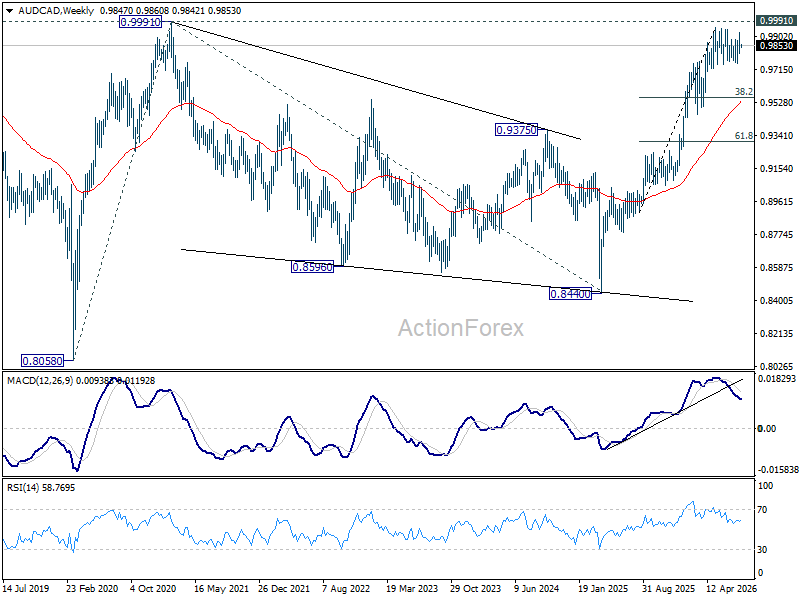
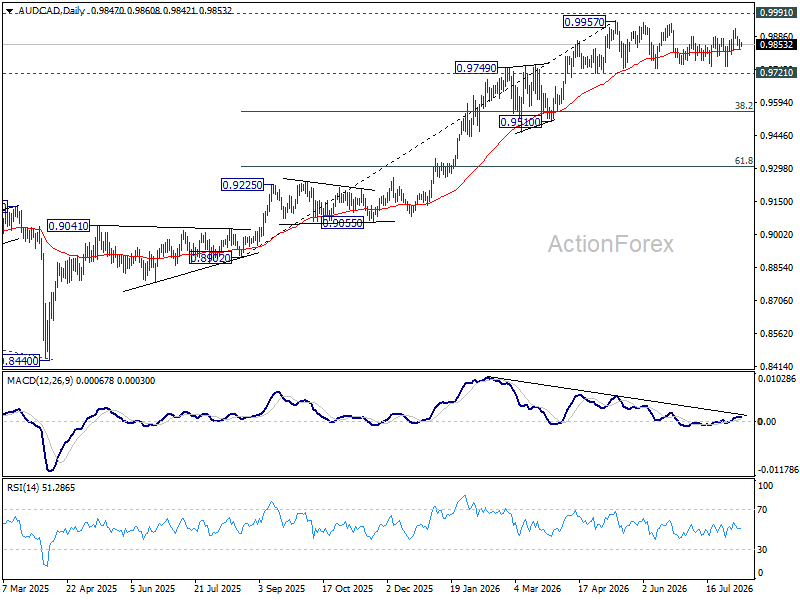
That asymmetry makes AUD/CAD particularly interesting. CAD received support from last week’s stronger-than-expected Canadian employment report and could benefit further if the oil rebound extends. At the same time, AUD/CAD’s uptrend from 0.8902 has clearly lost momentum, as reflected in both daily and weekly MACD, while the pair is close to major resistance at 0.9991 from the 2021 peak.
ActionForex’s Technical View on AUD/CAD
Technically, a break of 0.9721 support would indicate the five-wave rally from 0.8902 is already correcting, bringing a deeper fall to the 38.2% retracement of 0.8902 to 0.9957, at 0.9555. That area is close to the fourth-wave low around 0.9510 and the 55-week EMA near 0.9536.
However, a decisive break of 0.9991 would invalidate the correction case and extend the broader uptrend instead.
For now, the RBA retaining its tightening bias may be enough to keep AUD/CAD supported in range; losing it could provide the catalyst for a deeper correction.
Key Takeaways
- Tuesday’s RBA hold at 4.35% is a formality — the real signal is whether the tightening bias survives in the policy statement and SoMP forecasts.
- The key phrase to watch is “attentive to upside risks to inflation”; its removal would be the clearest signal yet that 4.35% is the peak rate.
- The quarterly SoMP matters more than the statement — whether the RBA maintains or delays its 2027 return-to-target path will show how much it trusts the Q2 inflation undershoot.
- The setup is asymmetric for AUD: preserving the tightening bias offers limited upside since another hike already looks unlikely, while losing it opens clearer downside.
- AUD/CAD is capped near 0.9991 resistance; a break of 0.9721 support opens a deeper correction toward 0.9555, while a break above 0.9991 would invalidate that case.
Gyrostat September Retirement Portfolio Resilience Assessment
September Retirement Portfolio Resilience Assessment Markets have fallen. The price of risk has risen. ... Read more
Does The West Have A Problem With Government Bonds
If you have been following the financial pages over the past few weeks, one theme has begun to stand out from the usual ... Read more
August Retirement Portfolio Resilience Assessment
Markets Are Higher. The Price of Risk Is Lower. Retirement invest... Read more
When The Wave Turns
Why Retirement Investing Is Moving Towards Resilience Jeremy Grantham’s latest market warnings have revived an old tru... Read more
Gyrostat Capital Management: July Retirement Portfolio Resilience Assessment
The Market Is Currently Presenting an Opportunity to Strengthen Retirement Portfolio Resilienc... Read more
The Invisible Risk That Decides Your Retirement
Why how investors behave matters more than what markets do and what disciplined port... Read more