

Saudi-US Bilateral Accords Not That Connected To Israel Normalization
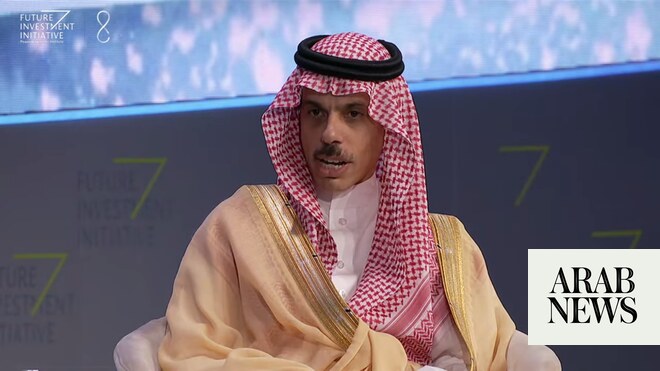
RIYADH: Saudi Arabia’s foreign minister said on Thursday that some of the bilateral agreements the kingdom has been negotiating with Washington are “not that tied” to the normalization of Saudi relations with Israel and are “moving ahead.”
He noted that potential US-Saudi agreements on trade and artificial intelligence are “not tied to any third parties” and “can progress probably quite quickly.”
“Some of the more significant defense cooperation agreements are much more complicated. We would certainly welcome the opportunity to finalize them before the end of the Biden administration's term, but that’s reliant on factors outside of our control,” he said.
“The other work streams are not that connected, and some of them are progressing quite quickly, and we hope to see movement forward.”
Ruling out the possibility of Saudi Arabia recognizing Israel without the establishment of a Palestinian state, Prince Faisal stated that this remains the only viable solution, regardless of Israel’s acceptance.
Speaking at the Future Investment Initiative summit in Riyadh, he emphasized that the creation of a Palestinian state is rooted in international law and UN resolutions.
“In reality, the establishment of a Palestinian state is not tied to whether or not Israel accepts it; it’s tied to the principles of international law,” he said. “The UN resolutions that led to the establishment of the state of Israel clearly envisioned a Palestinian state as well, so we need to make that happen.”
Prince Faisal asserted that normalization of Saudi-Israeli ties is “off the table” until there is a resolution regarding Palestinian statehood. He further highlighted the broader implications, stating, “The security of the region as a whole is at risk if we do not address the rights of the Palestinians.”
Addressing the ongoing crisis in Gaza, he called for a cease-fire, emphasizing the dangers of an Israeli overreaction following the events of October 7th. “We have seen the reality that Israel’s reaction and its continuing military assault have led to a humanitarian catastrophe,” he remarked. He described the situation in northern Gaza as dire, with blockades and no safe zones for civilians, stating, “That can only be described as a form of genocide. It is certainly against humanitarian law, and that is feeding a continuing cycle of violence.”
On the prospects of an immediate cease-fire, Prince Faisal expressed caution, saying, “I hope it’s the case that we can see a cease-fire in the immediate hours, in the immediate short term. I’m not sure that that’s the case. I don’t have the details.”
He acknowledged US efforts to facilitate negotiations, adding, “We are not part of the direct negotiations, but we certainly support the efforts that the US has undertaken to find a pathway to a ceasefire. I hope it comes to fruition.”
He noted that previous attempts at cease-fire negotiations had failed due to new demands from Israel. “In most of those instances where the talks collapsed, it has been because new requirements or demands were added on the part of Israel,” he explained.
Prince Faisal also addressed Saudi Arabia’s position on Lebanon, emphasizing a hands-off approach. “We have never fully disengaged. But we believe it’s up to the Lebanese politicians to seek a direction that puts Lebanon on the right track,” he stated.
He added: “It’s not up to any outside influence, any outside countries, or any outside powers to tell the Lebanese what to do or to influence the political process in Lebanon. That is our opinion.”
Regarding relations with Iran, Prince Faisal indicated that recent discussions focused on regional de-escalation. “I hope that Iran, like us, is working toward regional de-escalation on all fronts, not just in Lebanon. That’s very much the focus of my conversations with my Iranian counterpart,” he said. While he could not be “confident of anything that is in the control of other parties,” he emphasized the importance of avoiding further escalation.
“I have made it clear to our Iranian counterparts that it is important to avoid any further escalation. My sense is that they realize the risks of escalation and would prefer to avoid it. But, of course, they have their own strategic calculations.”
Jeddah Volunteers Dive In To Protect Red Sea Ecosystem
JEDDAH: Community volunteers, divers and environmental groups are joining forces once again in Jeddah for the latest con... Read more
Nigeria Police Probe Mass Deaths Of Suspected Illegal Miners In Custody
LAGOS: Nigeria police have launched an investigation into the deaths of “scores” of suspected illegal miners while i... Read more
Irans IRGC Says It Struck Togo-flagged Tanker In Strait Of Hormuz
Iran’s Revolutionary Guards Navy said a Togo-flagged oil tanker was struck while attempting to ma... Read more
Book Review: Sisters Of Sword And Song Delivers A Magical Escape, With A Few Loose Threads
I enjoy the young adult fantasy genre — as much as any other millennial who grew up feasting on a literary diet of “... Read more
What We Are Reading Today: Seven Decades By Michael D. Gurven
Our ability to live for decades may seem like a modern luxury made possible by clean water and advances in medicine. In ... Read more
Will Paris Talks Help Lebanons Army Turn Sovereignty Pledges Into Reality?
Lebanon sought international backing for an expanded role for its army at talks in Paris on Thursday that focused on the... Read more