

Boutique Managers Crowd Into ETFs, But Assets Still Follow The Giants
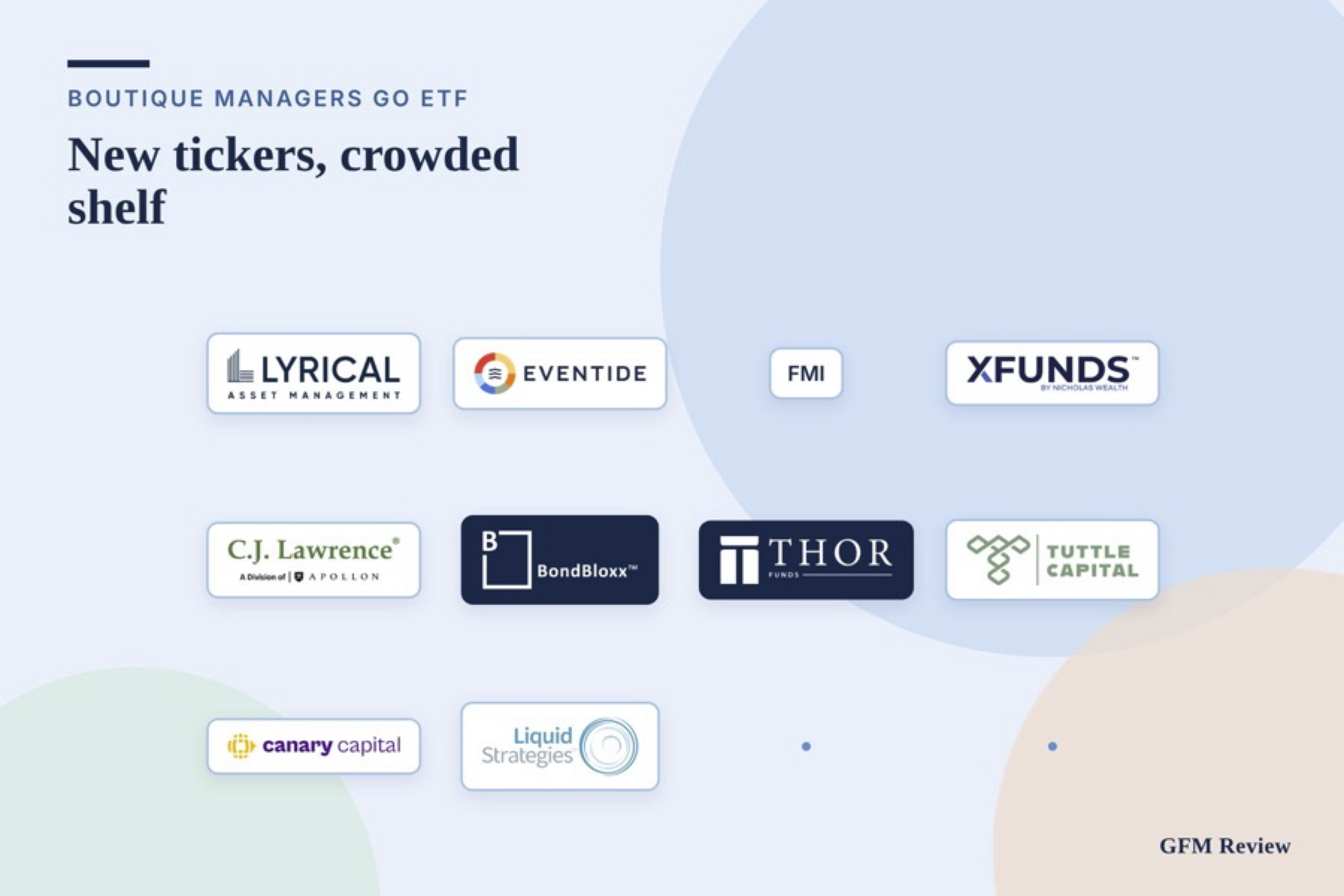
Independent US managers are converting mutual funds and launching ETFs at pace. Record flows into the wrapper do not guarantee that a small issuer's new ticker will gather the assets it needs to survive.
The exchange-traded fund has become the default shelf for new US investment products, and independent managers are no longer leaving it to the giants. In the three weeks to 9 November, a cluster of smaller firms converted mutual funds, launched first or additional ETFs, and pushed strategies ranging from value equity to staked crypto tokens into the wrapper. The harder question is whether a shelf this crowded leaves room for them to gather assets.
Demand for the structure is not in doubt. US ETFs took in $203.8bn in October 2026, the second-strongest month on record, according to TD Securities data reported by InvestmentNews. The market held $16.3tn across 5,713 funds from 445 providers at 30 October, and actively managed ETFs accounted for about $2.2tn, or roughly 13.7 per cent of the total. New supply is just as lopsided: active ETFs made up 933 of the 1,255 long-term fund launches across all US vehicles in the first nine months of 2026, according to ISS Market Intelligence.
Conversions and first launches
The clearest example came from Lyrical Asset Management, an independently owned value manager, which on 9 November converted its US Value Equity and International Value Equity mutual funds, holding more than $1bn combined, into two ETFs, LYR and LYRI. The reorganisation is intended to qualify as tax-free, so shareholders move across without a taxable sale. Jeffrey Keswin, Lyrical's chief executive, said the ETF structure "opens our strategies to a broader set of advisors, platforms and model portfolios".
Others are adding the wrapper alongside existing businesses. Fiduciary Management, Inc., a Milwaukee firm founded in 1980 with about $8.3bn under management at 30 September, listed the actively managed FMI Global Equity ETF (FMIG) in early November. Boston-based Eventide Asset Management launched dividend growth and large-cap ETFs on NYSE Arca on 29 October, and said its six existing ETFs held more than $600m combined as of 27 October.
Fixed income is moving too. BondBloxx, which describes itself as the first ETF issuer focused solely on bonds, launched the BondBloxx Core Plus ETF (BBLX) on 5 November. Unlike most of this group, it tracks an index, adding high yield, emerging market debt and collateralised loan obligations to a conventional core allocation; SEI collaborated on its design.
The commercial logic rests on tax, cost and distribution. Lyrical cites greater tax efficiency, daily portfolio transparency and lower ongoing expenses. On tax, ETFs can usually meet redemptions by handing over securities rather than selling them, which limits the capital gains passed on to remaining holders. For a smaller manager, the distribution point may matter more, because a listed ticker can sit in any brokerage account and be placed in advisers' model portfolios.
Regulation has widened the route. The SEC's 2019 ETF Rule made it far easier for active managers to use the structure, according to Morningstar research, which counts more than 200 mutual fund conversions to ETFs between March 2021 and 30 June 2026. Since late 2025 the regulator has also granted dozens of managers relief to add an ETF share class to an existing mutual fund, according to K&L Gates.
Options, income and crypto
Many of the boutique launches lean on derivatives. XFUNDS, the ETF brand of Nicholas Wealth Management, launched the XFUNDS Value Income ETF (VTVX), which pairs US value stocks with options strategies for income and takes its range to 16 funds. C.J. Lawrence, a division of Apollon Wealth Management, launched the Buffered Bulldog ETF (ACJL), which holds roughly 30 to 50 US stocks with an options overlay intended to give partial downside protection in exchange for limited upside. Liquid Strategies, an options specialist founded in 2013, launched the Overlay Shares Nasdaq 100 Income ETF (OVQ), which targets an annual distribution rate of 12 per cent but does not guarantee it, and warns that distributions may include a return of capital.
Other entrants are testing what the wrapper can hold. Canary Capital began trading its Canary Staked INJ ETF (INJC) on Nasdaq on 5 November; the fund expects to stake at least 90 per cent of its Injective tokens and charges 1.10 per cent a year. Tuttle Capital Management, which calls itself one of the leading architects of leveraged single-stock ETFs, added an artificial intelligence fund (DLAY) and an income and hedge fund (QQDH) in consecutive weeks. THOR Financial Technologies launched its fourth systematic fund, the THOR Conservative Risk Dynamic ETF (THCR).
A crowded shelf
Record flows say little about whether these particular funds will attract money. Morningstar found that six firms, including J.P. Morgan, Capital Group and Dimensional, captured roughly half of all active ETF inflows in 2025. Volume also makes it hard to stand out: ETF Express listed more than 40 US launches in the week to 29 October alone, 25 of them from VictoryShares.
Survival depends on scale. FactSet counted 1,950 US ETFs, or 38.4 per cent of the total, with less than $50m in assets at 31 March 2026. Cerulli Associates has found that more than 85 per cent of ETF closures since 2021 involved funds below that level. In its latest survey, 88 per cent of issuers named a lack of assets as a factor in closure decisions, against 38 per cent who named an ineffective strategy.

Source: Cerulli Associates US ETF research, reported by InvestmentNews, 12 November 2026.
Closures are already rising. Active ETF liquidations and mergers reached 159 in the first nine months of 2026, above the 127 recorded in all of 2025, according to ISS Market Intelligence data reported by InvestmentNews. Single-stock funds accounted for 77 of those exits.
The case rests on claims yet to be tested. A conversion carries an existing record and asset base into the new wrapper; a new ticker starts close to zero and needs platform support to reach advisers. The options-income funds enter a category holding roughly $130bn by 2025, on J.P. Morgan Asset Management data, in which J.P. Morgan's own premium income ETFs were among that year's most successful products.
Performance is the other test. The most recent SPIVA scorecard found that 79 per cent of active large-cap US equity funds lagged the S&P 500 in 2025. Boutiques selling concentrated, high-conviction portfolios will need to show why theirs belong in the minority.
What to watch
Lyrical's two ETFs will show whether converted assets stay put once shareholders can sell during the trading day. The newer launches will need to clear the $50m level below which, on Cerulli's figures, most closures occur. And the spread of ETF share classes, which roughly 37 per cent of issuers are developing according to Cerulli, may decide whether conversion remains the boutique route at all, or whether managers can keep their mutual funds and simply add a ticker alongside.
Why Sequencing Resilience Is Built Before The Fall
The week the fear gauge reminded us Read more
Retirement Portfolio Construction
Pairing Growth with Retirement Portfolio Resilience Executive summary Traditional portfolio construction has general... Read more