

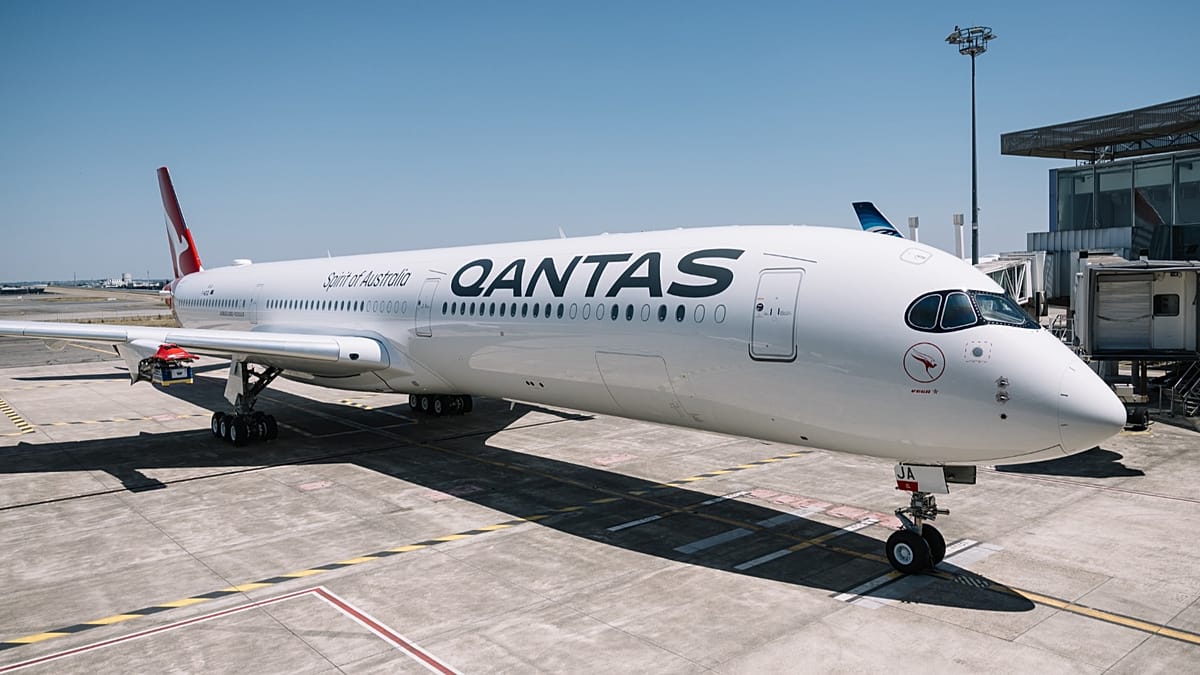
Qantas has confirmed Sydney to London as the first route for its long-awaited "Project Sunrise", with the world's longest non-stop passenger flight set to launch in October 2027.
 ADVERTISEMENT
ADVERTISEMENT
ADVERTISEMENT
Covering more than 16,000 kilometres, the service will connect the two cities without a stop for the first time.
The Australian airline has also unveiled the first of its specially modified Airbus A350-1000ULR aircraft that will operate the route. Flight times between Sydney and London are expected to range between 19 and 22 hours.
Project Sunrise will eventually connect Australia's east coast with other international destinations, with Sydney-New York confirmed as the next route to follow Sydney-London. The launch timing for those services will be announced next year.
"Qantas was built on the belief that Australia's distance from the rest of the world should never stand in the way," said Qantas Group CEO Vanessa Hudson.
"The pioneering spirit of generations of our people has forged that path ever since, and today is the most significant step in that mission in our 105-year history.
"Since we first flew the Kangaroo Route in 1947, where we stopped seven times on the way to London, every generation of aircraft has taken a stop out of the journey. Today, we're taking out the last one.
"We made a commitment in 2017 that Qantas would conquer the final frontier of long-haul aviation and connect Australia's east coast directly to London, something that has never before been possible. From October 2027, that promise becomes reality."
Qantas’ customised A350-1000ULR
The current longest regularly scheduled non-stop passenger flight is Singapore Airlines' service between Singapore and New York, covering 15,349 kilometres in just under 19 hours.
A significant difference in passenger comfort between the airlines is that Singapore’s flight SQ24 doesn’t fly economy passengers.
While a standard Airbus A350-1000 can carry up to 480 passengers, Qantas' customised A350-1000ULR will carry just 238, including 140 economy seats, on flights between Sydney and London.
The farthest an economy passenger can currently fly on a direct flight in the world is with Qantas between London and Perth on Australia’s west coast. That’s a distance of 14,499 kilometres flown between 16 and 18 hours.
The A350-1000ULR has been specially developed by Airbus for Project Sunrise and is fitted with an additional 20,000-litre fuel tank, enabling it to fly more than 16,000 kilometres non-stop for up to 22 hours. Qantas will take delivery of 12 aircraft in total, each configured with 238 seats across four cabins.
A second aircraft is currently undergoing its eight-week testing and certification programme after making its first flight earlier this month.