

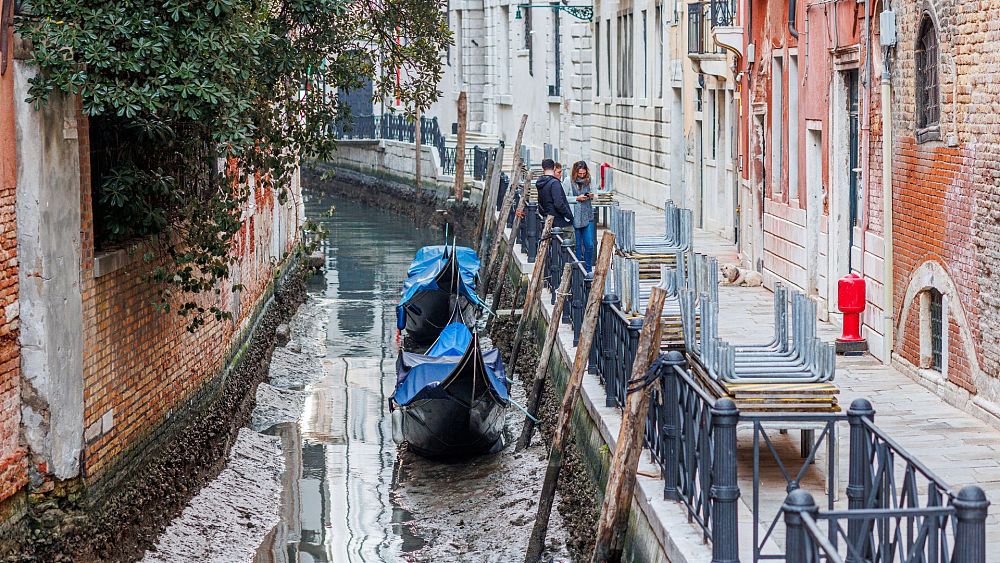
Venice has been making the headlines due to the exceptionally low water levels in the city’s canals.
Climate change has been cited as the culprit for the dry waterways, but the reality is more complex. I am one of many Venetian residents growing frustrated by the misinformation. So I’m here to set the record straight.
Low water levels are an annual phenomenon here, and they’re only indirectly related to the drought hitting many areas of Europe.
If you’ve booked to visit Venice during this period, you might be worried about how the dry canals will affect your holiday.
As someone who has experienced this phenomenon many times, here’s how to prepare for your trip and the easy ways to navigate the low water.
What is causing Venice’s dry canals?
During January and February, there is usually a period of a few days when the water levels of Venice’s canals drop.
The occurrence is known as ‘bassa marea’ or ‘acqua bassa’, meaning low tide or low water.
It’s the opposite of ‘acqua alta’, a term referring to high tides that have caused severe damage to the city in the past.
‘Acqua bassa’ refers to when water levels are more than 50cm lower than average due to an abnormally low lunar tide coinciding with a period of high air pressure.
When this happens, some secondary canals are drained of water revealing the muddy bed.
Italy is currently experiencing a prolonged period of high pressure which is protracting the low tide phenomenon.
The high pressure is also responsible for the droughts affecting other regions in the country.
How will the low water levels affect my holiday in Venice?
Low tide rarely hinders daily life in Venice, whether that’s catching the waterbus to work or getting supplies by delivery boat.
This is partly because the low water depends on the tides, which change about every 6 and a half hours. This means that some canals are only very dry about twice a day; at peak tide times they usually look completely normal.
But if your holiday coincides with the phenomenon, there’s a few things you can plan for just in case.
Are water buses and taxis affected by the low water levels?
Water buses, known as ‘vaporetti’, and taxis are generally unaffected during low tides. Occasionally a water bus may be redirected down the Grand Canal, which is never too low to navigate, but the service still runs as normal.
As for water taxis, “at worst, it might have to pick you up or drop you off in a location that is going to be 30 seconds away from where you are or want to go,” says Sebastian Fagarazzi, co-founder of travel advice website Venezia Autentica.
Can I arrive at my hotel by boat when there’s a low tide?
If you are planning on arriving at the canal entrance to your hotel by water taxi or private boat, most of the time you shouldn’t have a problem.
But if you happen to have booked a property on a very shallow canal and your arrival coincides with the couple of hours of low tide, your taxi will simply take an alternative route and you may have to walk a minute or so to the street-side entrance.
Can I take a gondola ride when the canals are dry?
“When tides are very low, gondolas at one specific gondola station in the district of San Polo might not be able to work for about two hours,” explains Faragazzi.
“When that happens, you can either find a different gondola at one of the many other locations in Venice or come back two hours later.”
In short, it is very easy to take a gondola ride or another boat tour even during low tide.
How can I track when there will be low tides?
“In Venice, many locals use the app ‘Hi!tide Venice’, which shows tide forecasts,” says Faragazzi.
“As the name shows, however, what locals care about are high tides, because low tides really play a marginal role in Venice.”
What are the advantages of visiting Venice during low tide season?
In addition to having little adverse effect on your holiday, low tides can be interesting to witness.
“A marvellous thing about low tides is that it allows you to see decorations on the side of palaces and shores that are otherwise hidden as the average tide has risen throughout the centuries,” says Faragazzi.
It also shows the more sobering impact of the waves caused by passing motorboats which damage the centuries-old palaces.