

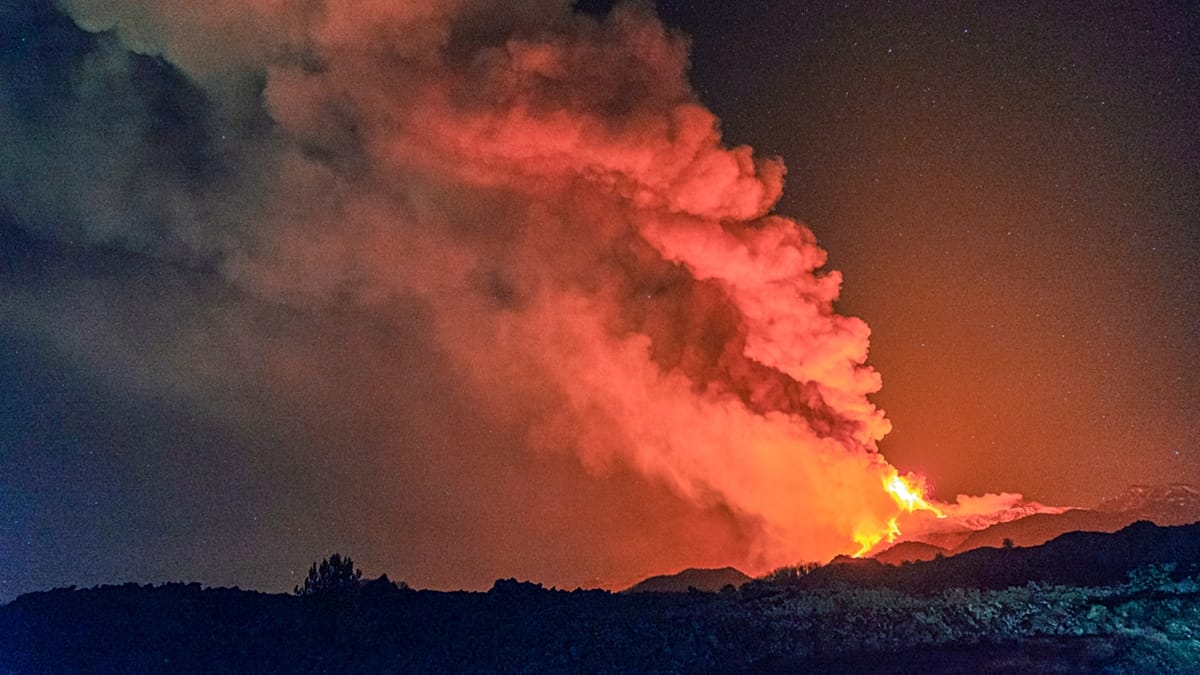
Volcanic eruptions are one of the greatest single short-term threats to air travel, but a groundbreaking solution to managing their impact has finally been unveiled.
In 2010, the eruption of the Eyjafjallajökull volcano on Iceland sent thick plumes of volcanic ash over nine kilometers into the sky. Even though the eruption was relatively small, the consequences were huge. Air travel in Europe ground to a standstill.
According to the National Centre for Atmospheric Science, airlines lost an estimated £130 million (approximately €148.49 million) every single day that airspace remained closed. Millions of passengers were left stranded from cancelled and delayed flights.
Today (27 November), the UK’s Met Office has launched a new volcanic ash forecasting provision that it says could halve disruption and keep airspace open in the event of a similar eruption to Eyjafjallajökull.
‘Significant’ problems
Volcanic ash can cause “significant problems” with aircraft, and has the potential to stop or severely damage jet engines. However, at lower concentrations of ash, flights may still be able to operate if they receive authorisation.
Ash forecast data provided by the Met Office, in its role as the London Volcanic Ash Advisory Centre (VAAC), helps airlinesdecide where they can safely operate and reduces the amount of North Atlantic and European airspace that must be avoided.
VAAC London is responsible for issuing forecasts forvolcanic eruptionsoriginating in Iceland and the north-eastern corner of the North Atlantic.
But as our skies get busier, the need for better, more accurate data around volcanic ash is growing.
The Met Office’s new volcanic ash service
The Met Office is one of the first of the nice VAACs in tandem with Meteo France (VAAC Toulouse) to start producing new, higher-resolution Quantitative Volcanic Ash (QVA) forecasts required under new regulations. The seven other VAACs will follow next year.
This new service will be available for free to all airlines in the aviation industry worldwide, and comprises gridded forecasts which provide the expected ash concentration for 12 horizontal slices of the atmosphere (from the ground all the way up to around 60,000ft).
It will also predict the likelihood of certain ash concentrations being exceeded.
‘Halving’ flight disruption
“With our new service, we estimate that the disruption today from an eruption of Eyjafjallajökull would be half of that experienced in April 2010,” says the Met Office’s Mark Seltzer, Expert Operational Lead for VAAC London.
Met Office aviation specialist Karen Shorey says the QVA data will help airlines make more “informed decisions” to avoid higher concentrations of ash, minimising the airspace that needs to be closed in the event of a future eruption.