

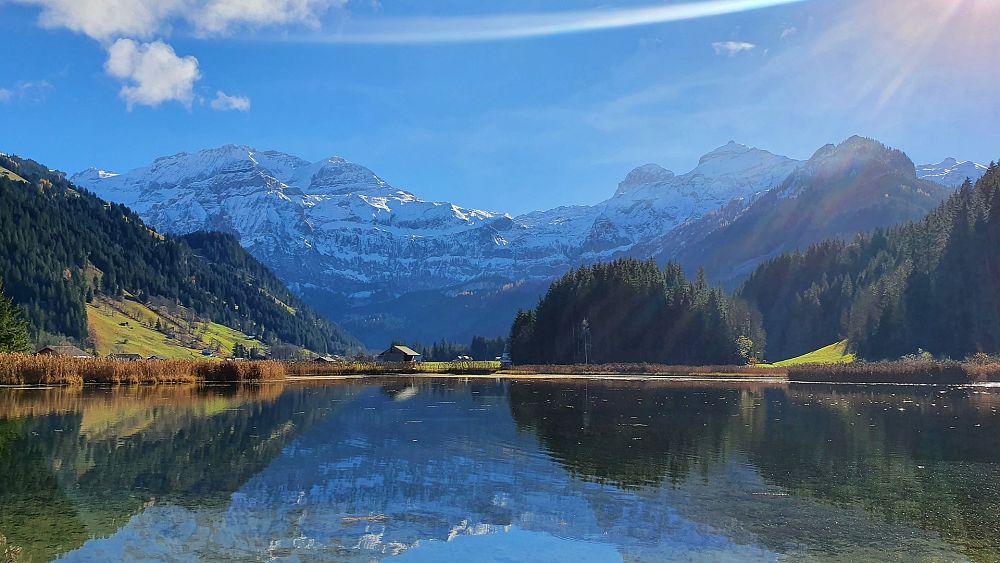
Switzerland might not be the first country you think of for digital nomads, but the peaceful mountainous surroundings have a lot to offer.
After 10 years as a digital nomad, travelling all over the world, Andy Stofferis has landed in the Alpine village of Lenk. He finds the quiet environment and lack of crowds make for a much better working environment than busier, more conventional locations.
“I prefer a peaceful environment where I can really work and be productive because there is no real noise,” Andy says.
“In the big cities, you are always disturbed by a lot of things.”
Now Andy is setting up a digital nomad hub in the village for those who want to join him in Lenk.
Why is Switzerland good for digital nomads?
Running from 16 October to 22 December, the hub will have private apartments suitable for everyone from solo nomads to families. Each one has its own desk for more individual business but there’s also a co-working space to get to know your fellow residents.
So why Lenk? This village in the Swiss Alps has around 2,500 permanent residents with about 15 per cent of them having moved from other countries.
Some 20 different hiking trails start there with a selection of the highest peaks in Europe easily accessible by car or public transport.
There’s also horseback riding, cycling and other outdoor activities in the summer months. In winter, there are 200km of ski slopes to take advantage of in the region.
The incredible scenery means that, from the hub’s accommodation, there are mountain views on every side.
Andy says that the location is ideal for fans of the outdoors but also those that are a bit more introverted. You don’t need to be an experienced digital nomad to stay at the hub and he’s hoping to attract remote workers that are fed up with working from their home countries.
Lenk isn’t completely disconnected from city life, however.
“The capital Bern is only one hour and 30 minutes by public transport, by train,” Andy says.
Commuting to airports in Geneva, Basel or Zurich isn’t difficult either. And, compared to the rest of the country, Lenk is a relatively affordable corner of Switzerland.
The pricing at the hub reflects that and it decreases for every additional month you stay.
“For the first month, the apartments are 1,500 CHF, which is more or less €1,500, which for Switzerland is quite fair. Then progressively everything is discounted,” Andy says.
“If you stay for the second month it would be 1,200 CHF and then for the third month, 800 CHF or euro, which is for a private apartment in Switzerland is very good.”
Connecting with the local community
Andy’s aim is to create a community of remote workers that can integrate with locals - something that can be difficult for transitory nomads.
“The goal is to create some activities between the locals and the digital nomads,” he explains.
“Because digital nomads have a lot of things to share in terms of experience in digital marketing or whatever their job or passion is. And the locals have things to share with them like places to explore and all the things to do in Switzerland or how to save on money.”
Rather than staying for a week or two then moving on, he recommends staying in the same place for one to three months.
While the village can see up to 5,000 tourists at a time, Lenk doesn’t typically attract many visitors in the Spring and Autumn.
Travellers tend to come for snowsports in the winter or outdoor activities in the summer. A digital nomad hub could help attract digital nomads in the low seasons.
“A proportion of the residents really depend on the tourism industry directly or indirectly,” Andy says.
So this is really something that we are creating as well with the tourism board and with [apartment provider Ferienlenk] that actually provides the accommodation.”
What are the visa requirements for Switzerland?
Though many countries in Europe have introduced them, Switzerland doesn’t yet have a digital nomad visa and there’s no indication the government is considering introducing one.
This means non-EU citizens can’t live and work there without applying through a more conventional means. That often requires them to have a job with a Swiss employer or strong ties to the country.
Andy says that the best option for those from outside the EU or European Economic Area (EEA) could be a Type C Schengen visa. This short-stay visa allows you to circulate in the Schengen area for a maximum of 90 days within a 180-day period.
But you will need to show you have health insurance for the duration of your stay, sufficient funds to support yourself and be a resident elsewhere for tax purposes.
EU citizens or people from countries in the EEA can stay for three months in any 180-day period due to freedom of movement rules. To stay longer, they need to register and apply for a Swiss residence permit.