

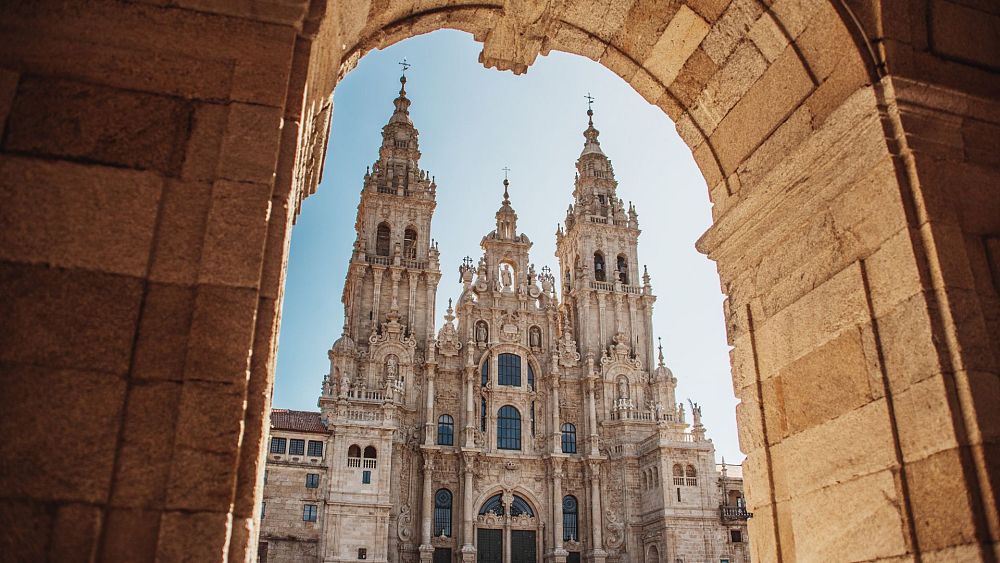
Santiago de Compostela, the destination of Spain’s famed Camino de Santiago pilgrimage, wants to introduce a tourist tax to curb overcrowding.
The popular destination in Spain’s northwestern autonomous community of Galicia welcomed almost 440,000 ‘pilgrims’ in 2022. Its annual average number of visitors exceeds 300,000.
Walkers take a wide range of pilgrimage routes starting in Spain, France and Portugal and ending at the city’s 9th-century cathedral. For Christians, the Romanesque basilica is believed to be the burial place of Saint James the Great, one of the apostles of Jesus.
Sworn in as the city’s first female mayor last month, Goretti Sanmartín of the Galician Nationalist Bloc (BNG) announced plans to promote sustainable tourism and make Santiago de Compostela a better place for locals to live, according to Spanish news agency Europa Press.
How much will Santiago de Compostela’s tourist tax be?
The idea of a tourist tax was presented to hoteliers by Santiago’s former mayor Xosé Sánchez Bugallo in April, Spanish radio station La Cadena SER reports.
A regional tax that could be introduced in 2025 was proposed. It would be charged as a nightly fee by the hotels and is likely to cost between €0.50 and €2.50, depending on the type of accommodation.
It is thought the tax could raise between €2.5 and €3 million per year for Santiago, which would go towards maintaining the city’s historic centre.
Mayor Sanmartín raised the idea again in her investiture speech, which laid out plans for ‘conscious tourism’ in the city.
“I want this municipality to stop being just a tourist destination and a theme park,” she said, according to Europa Press.
“I want a Santiago from which there is no need to flee due to uncontrolled tourism. We aspire to… enjoy a rich and prosperous tourism sector but also a comfortable and breathable city.”
She said that securing housing for locals would also be a priority.
The Cathedral of Santiago de Compostela itself is free to enter, but visitors can pay a €12 fee to gain full access to the museums, tower and cloister.
Where else in Spain charges tourist taxes?
Tourist taxes are not a new concept in Spain. Barcelona introduced a fee in 2012, which has been steadily rising since then. In April 2024, it will increase to €3.25 per night.
Valencia also plans to introduce a tourist tax within the next year of between €0.50 and €2 to contribute to sustainable tourism.
Holiday accommodation on Spain’s Balearic Islands (Mallorca, Menorca, Ibiza, Formentera), is also subject to a tax, which can reach up to €4 per night in high season.