

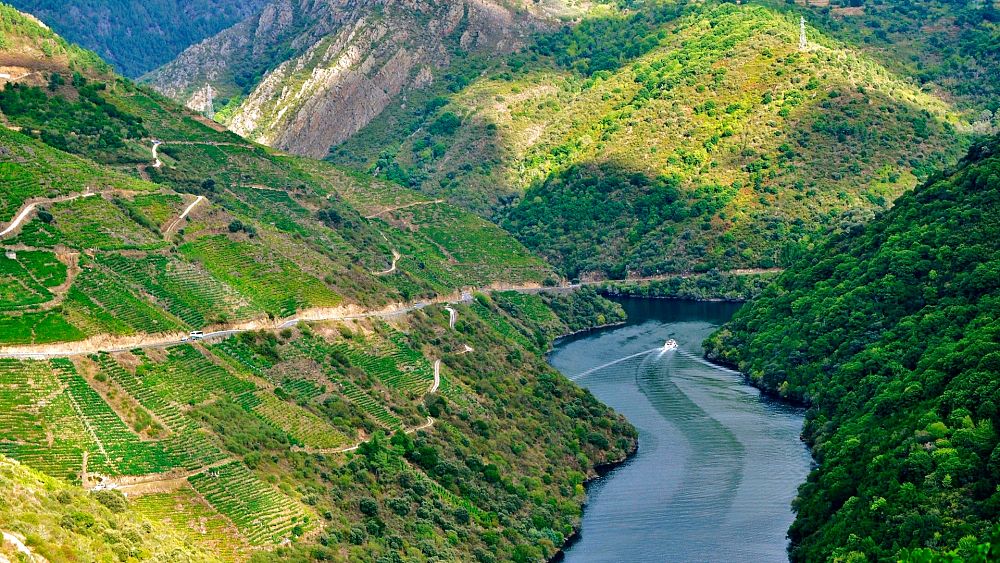
Perched above Portugal, the most northwesterly region of Spain is home to some of the country’s most verdant landscapes.
Part of ‘Green Spain’ - the northern regions of the country which are defined by rolling hills and lush woodland - Galicia is a must for nature lovers, hikers and bikers.
Sitting on the Cantabrian coast, which stretches from the northern border with Portugal all the way to the border with France, Galicia’s wet climate and green grass make the landscape here closer to Ireland’s than the dry and arid plains of southern Spain.
Thanks to this luscious climate, you’ll find some of the most scenic hiking trails in the country here, as well as some of the longest.
The most famous of these is the Camino de Santiago, an ancient route that traditionally took pilgrims from Spain and France to the Cathedral Santiago de Compostela, the reputed burial site of St James the Great, one of the 12 Apostles of Jesus Christ.
How can I walk the Camino de Santiago?
“The Camino de Santiago, of course, has everything. It allows you to reflect, to walk, to encounter nature,” explains Nava Castro, Director of Galicia Tourism.
The Camino de Santiago - also known as the Way of St James - is a huge, sprawling network of pilgrim routes. The routes stretch out across the continent, converging on the Galician city of Santiago de Compostela. While the routes are still popular with religious tourists, many non-religious pilgrims make the journey now too, with over 350,000 tourists per year seeking a sense of peace and calm.
The pilgrimage dates back over 1,000 years to the 9th century, when the remains of St James were reportedly discovered in northern Spain. Now, record numbers of tourists are walking the routes every year.
If you like to do things by the book, you can obtain a Camino Pilgrim Passport, which you can use as proof that you’ve walked at least 100 km of the trail. Completing this distance gets you a Camino Compostela, the official certificate of your epic walk. To get your certificate, you’ll need to get your passport stamped along the route at local town halls and churches.
Some of the routes, which stretch from France to Santiago de Compostela, are much longer than 100 km, with the Camino Frances (the French Way) nearly 800 km long. If you’re feeling brave, this epic trek will take you between 4 and 5 weeks.
What is there to do in Santiago de Compostela?
Though sleep might be the first thing on your mind, once you’re fully recovered there are plenty of places to explore in Santiago de Compostela other than the tomb of St James.
The city’s Old Town is a UNESCO World Heritage Site and there are plenty of historical buildings to explore. One of the best ways to experience the city, though, is from above. The roof of the Santiago de Compostela Cathedral offers spectacular views of the city below.
Packed full of convents, monasteries and churches, the historic quarter is a must-see too, especially if you’re a fan of religious architecture.
It’s outside of the region’s seven cities, though, that you’ll find the true beauty of Galicia.
Best places for nature lovers in Galicia
Although it sounds like a location straight out of The Lord of Rings, the Galician woods are not to be missed. Packed with oak, birch and chestnut trees, the woods here can be very dense but are brimming with natural wonders.
“What we want to show about Galicia and the reason why tourists choose us is because of nature. We are a natural landscape. ” says Castro.
The Serra do Courel is a UNESCO World Geopark and you’ll find deer, wild boar and even wolves in this dense, wild landscape. There are plenty of hiking trails to wander around here, just make sure to come well equipped to tackle the steep slopes of the woodland terrain.
With a tree-lined landscape, it should come as no surprise that Galicia is a haven for birds too. You can find birds right across the region, from grouse in the Serra do Courel to colourful European bee-eaters in the more temperate regions of south western Galicia.
In order to protect this rich natural environment, the Galician tourist board is encouraging people to travel around the region more sustainably too.
“We are going to use electric cars, electric motorcycles, electric boats, electric bicycles, so that the nature that surrounds us will suffer no interruptions,” says Castro.