

 ADVERTISEMENT
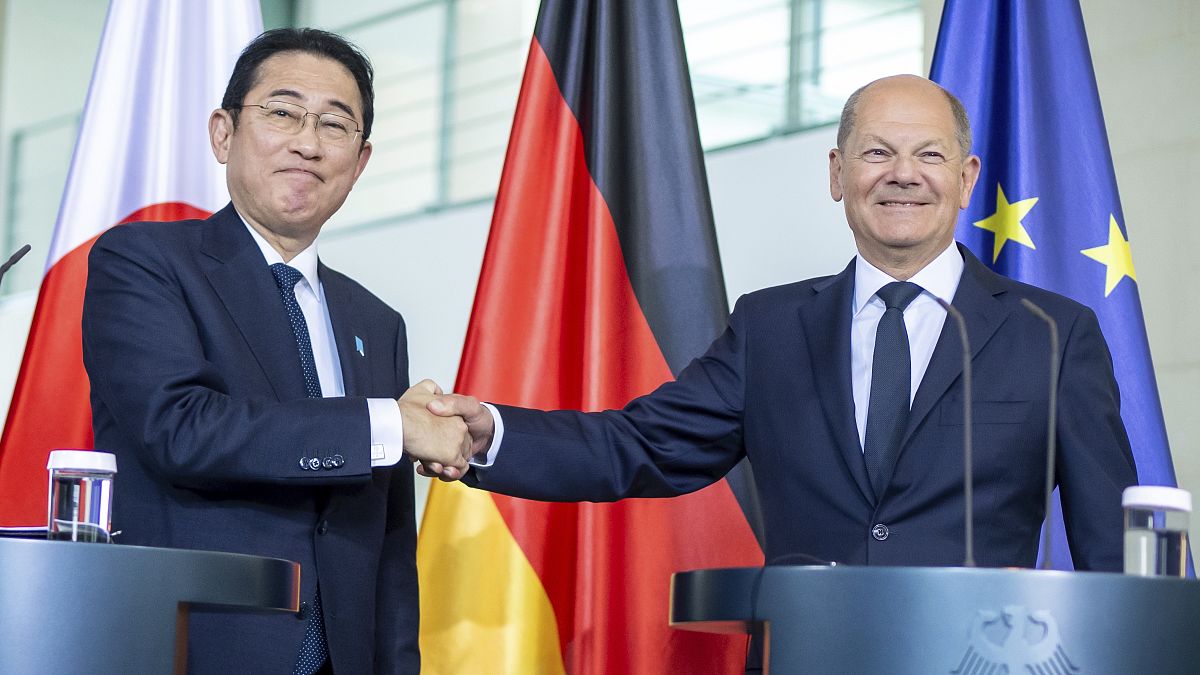
German Chancellor Olaf Scholz and Japanese Prime Minister Fumio Kishida have agreed to boost security cooperation in the Indo-Pacific, a region which has seen increasing military assertiveness from China.
"While the security environment in the Indo-Pacific region is under bigger threat, due to China and North Korea's movement, the cooperation between Germany, with whom Japan shares similar values, is becoming more important," Kishida said.
During talks in Berlin, Kishida and Scholz also confirmed that their countries would create an economic security framework amid fears about what they view as China's overproduction of electric vehicles and other key products using massive subsidies.
As part of efforts to accelerate bilateral cooperation, the two leaders also agreed to hold high-level intergovernmental talks in Germany possibly next year to grapple with a wide range of global and regional issues.
"Today we agreed to set up a new dialog on economic security. And we have decided to hold joint intergovernmental consultations again next year, this time in Germany," said Scholz.
Scholz also said that despite the distance between the two countries, Japan and Germany have "many things in common" and the two leaders agreed that the defence and foreign ministers of the two countries will hold 'two-plus-two' security talks in Japan soon.
Kishida travelled to Germany after attending the 75th NATO summit in Washington which ended on Thursday.
In talks with Scholz, he expressed "grave concern" over North Korea's deepening military cooperation with Russia, with Scholz calling it a "clear violation of UN sanctions".
Japan also believes escalating China-Taiwan tensions are among the most serious security challenges, with Beijing viewing the self-ruled democratic island as a renegade province to be reunified with the mainland, by force if necessary.
Kishida and Scholz met as their countries' acquisition and cross-servicing agreement (ACSA), which simplifies the process of sharing food, fuel and ammunition between Japan's Self-Defence Forces and the German military, came into force on Friday.
A German frigate is scheduled to make a port call in Japan this summer, while a Maritime Self-Defence Force training squadron is planning to stop in Hamburg, Japanese officials said.
On economic security, the Japanese and German leaders discussed how to work in tandem to strengthen a free and fair global trade order, while confirming their cooperation to bolster supply chains of hydrogen, semiconductors and critical mineral resources.
Scholz also said that he believed an agreement between the European Union and China on tariffs for Chinese electric vehicles was possible.
The EU is imposing provisional tariffs of up to 37.6% on EVs imported from China, ratcheting up tensions with Beijing in the EU's largest trade case yet.
"We will always insist on conditions being fair on all sides and that’s what’s being discussed right now between the European Union and China," said Scholz.
Those remarks comes a day after Interior Minister Nancy Faeser said Germany will bar the use of critical components made by Chinese companies Huawei and ZTE in core parts of the country's 5G networks in two steps starting in 2026.
Germany, which is Europe's biggest economy, has long mulled what to do about components made by Chinese suppliers in its new-generation cellphone networks.
Faeser said critical components from Huawei and ZTE will be barred from 5G core networks by the end of 2026, while "critical management systems" from the two manufacturers in 5G access and transport networks must be replaced by the end of 2029.