

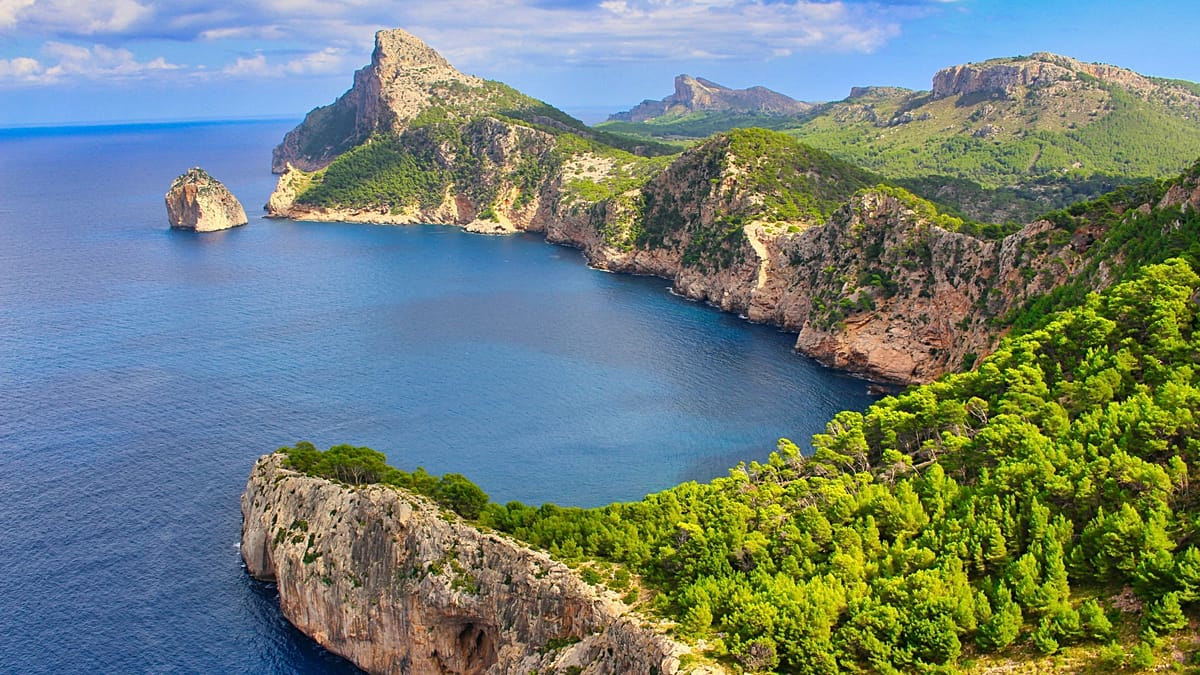
A new long-distance hiking route has opened on Mallorca.
 ADVERTISEMENT
ADVERTISEMENT
ADVERTISEMENT
The trail offers travellers an alternative to the Spanish island’s beaches, resorts and nightlife, whose popularity has contributed to an overtourism crisis.
The new trekking path gives visitors the chance to explore the wilder east coast, home to pine forests and mountain ranges.
There are also cultural attractions, including a 14th-century castle and an embroidery museum, en route.
A new 100km hiking route
The 104km-long hiking trail is split into four stages and follows a variety of dirt tracks, mountain paths and coastal routes around Mallorca’s Llevant.
This eastern side of the island is defined by the Serra de Llevant mountain range. On the new Gran Recorrido del Llevant route, hikers scale some of the peaks, with the largest elevation gain in one day being 248 metres.
Stage one begins at Cales de Mallorca on the coast, famous for its cliff-hugged bays of white sand, and heads inland through pine forests, oak groves and vineyards to the town of Manacor.
Stage two delves into the rural heart of the region, passing through traditional Balearic landscapes of almond trees and crops.
The route passes through the historic village of Sant Llorenç des Cardassar, where walkers can visit the Embroidery Museum to learn about local artisan heritage.
Castles and monastic complexes
Stage three is particularly rich in terms of culture and heritage. Just after setting off from the town of Son Carrió is the Talayotic Settlement of S’Illot, a 3,000-year-old archaeological site.
In the municipality of Artà, the route passes very close to the Monestir de Bellpuig, whose construction began in 1240, making it one of the oldest monastic complexes in Mallorca.
The stage ends in the town of Artà, where you can explore Na Batlessa, a stately home built between 1898 and 1900 and now the municipal library, the 16th-century church of La Transfiguració del Senyor and the 19th-century Santuario de Sant Salvador.
The final stage begins by heading towards Capdepera, where hikers can visit more historical attractions such as the 14th-century Castle of Capdepera with panoramic views of the coastline and the Menorca channel.
The itinerary then heads towards Puig de sa Cova, running along mountain paths, surrounded by pine forests, palm hearts and native vegetation.
The route ends by passing through the old fishing village of Cala Rajada and reaching Cala Agulla, a spectacular beach of white sand and crystalline waters.
For hikers looking for a shorter route that accommodates all skill levels, there are two additional access points at Son Macià and the Costa dels Pins.