

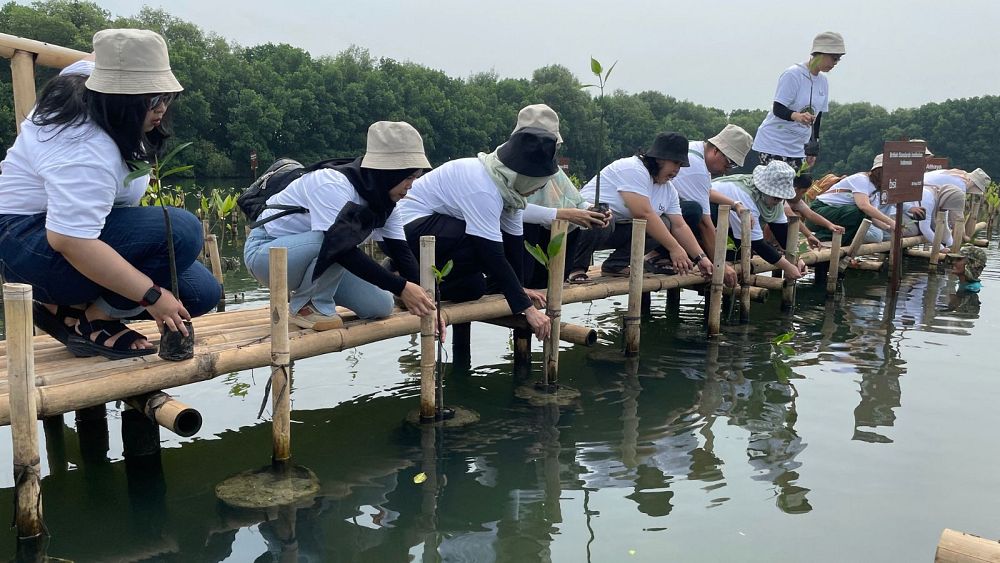
Mangroves are drawing tourists to Indonesia, as the archipelago tries to replant or conserve carbon-rich coastal areas that have been decimated by human activity.
Connie Sihombing, a 50-year-old resident of Jakarta, does not mind that she can hear traffic or planes flying above as she paddles her kayak through murky waters and the arching roots of mangrove trees.
"I've travelled far, yet I had no idea that close to home lies this fascinating and beautiful park," she said, referring to a protected mangrove forest along the northern coast of the capital.
Mangroves in Indonesia, a country of more than 17,000 islands and miles of shoreline, have dwindled to about 4.1 million hectares (10.1 million acres) as urban development or seafood farming replaces what is a natural defence against rising sea levels and saltwater intrusion.
Last year alone, the country lost 700,000 hectares of mangroves, according to Indonesia's Mangrove and Peatlands Restoration Agency (BRGM).
Indonesia hopes that alongside state efforts, 'ecotourism' - involving people exploring, planting, and caring for the forests - will help them understand their importance as carbon stores and biodiversity hotspots.
"A lot of people and businesses have these mangrove forests levelled down and then build a tourist spot above it by piling sand to make artificial beaches. That contradicts nature preservation," said Muhammad Saleh Alatas, owner of The Mangrove Paddling Centre, which organises tours in the mangroves of Jakarta.
The 98-hectare Angke Kapuk Nature Reserve Park where the tours operate is but a tiny part of what environmental experts say the world needs to reverse the damage that has been wrought on mangroves and other wetlands.
While government funding has risen in the past five years, support from private institutions and non-governmental organisations is still needed, said Nusantara Nature Conservation Agency director Muhammad Ilman.