

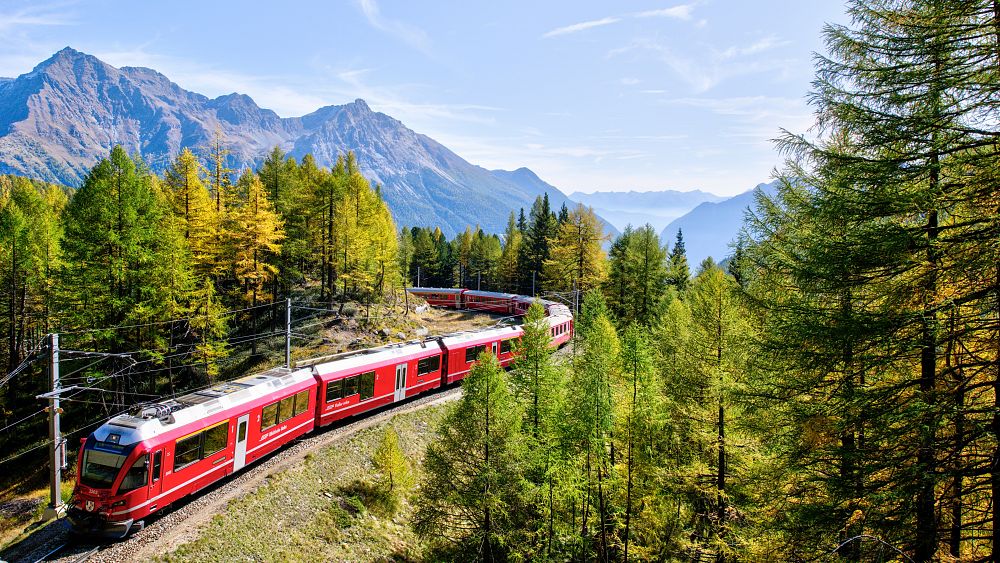
As travel aspires to be more eco-friendly, sleeper trains could be on track to be one of the most popular ways to get around Europe.
The past couple of years has seen the launch of a plethora of new overnight routes across the continent.
Going forward, there are plans for network extensions to existing services and a new night train company offering routes from 2025.
But sleeper train operators also say infrastructural and bureaucratic obstacles need to be overcome before rail travel can really flourish.
Here’s what to expect for the future of overnight rail journeys.
Why are travellers choosing train travel over flying?
Movements like ‘flight shaming’ or the ‘no-jet setters’ have encouraged travellers to opt for the railway over the runway.
A survey by Global Railway Review conducted last year found that two-thirds of respondents would prefer to travel by train over plane, with 66 per cent saying they’d opt for rail travel in Europe for business and 77 per cent for leisure.
Austrian national rail firm ÖBB currently leads Europe’s sleeper train revival with its Nightjet service.
“In recent months, we have seen another significant increase in demand: actually, we are often fully booked,” says Bernhard Rieder, ÖBB’s media spokesperson.
The push for greener travel has also been taken up by some governments. Last year, France banned short haul flights between destinations linked by a train journey of less than 2.5 hours.
Europe’s new night trains
As rail seeks to replace flight routes, companies have expanded their offering of sleeper trains.
In 2021, Austria’s ÖBB launched a new Nightjet sleeper route between Vienna and Paris via Salzburg and Munich.
It also extended its route between Vienna/Munich and Milan to reach Genoa and La Spezia in Italy.
Back-on-Track, a European network promoting cross-border passenger rail travel, has helpfully collated all the routes in a sleeper train map.
It includes current services and those scheduled for 2023.
European sleeper trains launching in 2023
In a couple of months, the long-awaited European Sleeper, a Belgian-Dutch social cooperative, will launch its first route. The service will run from Brussels to Berlin via Amsterdam and starts on 25 May 2023.
From 2024, it also plans to extend the route to Dresden and Prague.
This summer, Nightjet trains are also levelling up. The company says the new wagons will have wireless charging stations, free wifi, bicycle and snow sports equipment storage and private compartments with ensuite showers and toilets.
Plenty more new sleepers are planned, and you can see the full list here.
Hotel on rails: A new night train company
In 2025, a new sleeper train company is appearing on the scene. Midnight Trains plans to open one route a year from its hub in Paris. Services will link the French capital to Venice, Barcelona, Florence and Madrid.
According to Midnight Trains, their innovation lies in prioritising comfort. “We have a different vision of a night train: a hotel on rails,” says co-founder Romain Payet.
“We focus on intimacy (only private accommodations, real bed sets, good soundproofing), conviviality (proper bar and restaurant offer as well as events and happenings) and a digital experience from end to end.”
Why aren’t there more night trains in Europe?
Despite the expansions and launches, rail operators still say their sleeper train offerings could be more extensive if certain obstacles were overcome.
“The most complicated one is probably the fact that infrastructure managers do not coordinate infrastructure works,” Payet says.
“[They] have different processes and timing with railway undertakings, [and] do not talk to each other, making track access very challenging.”
Rieder at ÖBB also says sleeper services are currently not often economically viable. “The costs of ‘hotel operation’ and travel in one product are significantly higher than the cost structure of day connections by rail.”
However, he says they could be economically successful if framework conditions change.
“The disadvantages of rail compared to other modes of transport - such as air or bus - have to be compensated.”
Campaign group Trains for Europe is asking for the EU to organise the procurement of a new fleet of night trains to “allow cross-border services to be swiftly scaled up.”
They say finding a manufacturer for the trains is not a problem, rather the question is: “Who other than ÖBB in Europe is committed enough to night trains, and strong enough, to place an order?”