

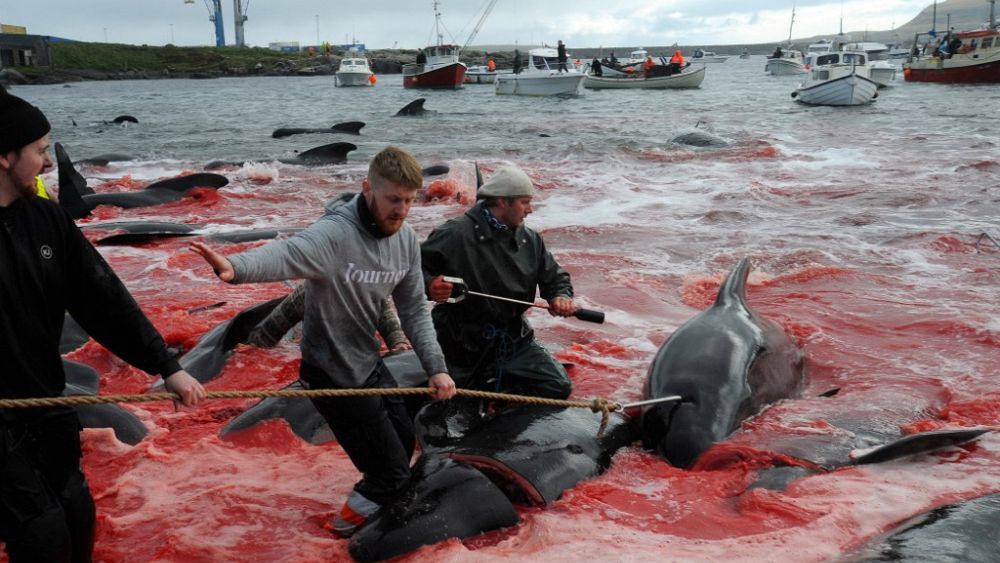
A campaign was launched on Thursday to boycott the Faroe Islands over their highly controversial slaughter of pilot whales and dolphins.
'Dont Visit Faroe Islands' wants tourists to skip the small North Atlantic islands in a bid to pressure the government to end its annual hunts of marine life.
"We're hoping many supporters can join us as we try to encourage people to halt their visits to the Faroe islands and put pressure on the Faroese government to ban hunts once and for all," campaigner Maissa Rababy told Euronews.
"These hunts aren't advertised in the travel brochures... We want to make sure everyone knows what is happening."
Whale hunts on the Faroe Islands are considered by animal rights activists as cruel.
They involve corralling pods of highly-intelligent, social creatures into a bay with jet skis and boats, where they are then dragged onto the beach and killed one by one - while the others await their grim fate.
Defenders say the practice is an integral part of island life and resist what they see as outside interference. Islanders largely support the “grindadráp” (as it is called in Faroese).
Campaigner Rababy said they decided to begin their boycott initiative after a tourist cruise ship recently stumbled upon the spectacle when it docked into the Faroe Islands, with hundreds of horrified onlookers seeing waters turn red with blood.
The group behind the campaign, Only One, launched a petition in 2021 to end the practice after 1,400 dolphins were killed in a single hunt, it claimed.
It has been signed by 368,000 people so far from around the world.
Following this campaign, Rababy pointed out that local authorities put in place quotas on how many animals could be killed each season.
But she says campaigners were disappointed by the move, with quotas allegedly too large.
In a statement sent to Euronews in May, Faroe's Ministry of Foreign Affairs, Industry and Trade said whale drives are "well organised and fully regulated."
Evidence of whaling on the Faroe Islands dates back to 800 AD, with hunts featuring predominantly in Faroese culture, art and literature.
Some see foreign campaigns against it as a form of cultural imperialism imposed on their small population of 50,000.
Anti-hunt activist Rababy pushed back against this, saying "we're not attacking the island's population".
"This campaign is about stopping a practice that we think is outdated and is hurting people, the environment and special species in the ocean," she told Euronews.
Mercury levels within marine animals have been rising over the decades, leading to a number of health consequences - particularly for the development of children.
People who consume whale or dolphin meat have an increased risk of hypertension, diabetes, and even Parkinson’s disease, according to health experts.
"We're hoping to spark a conversation again with the Faroese government to find a better solution for these animals," said Rababy, suggesting the hunts could be putting the species in jeopardy.
Pilot whales - of which 700 are killed on average by islanders each year, according to the marine conservation organisation Ocean Care - are not a protected species.
In its statement for Euronews, the Island's Foreign Ministry said: "The pilot whale catches in the Faroe Islands are sustainable", adding it "has long since been internationally recognised" as so.
"Hunts are deeply cruel... We want the Faroese government to listen", sad Rababy. "It's time to revise an outdated practice and find a way to collaborate for the health of the oceans together."
The Faroe Islands are an independent territory of Denmark, some 300km north of the United Kingdom.