

 ADVERTISEMENT
Friday 19 July was set to be one of the busiest days of the summer for Europe’s airports. But the world’s biggest IT outage had other plans for hundreds of thousands of holidaymakers.
A defective software update from cybersecurity firm CrowdStrike was to blame, bringing down the online systems of numerous big and small businesses that use Microsoft services.
Yesterday, Microsoft pointed the finger at the European Commission, saying the bloc’s competition rules prevented it from overriding the update.
While the Big Tech fallout continues, airports and airlines are looking inwards to evaluate how their own contingency plans held up against the calamity.
Here’s how the disruption unfolded within the aviation world - and why some places were hit harder than others.
How were airlines and airports impacted by the global IT outage?
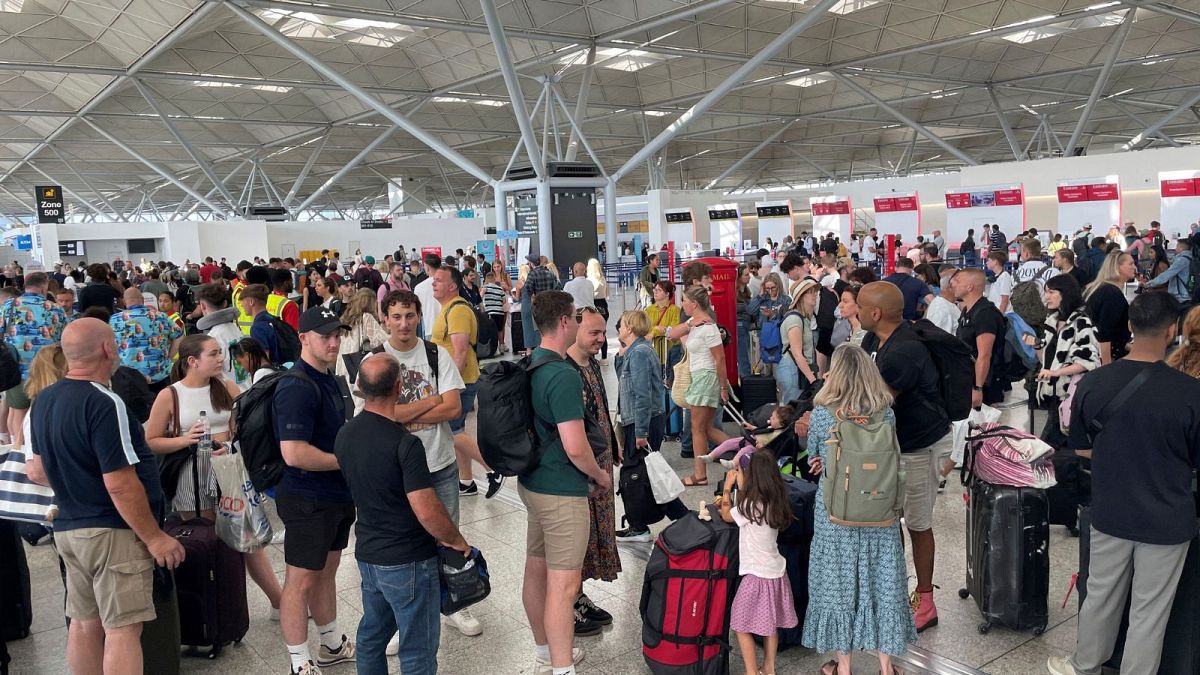
Although the stressful scenes took place inside airports, which quickly filled up with stranded passengers, Friday’s IT outage was primarily an airline problem.
That’s because most airlines rely on Microsoft's Office365 - Cloud-based software - to do their scheduling, getting crew, passengers and bags where they need to be.
The public-facing side of this is check-ins. When the airlines’ online systems stopped working on Friday morning, they resorted to checking people in manually at airports. Obviously this is a much slower process, which snowballed through their tight schedules.
There were more than 4,000 flight cancellations and 35,500 flight delays worldwide by Friday afternoon, according to flight tracking firm FlightAware.
“The IT outage affected multiple systems making it impossible to handle flights,” a spokesperson for Dutch carrier KLM explains. “As soon as it became clear that the computers and laptops running on Windows could not boot up due to the third-party update, we started the backup plan, namely doing processes that could be done manually and at the same time using a workaround to get the machines up and running as soon as possible.”
The outage wreaked havoc with systems optimised for efficiency - and not just for checking in passengers and luggage.
Airlines outsource a range of jobs to ground handling companies (cabin cleaning, gate security and so on) and some of these firms’ systems were affected too, meaning they struggled to get workers to the right place at the right time.
Which European airports were worst hit during the IT outage?
It was a more mixed picture for the airports themselves. Berlin Brandenburg Airport had issues with its IT systems early on Friday morning that were resolved quicker than some airlines and other airports. Aena, which manages airports in Spain, says its entire network was affected.
But other European airports say it was wholly an airline issue. “Airport systems were not affected in any way, but a ticketing system used by four airlines at the site,” says a spokesperson for Hamburg Airport, which saw 49 cancellations on Friday.
“All of the airport’s systems were unaffected by the issue,” London Stansted airport says too, “but some airline check-in systems were impacted, including Ryanair, London Stansted’s biggest airline partner.”
ADVERTISEMENTWhy were some airports impacted more than others by the IT outage?
Despite the highly connected, globalised nature of air travel causing problems everywhere, not all parts of the world were equally affected.
US airlines suffered a disproportionate number of cancellations - with American carriers having to cancel around 3.5 per cent of their flights on Saturday, according to Cirium data, as the knock-on effects continued.
Possible causes include a greater degree of outsourcing of technology and more exposure to Microsoft operating systems that received the faulty upgrade from CrowdStrike, Robert Mann, a former airline executive told AP.
Other experts point to the “hub and spoke” model favoured by Delta, American and United - which were among the most-impacted US airlines. Under this model, flights are funnelled through a few major airports where passengers make connections.
ADVERTISEMENTThis level of centralisation relies on a well-greased system, so delays tend to stack up more quickly than with “point-to-point” flights.
“The European airlines are not as dependent upon the hub and spoke system as the US airlines are,” Michael McCormick, a professor at Embry-Riddle Aeronautical University’s Air Traffic Management programme, tells Euronews Travel.
British Airways, for example, is largely dependent on one hub at Heathrow. This put it in a stronger position than US airlines with multiple hubs. By comparison with Delta, BA was “better able to understand the impact of the outage and then develop an alternative strategy to deal with it.”
They didn’t have as many misplaced aircraft and air crews around the EU, making it easier to bounce back the following day.
ADVERTISEMENTAs in the US, big “hub” airports like Schiphol and Heathrow were more impacted than their smaller counterparts. The Amsterdam hub reported a total of 200 flight cancellations and 150 delays because of the airlines’ difficulties.
Why did budget airlines fare better?
“The more dependent the airline is on cloud servers - which means the more modern IT systems - the more vulnerable they were to the challenge,” McCormick explains.
In the US, low cost carriers were less impacted because they generally have older software platforms, and deal with more point-to-point flights. Southwest Airlines wasn’t impacted at all, because they are still operating on Windows 3.1.
It was a similar story in Europe, where the likes of easyJet and Ryanair fared better than larger international carriers like BA, Air France and Lufthansa.
ADVERTISEMENTSince their networks are more simplistic, these budget airlines don’t need such sophisticated automation systems to track in real time where all their aircraft and crews are going to be, according to McCormick.
Could airports be struck by a similar IT calamity in future?
“What this really highlights is the fact that something that people aren't even aware of is what can cause the greatest impact,” adds McCormick.
Since Friday, the centralised nature of the software industry has been thrust into the spotlight.
“We have now seen one of the repercussions of the lack of diversity of software,” Marie Vasek, a computer science professor at University College London, writes for MSNBC. “If nothing changes, such a catastrophic event will inevitably happen again.”
ADVERTISEMENTAirlines and airports will now be reviewing their systems, but they - and their customers - remain vulnerable.