

Why Crypto Markets Spend More Time Ranging Than Trending

Despite their reputation for volatility, crypto markets spend most of their time ranging, as liquidity cycles, leverage resets, and value discovery limit sustained trends.
Summary
- Market auction theory favors value discovery over constant trends.
- Leverage cycles repeatedly halt sustained directional moves.
- Institutional activity reinforces range-bound market behavior.
Crypto markets are often associated with explosive rallies and sharp crashes, but these headline-grabbing moments make up only a small portion of overall price behavior. In reality, cryptocurrencies spend far more time consolidating within ranges than trending in one direction.
This tendency is not a flaw in the market, it is a structural feature driven by liquidity dynamics, leverage mechanics, and the process of value discovery.
Understanding why crypto markets range more than they trend can help traders and investors align expectations, avoid frustration during sideways periods, and better interpret what price action is signaling beneath the surface.
Market auction theory and value discovery
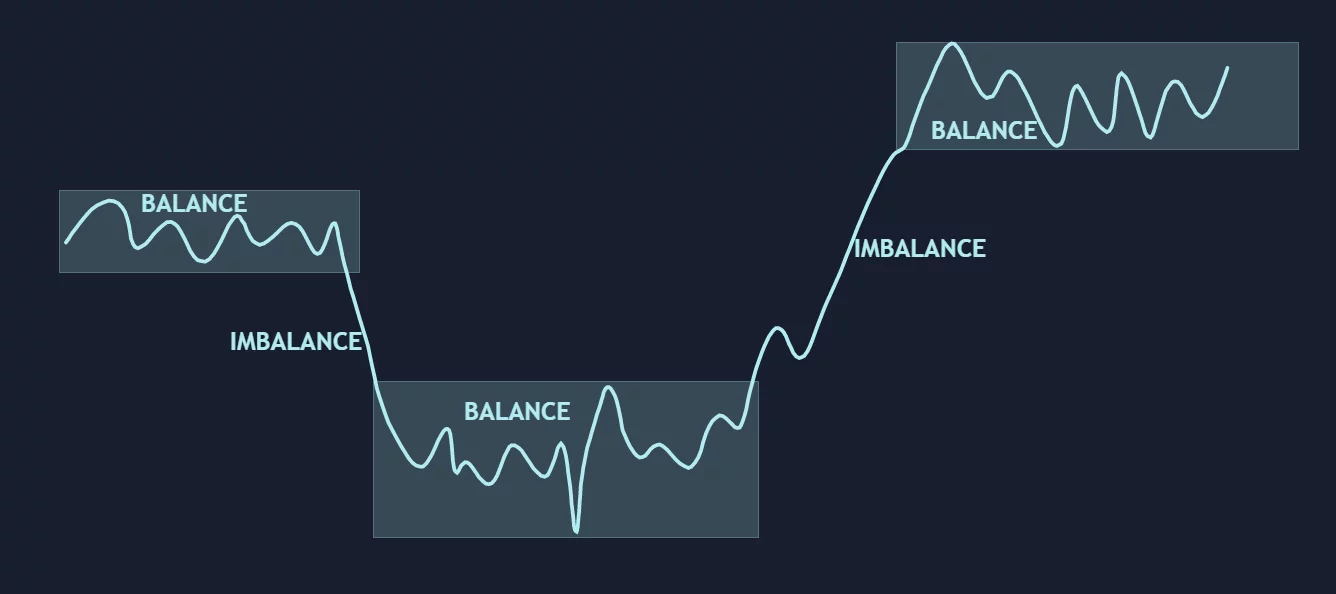
At the core of range-bound behavior lies market auction theory. Markets exist to facilitate trade and discover fair value, not to move endlessly higher or lower. When buyers and sellers reach a temporary agreement on price, trading activity compresses, forming a value area.
In crypto markets, price frequently oscillates between a Value Area High and a Value Area Low, testing the point at which supply and demand are balanced. Once a value is established, price naturally rotates within that range until a new catalyst forces a reassessment. Trending phases typically occur only when the value is rejected, not when it is accepted.
Because cryptocurrency trades globally, without centralized market hours, this value-discovery process occurs continuously. As a result, consolidation becomes the dominant state, with trends emerging only when the imbalance is strong enough to overwhelm the equilibrium.
Leverage cycles and trend exhaustion
Another major reason crypto markets range more than they trend is the heavy use of leverage. Perpetual futures and options allow traders to amplify exposure, thereby accelerating price movements during trends. However, leverage is a double-edged sword.
As trends develop, leveraged positions build rapidly. Eventually, this leverage becomes unstable, triggering liquidations that abruptly halt directional movement. Once these liquidations occur, the market often lacks the fuel required to continue trending, forcing price into consolidation.
These leverage resets are not anomalies; they are recurring structural events. Ranging conditions allow leverage to reset, risk normalizing, and liquidity to rebuild before another trend can emerge.
Institutional behavior favors ranges
As institutional participation grows, range-bound conditions become even more pronounced. Large participants prefer stable environments where they can accumulate or distribute positions without causing excessive slippage.
Institutions rarely chase price. Instead, they operate within ranges, building exposure gradually while liquidity is abundant. This behavior reinforces consolidation phases and delays breakout attempts until positioning is complete.
When breakouts do occur, they are often sharp and decisive, precisely because liquidity has already been absorbed during the range. In this sense, ranges function as preparatory zones for future trends rather than as signs of indecision.
Why trends feel rare but powerful
Trends stand out because they are compressed in time. While ranges can last weeks or months, trends often unfold quickly, driven by cascading liquidations, sudden inflows, or macro catalysts. This creates the illusion that trends dominate market behavior, even though they are statistically rare.
Once a trend exhausts, price typically returns to balance, resuming its range-bound behavior. This cycle repeats across all time frames, from intraday charts to multi-year market structures.
What to expect in the market
Crypto markets will continue to spend most of their time ranging, punctuated by brief but aggressive trending phases. Understanding this reality allows market participants to adapt strategies, manage expectations, and recognize that consolidation is not stagnation; it is the market doing its job.
Bitcoin Suisse Turns Regulation Into Growth
For much of crypto’s short history, growth was measured in trading volumes, token prices and the number of customers w... Read more
Circle Wins Landmark US Banking Licence
Circle Internet Group has finally secured the regulatory prize it has been chasing for more than a year, with the Office... Read more
Crypto Treasuries Chase A New Kind Of Capital
There is a peculiar irony at the heart of the crypto treasury movement. Companies that staked their futures on digital a... Read more
What Strategy's Bitcoin Sale Really Tells Us
There is a moment in every bull run when the narrative starts to fray. Not with a crash, not with a scandal, but with so... Read more
The Clock Is Ticking On UK Stablecoins
The world is not waiting for Britain to make up its mind. While the United States and the European Union have spent the ... Read more
From Cypherpunk To Citadel
How Crypto Moved from the Wild West to the Mainstream Financial SystemA long-form analysis of Bitcoin's journey from fri... Read more