

Polygon Price Double Bottoms As Tazapay, Revolut, Paxos, And Moonpay Payments Rise

Polygon price crashed and erased all the gains it made earlier this year despite its strong fundamentals, including its growing market share in the payment industry and its growing burn rate.
Summary
- Polygon price has crashed and erased most of the gains it made earlier this year.
- Data shows that its payment transaction volume has soared in the past few months.
- Technical analysis suggests that the token will rebound in the coming weeks as it has formed a double-bottom pattern.
Polygon (POL), whose ticker was previously known as MATIC, was trading at $0.095, down sharply from the year-to-date high of $0.1853. It remains much lower than its all-time high.
POL price crash coincided with the ongoing crypto market dip that has affected Bitcoin and most altcoins. It also happened as Vitalik Buterin criticized layer-2 network. He believes that these networks will likely struggle in the future as Ethereum has largely solved some of the scaling challenges it had in the past.
Ethereum is now substantially faster than it was a few years and its upcoming upgrades will make it faster. Also, its transaction costs have continued falling in the past few years.
Buterin believes that layer-2 networks that will survive are those that will solve key challenges and focus on key niches. Polygon has largely succeeded in this by focusing on the payment industry.
For example, data shows that it has the second-highest monthly USDC addresses after Solana. Its stablecoin P2P transfer volume has jumped to over $39 billion. The top players using its chain are Tazapay, which handled over $687 million in January.
Revolut handled over $50 million, while Stripe, Paxos, Moonpay, and Avenia Pay handled millions of dollars in volume. These networks will likely continue experiencing more volume in the near term, benefiting Polygon.
The rising growth, together with its strong market share in the predictions market, has led to a surge in network fees. Data compiled by Nansen shows that its network fees jumped by double digits, while the burn rate has soared in the past few months.
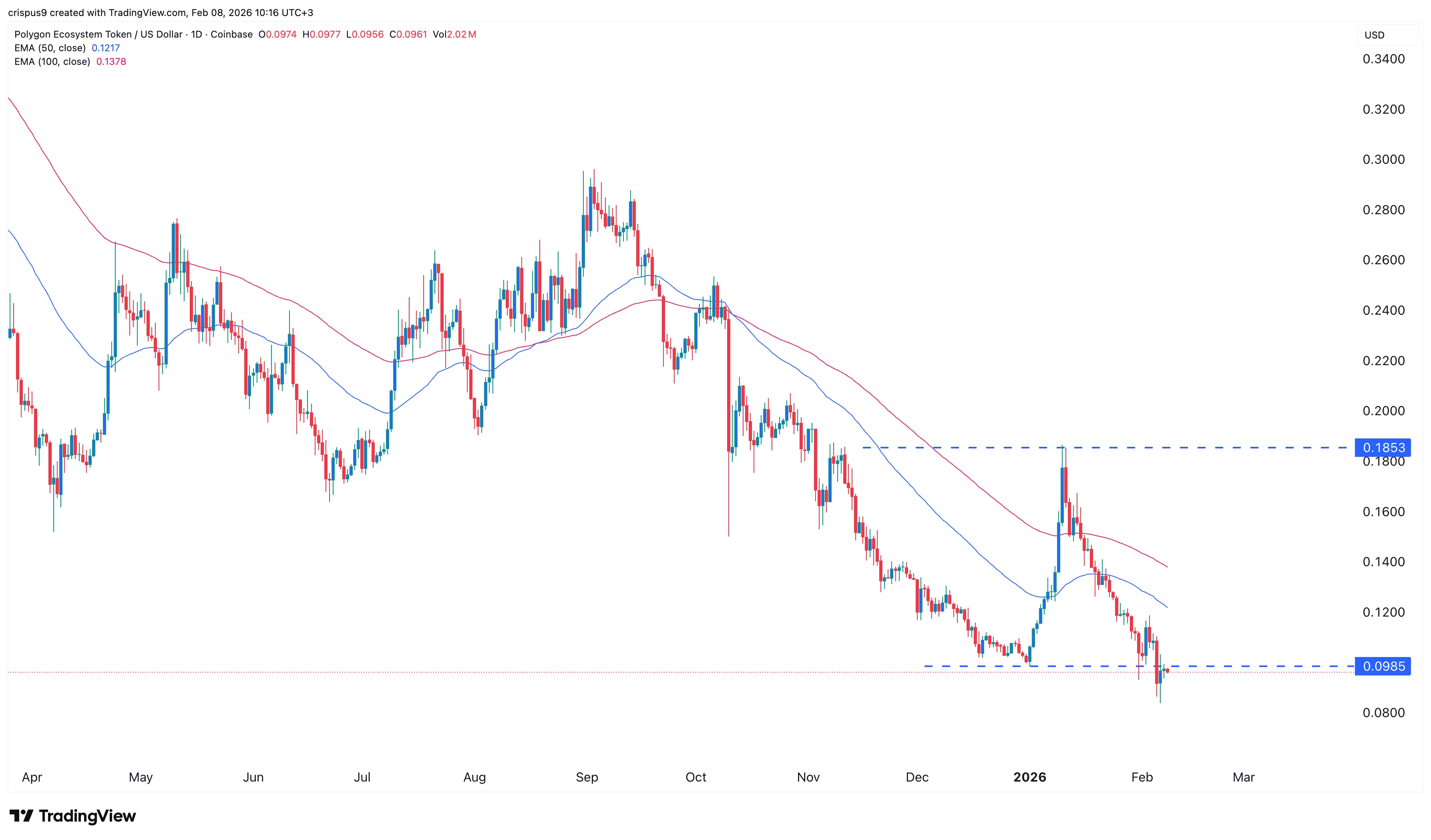
The daily timeframe chart shows that the POL price has retreated sharply in the past few weeks, moving from a high of $0.1853 in January to a low of $0.0841 last week. This drop coincided with the broader crypto market crash.
POL price has formed a double-bottom pattern, whose neckline is at $0.1853. A double-bottom is one of the most common bullish reversal signs in technical analysis.
Therefore, the most likely POL price prediction is bullish, with the initial target being at $0.1500, which is about 57% above the current level. A drop below the key support level at $0.0845 will invalidate the bullish outlook and point to more downside.
Bitcoin Suisse Turns Regulation Into Growth
For much of crypto’s short history, growth was measured in trading volumes, token prices and the number of customers w... Read more
Circle Wins Landmark US Banking Licence
Circle Internet Group has finally secured the regulatory prize it has been chasing for more than a year, with the Office... Read more
Crypto Treasuries Chase A New Kind Of Capital
There is a peculiar irony at the heart of the crypto treasury movement. Companies that staked their futures on digital a... Read more
What Strategy's Bitcoin Sale Really Tells Us
There is a moment in every bull run when the narrative starts to fray. Not with a crash, not with a scandal, but with so... Read more
The Clock Is Ticking On UK Stablecoins
The world is not waiting for Britain to make up its mind. While the United States and the European Union have spent the ... Read more
From Cypherpunk To Citadel
How Crypto Moved from the Wild West to the Mainstream Financial SystemA long-form analysis of Bitcoin's journey from fri... Read more